

- How to Build an AI Visibility Strategy for Payments & Fintech - September 14, 2026
- What Caught Our Eye on the Money20/20 Middle East Agenda - September 9, 2026
- How to Use AI in Content Marketing: Practical Use Cases, Tools & Best Practices - July 7, 2026
Brand visibility has never been simple – and it still isn’t.
For most brands, being visible has always meant building a strong digital presence across multiple touchpoints: search visibility through SEO, credible content, brand consistency, and trust built over time.
Google remains the dominant search engine, and traditional search behaviour is still very much alive. But something important is changing alongside it …
Instead of just scrolling through search results, research suggests that over 900 million users around the world in 2025 were asking AI tools like ChatGPT, Perplexity, Gemini, and Google’s AI Overviews to just … tell them the answer. And those tools don’t rank brands in the traditional sense – they summarise, reference, and recommend them.
This is where things can become uncomfortable for many brands. You can be doing ‘everything right’ from a traditional SEO perspective – solid rankings, decent traffic, and plenty of content – and still disappear from AI-generated answers because AI search doesn’t work like traditional search engines. Whilst strong rankings still help, they no longer guarantee visibility inside AI answers.
This shift is becoming clearer thanks to the rise of AI brand visibility tools. These tools analyse how – and how often – brands appear across AI-generated answers, tracking things like brand mentions, source references, topic associations, and inclusion in AI responses. The result is an AI visibility score that shows whether your brand is actually being surfaced by AI platforms, or quietly overlooked.
For many brands, these scores reveal a disconnect: strong performance in traditional search, but limited or inconsistent presence across AI-driven results. In other words, the visibility you assumed you had – versus the visibility AI engines can actually recognise and reproduce.
There are now more tools than ever promising to track AI visibility. The challenge isn’t access to data – it’s understanding what it means, where the gaps are, and which signals genuinely influence AI-generated answers. That’s where a strategic view matters. At Blue Train Marketing, we help brands make sense of their AI visibility score and, more importantly, what to do about it.
It’s transitioning from optimising pages to shaping brand presence across AI platforms. From chasing rankings to making sure your brand actually appears when AI models generate responses to real user queries.
At Blue Train Marketing, we don’t see this as ‘AI versus human’. We see it as a clarity problem. AI is changing how answers are delivered – but it’s still humans who shape the signals AI learns from. Strong brands, clear positioning, and joined-up marketing matter more than ever.
And here’s the real risk: If AI can’t clearly identify who you are, what you do, and why you matter, it won’t surface you. No matter how strong your SEO fundamentals look on paper.
That’s where AI visibility comes in – and why it’s quickly becoming the next growth channel brands can’t afford to ignore.
What AI Visibility Actually Means
Let’s clear something up early. AI visibility isn’t just about ‘ranking in ChatGPT’. That’s not how AI search works – and it’s where a lot of the confusion (and hype) comes from.
AI visibility refers to how clearly and consistently your brand is recognised, understood, and surfaced within AI-generated answers. Not as a link. Not as an ad. But as part of the response itself.
When someone asks an AI assistant a question – Who should I use? What’s the best option? How does this work? – AI visibility determines whether your brand:
- Gets mentioned by name.
- Is used as an example.
- Is referenced as a trusted source,
- Or is completely invisible.
That’s a very different game from traditional SEO. Unlike traditional search engines, where visibility is measured by rankings and clicks, AI search visibility is about inclusion. You’re either part of the answer, or you’re not. There is no page two.
It’s also not the same as paid visibility, and it’s not just ‘optimising content for AI’ either. While some AI search engines include ads, inclusion within the answer itself is driven by recognition and trust signals, not media spend.
Those associations aren’t created by a single page or tactic. They’re shaped by how your brand shows up over time – across your site, third-party coverage, expert commentary, and wider digital presence. AI simply connects what’s already there.
You’ll see AI visibility show up across:
- Google’s AI Overviews.
- Conversational responses from AI assistants.
- Product and service comparisons that are generated in real time.
- Recommendations that influence brand discovery long before a user ever visits a website.
So, what does this mean?
AI visibility is about how your brand exists across AI engines, not where a single page sits in search results.
And the most important shift of all? Visibility is no longer about position. It’s about presence.
If your brand isn’t present in AI-generated answers, it risks being invisible at the moment decisions are first shaped.
How Large Language Models (LLMs) Decide What to Surface
Before we go any further, it’s worth grounding what we mean by Large Language Models (LLMs).
Large Language Models (LLMs) are AI systems trained on vast amounts of text to understand language, recognise patterns, and generate human-like responses to questions.
Tools like ChatGPT, Gemini, and Perplexity don’t operate like traditional search engines — even when they retrieve live sources, they generate answers rather than ranked lists of links.
LLMs don’t rank websites the way search engines do, and the underlying models don’t crawl pages in real time — even though some AI systems now retrieve live sources to inform their answers.
When it comes to brands, that confidence comes from pattern recognition. AI models look for repeated, reinforcing signals that answer a few fundamental questions:
- Who is this brand?
- What does it do?
- When should it be mentioned?
Those signals are built over time, across many sources – not from a single article, campaign, or tool.
Crucially, most of these signals are still created by people – journalists, marketers, subject-matter experts, and customers. AI doesn’t invent authority; it reflects it.
In practice, LLMs tend to prioritise brands that demonstrate:
- Clear Entity Definition: A brand with a distinct name, offering, and focus.
- Consistent Topic Association: Repeated alignment with the same themes, problems, and areas of expertise.
- Corroboration Across Sources: Multiple credible sites describe the brand in similar terms.
This is where brands can struggle. If your positioning is vague, interchangeable, or constantly shifting, AI has nothing solid to anchor to. Generic language doesn’t just confuse your customers, it makes brands harder for AI models to recognise and recall.
Why Traditional SEO & Content Marketing Aren’t Enough On Their Own
This isn’t an anti-SEO argument. Traditional SEO still matters (we believe that strongly). It’s just no longer the whole picture.
The problem is that many brands are still optimising as if discovery only happens through blue links, when 66% of people now use AI tools as part of how they search for information. That increase fundamentally changes how visibility works.
Keyword rankings, on their own, don’t equal brand recognition. You can rank well for relevant keywords and still fail to show up when AI generates answers, recommendations, or comparisons.
The same goes for content volume. Publishing more articles doesn’t automatically build authority in AI systems if those articles don’t reinforce a clear brand narrative. A large content library with inconsistent messaging can actually dilute understanding, rather than strengthen it.
Backlinks still matter too – but not in isolation. A strong link profile doesn’t guarantee that AI understands why your brand is credible, or when it should be mentioned. Especially when many AI responses are shaped by unlinked brand mentions, citations, and repeated references across trusted sources.
This is also where ‘AI-friendly content’ often falls short. Structuring an article nicely or sprinkling in the right phrases won’t help if the brand signals underneath are weak or fragmented. Without a clear entity definition, even well-written content struggles to surface.
So yes – SEO remains foundational. It feeds many of the signals AI relies on. But unlike traditional SEO, AI visibility isn’t won by optimising individual pages. It’s about ensuring your brand is consistently understood, reinforced, and trusted across the wider ecosystem.
The Key Signals That Influence AI Visibility
AI visibility isn’t driven by a single ranking factor or tool. It’s shaped by a set of overlapping signals that help AI models understand who your brand is, what it stands for, and when it should be included in AI-generated answers.
These are the signals that matter most:
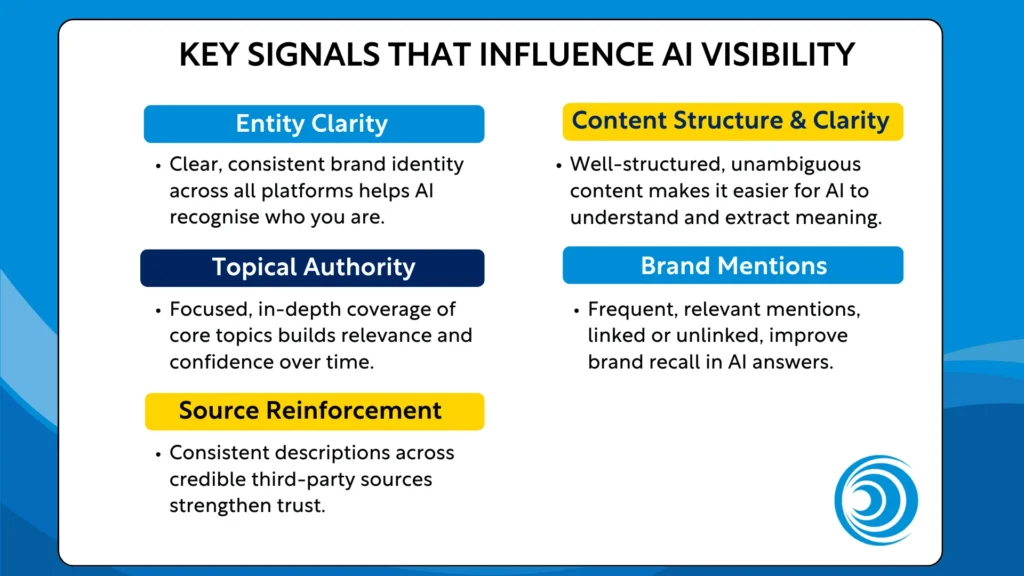
Entity Clarity
At the most basic level, AI needs to understand your brand as a distinct entity.
That means your brand name, offering, and positioning are consistent wherever they appear – on your website, in third-party coverage, and across AI search data. If your messaging changes frequently or relies on vague language, AI struggles to form a stable understanding of who you are.
If a human struggles to explain your brand in one sentence, there’s a good chance AI will too. This is where brand strategy quietly becomes an AI visibility issue.
Topical Authority
AI models don’t just surface brands – they surface brands in context.
Topical authority comes from being consistently associated with the same themes, problems, and areas of expertise over time. This is less about chasing every relevant keyword and more about reinforcing a focused set of topics that your brand genuinely owns.
Depth matters more than breadth here – because repetition builds recognition.
When your content, brand mentions, and external references all point in the same direction, AI becomes far more confident in including you in relevant responses.
Source Reinforcement
AI places more trust in signals that are repeated across multiple credible sources.
When respected publications, partners, review sites, or industry platforms describe your brand in similar terms, it reinforces your legitimacy. This corroboration helps AI models distinguish between brands that are self-promoting and brands that are genuinely recognised.
It’s not about being everywhere. It’s about being consistently described the same way in the right places.
Content Structure & Clarity
AI models are exceptionally good at extracting meaning – but they still need clarity.
Well-structured content, clear explanations, and unambiguous language make it easier for AI to understand what a page is about and how it fits into a broader topic. Content that rambles, overuses jargon, or buries key points makes that job harder.
Clarity isn’t just good for users. It’s a signal in itself.
Brand Mentions
Backlinks still matter, but they’re no longer the only signal that counts.
Unlinked brand mentions – especially when they appear in relevant, authoritative contexts – also contribute to how AI understands and recalls your brand. In many AI-generated answers, brands are surfaced based on how often and how consistently they’re referenced, not just how many links they’ve earned.
Together, these signals form the foundation of AI search visibility. None of them work in isolation – but they reinforce each other, they create a brand presence AI models can recognise, trust, and confidently include.
Common Misconceptions about AI & LLM Marketing
As AI search grows, so does the noise around it. New tools, bold claims, and quick fixes are everywhere – and many of them create more confusion than clarity.
Let’s reset a few of the most common misconceptions.
“You Can Optimise ChatGPT Directly”
You can’t.
Large Language Models aren’t search engines you can submit pages to or tweak in isolation. There’s no dashboard, no meta tag, and no shortcut that guarantees inclusion in AI responses.
What can be influenced is the ecosystem of signals AI learns from – your brand presence, consistency, and collaboration across the wider web.
That’s slower, but far more durable.
“Once Article Will Fix AI Visibility”
It won’t.
AI visibility is cumulative. It’s shaped by patterns over time, not by a single piece of content – no matter how well-written or ‘AI-friendly’ it is. One article without reinforcement simply doesn’t create enough signal to change how a brand is understood.
Progress comes from consistency, not one-off efforts.
“Tools Create Authority”
Tools can surface insights, but they don’t create credibility.
An AI visibility tool or brand visibility tool might help measure mentions, identify visibility scores, track AI responses, or highlight visibility gaps – but authority still comes from how a brand shows up across content, PR, partnerships, and trusted sources.
Tools support strategy. They don’t replace it. Used well, they reveal insight. Used without strategy, they create motion without meaning.
“AI Visibility Replaces SEO”
It doesn’t.
Traditional SEO remains foundational. It feeds many of the signals AI relies on to understand brands and topics. But AI visibility extends beyond rankings into areas SEO was never designed to cover – like summarised answers, comparisons, and conversational recommendations.
It’s not either/or. It’s evolution.
A Strategic Approach to Improving AI Visibility
Improving AI visibility isn’t about chasing algorithms or reacting to every new AI platform. It’s about stepping back and treating visibility as a brand-level signal, not a channel-specific metric.
A strong, strategic approach usually includes the following.
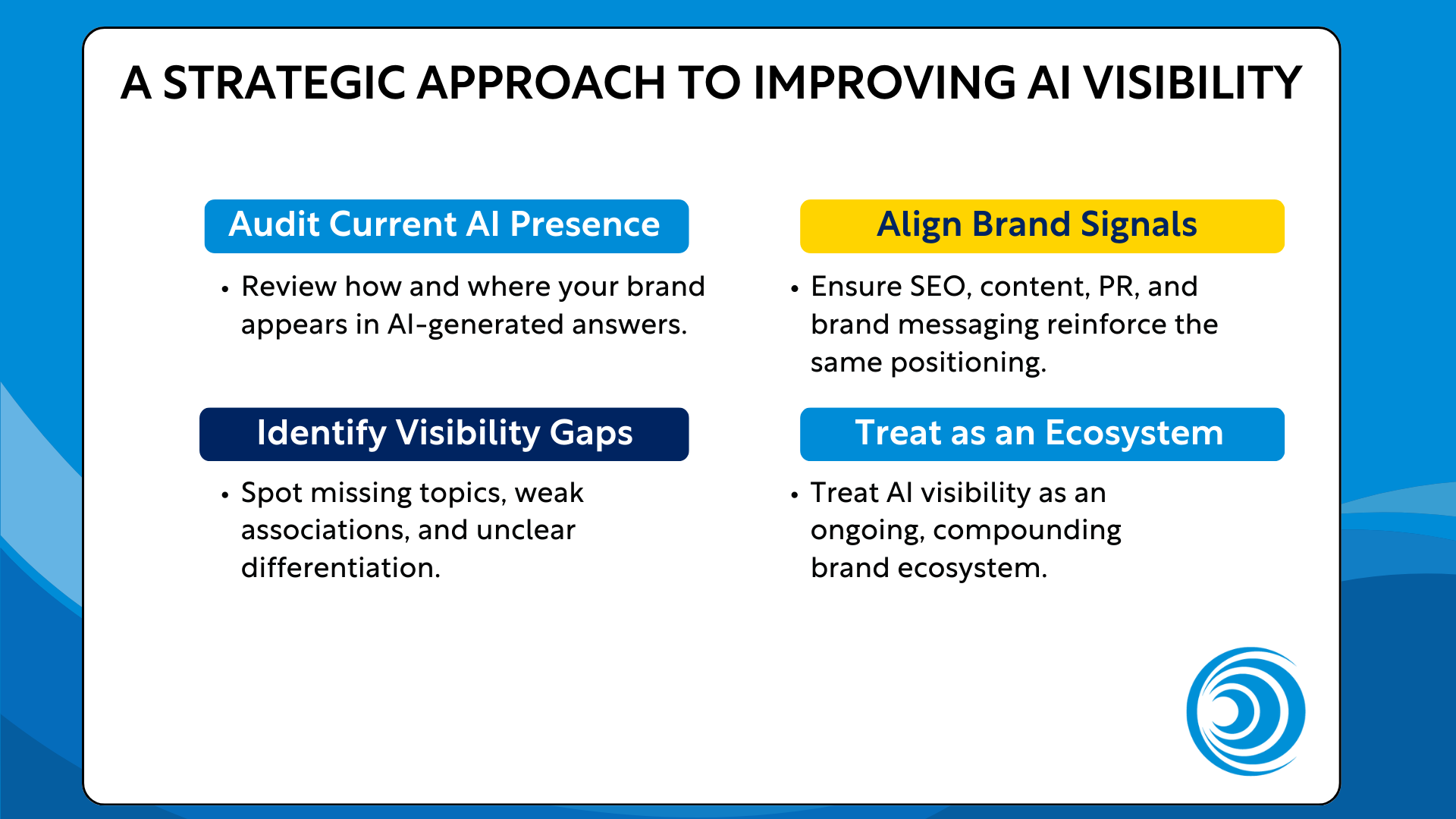
1. Understand How Your Brand Currently Appears in AI Outputs
Before you can improve AI visibility, you need to know where you stand.
That means reviewing how (and if) your brand appears in AI-generated answers across major AI platforms. Are you being mentioned by name? Are competitors showing up instead? Are you associated with the right topics – or the wrong ones?
This establishes a baseline for your AI search performance and highlights early visibility gaps.
2. Identify Gaps in Recognition & Topic Association
Once you understand your current visibility, patterns start to emerge.
Brands often discover they’re visible for some topics but invisible for others – or that AI understands what they do, but not why they’re different. These gaps usually sit at the intersection of brand messaging, content focus, and external reinforcement.
Closing them isn’t about producing more content. It’s about delivering clear, more consistent signals.
3. Align SEO, Content, PR & Brand Messaging
AI visibility breaks when teams work in silos.
SEO might focus on keywords, content teams focus on output, PR on coverage, and brand on messaging – but AI models absorb all of it together. If those signals don’t align, understanding weakens.
This alignment is often where brands stall – not because they lack capability, but because no one owns the whole picture.
The strongest results occur when SEO, content, PR, and brand are aligned, reinforcing the same positioning across all channels.
4. Treat AI Visibility as an Ecosystem, Not a Channel
This is the biggest mindset shift.
AI visibility isn’t something you ‘switch on’ or optimise once. It’s an ongoing ecosystem made up of content, mentions, structure, and consistency. Improvements compound over time – but only if they’re maintained.
Brands that approach AI visibility strategically don’t chase every new tool or trend. They focus on building a presence that remains legible and trustworthy as AI systems evolve.
This kind of approach doesn’t create overnight wins – but it does create durable visibility that scales as AI search becomes a bigger part of how users discover brands.
When AI Visibility Becomes a Commercial Priority
AI visibility isn’t equally urgent for every brand. But for some, it quickly moves from ‘interesting’ to commercially critical.
It tends to matter most when brands:
- Operate in Crowded or Competitive Markets: When multiple providers offer similar products or services, AI-generated answers often act as the first filter. If your brand isn’t included early, it may never enter the consideration set at all.
- Rely on Trust, Authority, or Regulation: In sectors where credibility matters – fintech, health, legal, B2B, professional services – AI assistants lean heavily on recognised, well-corroborated brands. Visibility here directly influences brand perception.
- Have Long or Complex Buying Journeys: AI is increasingly used at the research and education stage. If your brand doesn’t appear when users are exploring options, problems, or comparisons, you’re invisible long before sales conversations begin.
- Win Businesses Through Recommendation & Expertise: Many AI responses mirror the role of an expert referral. Brands that are consistently associated with insight and authority are far more likely to be surfaced than those relying on transactional messaging.
- See AI Tools Influencing the Sales Process: Whether it’s prospects arriving better informed, or sales teams referencing AI-generated summaries, AI is already shaping how decisions are made – even if it’s happening quietly in the background.
If recommendation, trust, or expertise influences revenue, AI visibility is already part of the commercial equation.
How Specialist AI Visibility Support Fits In
AI search doesn’t reward volume. It rewards clarity, consistency, and credibility.
That’s exactly what Blue Train Marketing’s AI Visibility & LLM Marketing Service is built around – with a deliberately hybrid approach.
We don’t treat AI as a shortcut, and we don’t treat it as something to fear. We combine deep SEO, strategic content, brand thinking, and human insight with a practical understanding of how AI models actually work. The result is visibility that feels natural, credible, and earned – not engineered.
No hacks. No hype. Just smart humans, strong strategy, and AI used properly.
If AI-driven discovery is already part of your audience’s behaviour (it probably is!), now’s the time to find out whether your brand is part of the conversation – or missing from it entirely. Talk to us about improving your brand’s AI visibility.
