

- Money20/20 Europe 2026: This Year Felt Different. - June 30, 2026
- Top Fintech SEO Agencies in 2026 | SEO, GEO & AI Visibility - June 26, 2026
- ChatGPT Ads: What Does This Mean for Paid Advertising? - June 19, 2026
Let’s be honest. AI in content marketing has gone from an interesting experiment to everywhere in about five minutes. Blog posts, social media posts, landing pages, video scripts – AI is already involved, whether you want to admit it or not.
The problem isn’t AI itself. It’s how lazily it’s being used.
Right now, a lot of AI-generated content is flooding the internet: safe, generic, vaguely correct, and instantly forgettable. The kind of content that ticks SEO boxes sounds fine at a glance, and then quietly does nothing. No personality. No point of view. No reason for your target audience to care – or for search engines to prioritise it long term.
But that’s not a failure of artificial intelligence. It’s a failure of strategy.
Used properly, AI-powered marketing can take the heavy lifting out of how you create and distribute content. In other words, AI should support human creativity, not flatten it.
This guide is all about integrating AI tools properly into your marketing strategy, not chasing new tools for the sake of it. But integrating AI content marketing tools into your strategy in ways that are practical, ethical, and genuinely useful – from long-form blog posts and SEO optimisation to visuals, video, and content distribution across multiple channels.
No hype. No shortcuts. Just clear use cases, tools worth knowing about, and best practices that help modern marketing teams embrace AI and create high-quality content that actually resonates.
The Role of AI in Modern Content Marketing
AI isn’t here to replace content marketers – but it will replace the marketers who treat it like a magic wand.
Today, AI has moved way past novelty. It’s baked into the everyday workflow of most marketing teams – streamlining content creation from brainstorming blog posts, analysing audience behaviour, and social media scheduling. In fact, 90% of marketing teams are using generative AI tools regularly in their work.
That doesn’t mean AI is doing all the thinking. Far from it.
At Blue Train Marketing, we framed this tension clearly in our “Intelligent, Not Imitated”whitepaper: the smartest use of AI isn’t about mimicking humans – it’s about amplifying human intelligence while preserving emotional resonance and strategic judgement. AI algorithms can generate language, but only humans define why that language matters to real people.
Here’s how it plays out in practice:
- AI makes routines work faster. Tools can summarise research, find relevant keywords, and draft outlines in seconds – freeing marketers to focus on strategic decisions, storytelling, and audience insights.
- AI reveals patterns humans might miss. Machine learning can analyse audience data-driven insights, highlighting behavioural preferences or engagement trends that would take a human team days to spot.
- AI doesn’t replace craft or context. It doesn’t understand your brand voice, target audience, or values unless you teach it. It doesn’t feel nuance unless it’s trained on data that reflects your brand guidelines and strategic intent.
AI-powered tools can fit neatly into content workflows – speeding things up without diluting strategic thinking. Used badly, it becomes a crutch for generic content that looks polished but feels hollow.
Here’s the real divide in 2026: a lot of teams are using AI, but far fewer are using it intelligently. Tools are already powerful, but the differentiator won’t be whether you use AI. It’ll be how you use it – from feeding the right brand data to guiding it with human creativity and strategic context.
Key Benefits of Using AI in Content Marketing
AI isn’t valuable because it creates more content. It’s valuable because it removes friction.
AI takes the slow, repetitive parts of marketing content off your plate – without touching the thinking, creativity, or strategy that make content work. The result isn’t louder output. It’s a better use of time, sharper focus, and content that gets to market faster without losing quality or brand voice.
Here’s where AI actually earns its place in modern content marketing workflows.
Save Time & Streamline Content Production
Content marketing often feels like a hamster wheel: endless research, outlining, drafting, editing, repurposing – wash, rinse, repeat. It’s necessary work, but it’s not where breakthroughs happen.
That’s where AI-powered content marketing tools actually earn their stripes.
AI chops hours of grunt work into minutes by helping with the unglamorous parts of the content creation process. According to the Content Marketing Institute, marketers are already using AI to:
-
-
- Brainstorm new topics (62%).
-
- Summarise content (53%).
-
- Write first drafts (44%).
In practice, this looks like:
-
-
- Turning rough thoughts into clear outlines and content structures.
-
- Summarising research, reports, and existing content.
-
- Drafting first versions of blog posts, landing pages, and email copy.
-
- Repurposing long-form content into social media posts, captions, and video scripts.
-
- Adapting content for different formats without rewriting from scratch.
This is already saving 86% of marketers more than an hour on creative tasks – allowing them to spend more time improving ideas, sharpening messaging, and making sure content aligns with brand guidelines and audience behaviour.
The important distinction: AI doesn’t replace the human in the loop. It augments the process. People still make the judgment calls – what gets published, how it sounds, and whether it reflects a consistent brand voice. AI simply helps content move from idea to execution without unnecessary friction.
AI becomes a productivity multiplier rather than a creative shortcut – and that’s exactly where it should sit in modern content marketing workflows.
Generate Ideas Faster & Support Creativity
Despite the panic headlines, AI doesn’t kill creativity. It removes the friction that stops creativity from showing up.
Every content marketer knows the feeling: the brief is solid, the audience is clear, and the deadline is looming – but the ideas just aren’t landing. This is where AI works best: not as the idea, but as the thinking partner that gets you unstuck.
AI tools are particularly effective at:
-
-
- Expanding a single topic into multiple angles or formats.
-
- Stress-testing ideas against different audience segments.
-
- Identifying content gaps based on existing content and search behaviour.
-
- Generating variations for headlines, hooks, and opening lines.
Instead of replacing human creativity, AI widens the playing field. It gives content marketers more starting points, more perspectives, and more options to shape – all without diluting originality or brand voice.
AI might suggest ten angles, but it can’t tell you which aligns with your content strategy, audience expectations, or commercial goals. It doesn’t understand nuance, tone, or cultural context unless a human does the filtering.
Improve SEO Visibility & Content Performance
AI doesn’t do SEO for you. Anyone telling you otherwise is selling shortcuts – and shortcuts don’t last.
What AI does well is supporting the parts of SEO that are time-consuming, pattern-heavy, and easy to get wrong when humans are rushed. Keyword research, content structure, internal linking logic, optimisation checks, and performance analysis are all areas where AI-powered tools can give content marketers a serious edge.
AI can help with:
-
-
- Identifying relevant keywords and semantic variations based on real search behaviour.
-
- Structuring long-form content so it’s readable for humans and understandable for search engines.
-
- Optimising headings, metadata, and internal links without keyword stuffing.
-
- Analysing existing content to spot gaps, decay, or opportunities to improve performance.
An AI-driven analytics tool can quickly surface which blog posts are underperforming, which topics are gaining traction, and where small changes can unlock better search engine results – insights that would take humans far longer to uncover manually.
But here’s the line that shouldn’t be crossed: optimisation without intent.
Search engines are getting better at recognising content that’s technically optimised but strategically empty. AI-generated content that’s built purely around keywords, without original insight or perspective, might rank briefly – but it rarely holds attention, earns trust, or performs over time.
That’s why AI should support SEO strategy, not replace it. Humans still define the target audience, decide which topics are worth owning, and shape content so it genuinely answers questions and resonates. AI simply helps ensure that good content doesn’t get held back by poor structure, missed opportunities, or inefficient workflows.
Deliver Personalised Content at Scale
Personalisation sounds great in theory. In practice, it’s often where content marketing ambition goes to die.
Because tailoring content for different audience segments usually means more work: more versions, more channels, more formats, more decisions. And without the right support, personalised content quickly becomes either unsustainable or surface-level.
AI content marketing tools can help teams adapt content for different audiences without multiplying workload. Not by rewriting everything from scratch, but by adjusting messaging, tone, format, and emphasis based on audience data and behaviour.
This shift is already underway. According to Segment’s State of Personalisation Report, 73% of business leaders believe AI will fundamentally reshape personalisation strategies, and it’s easy to see why.
AI supports:
-
-
- Creating variations of the same core content for different audience segments.
-
- Adapting messaging for different stages of the sales funnel.
-
- Tailoring social media captions, email copy, and landing pages to match audience preferences.
-
- Analysing performance data to understand what content resonates with which audiences.
Instead of producing dozens of disconnected assets, AI helps teams build modular content – one strong idea, adapted across multiple channels.
And this isn’t hypothetical. The same report shows that 92% of businesses are already using AI-driven personalisation to drive growth, because it makes relevance achievable without turning content operations into chaos.
The important caveat: personalisation without context is just automation.
AI can identify patterns in customer data and audience behaviour, but it doesn’t understand intent or emotion on its own. Humans still need to decide what level of personalisation is appropriate, what feels helpful versus intrusive, and how to balance relevance with brand consistency.
Training AI Tools With Your Brand Data
Here’s where most AI content efforts quietly fall apart.
Teams plug in an AI tool, ask it to “write like us”, and are then surprised when the output sounds … nothing like them. Generic tone. Vague messaging. A brand voice that drifts every time someone hits regenerate.
That’s not an AI problem. It’s a setup problem.
AI tools don’t magically understand your brand. They learn from the information you give them – and if that information is thin, inconsistent, or undocumented, the outputs will be too.
To get consistent, on-brand results, AI needed to be trained on your world:
-
-
- Brand guidelines and tone of voice principles.
-
- Core messaging, values, and USPs.
-
- Approved terminology, phrases, and language to avoid.
-
- Audience expectations and positioning.
-
- Past high-performing content.
Feeding AI the right brand data helps it act as a brand-aware assistant, not a generic copy generator. Over time, this dramatically reduces rewrites, speeds up approvals, and keeps brand voice consistent across any generated blog posts, social media posts, landing pages, and email campaigns.
It also creates alignment across teams. When everyone uses AI tools trained on the same brand foundations, outputs become more coherent – even when multiple copywriters, social media managers, or agencies are involved.
The non-negotiable part? Human oversight.
We’ll say it time and time again, AI should never be left to interpret brand nuance on its own. Humans still need to review outputs, sense-check tone, and ensure messaging aligns with wider marketing strategy and audience expectations.
Training AI isn’t a one-off exercise – it’s an ongoing process that evolves as your brand, audience, and goals change.
Using AI for Transcription & Video Content Repurposing
Video and audio content are everywhere. The problem? They’re often treated as one-and-done assets.
Webinars, podcasts, interviews, event recordings – they take serious time to plan and produce, then quietly disappear after a single publish. Which is a waste, because they’re usually packed with insights that could live far beyond the original format.
This is where AI-powered transcription and editing tools come into their own. And it’s not a niche use case – the AI transcription market was valued at $4.5 billion in 2024 and is expected to grow to $19.2 billion by 2034, reflecting just how central this capability is becoming for modern marketing teams.
Tools like Descript can automatically transcribe video and audio content, remove filler words, and let teams edit recordings as easily as editing text. From there, AI makes it simple to repurpose content at scale:
-
-
- Turing recordings into blog posts or long-form articles.
-
- Pulling quotes for social media posts or captions.
-
- Creating short-form video scripts and clips.
-
- Generating email content or landing page copy from spoken insights.
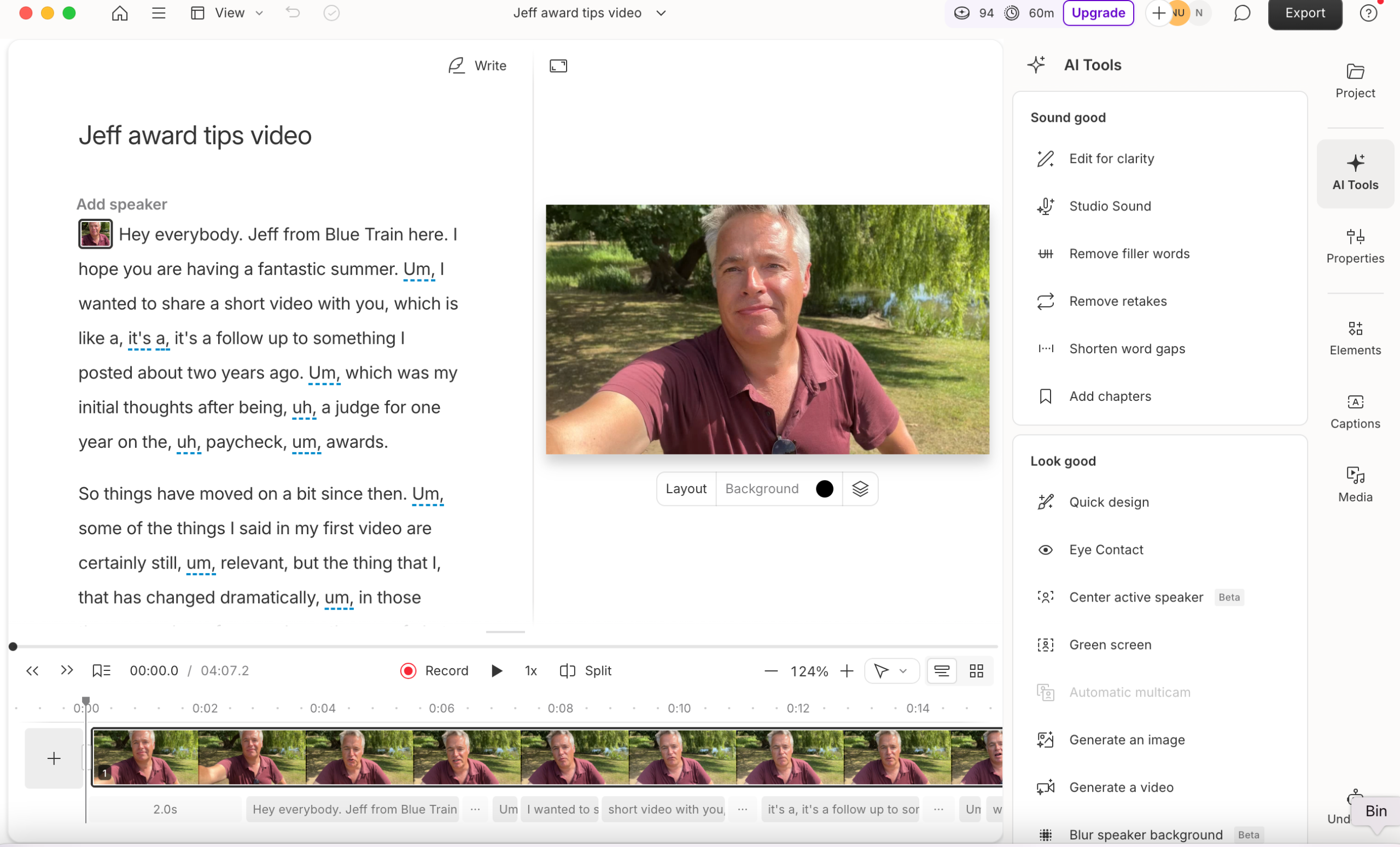
We’ve used this tool to transcribe important meetings and long interviews, and one of its biggest advantages is how easy it makes video editing. The automatically generated transcript allowed us to quickly remove unwanted sections, such as repetition, pauses, or natural speaking mistakes, without having to manually scrub through the entire video. This saved us a significant amount of time and fits seamlessly into a video content workflow.
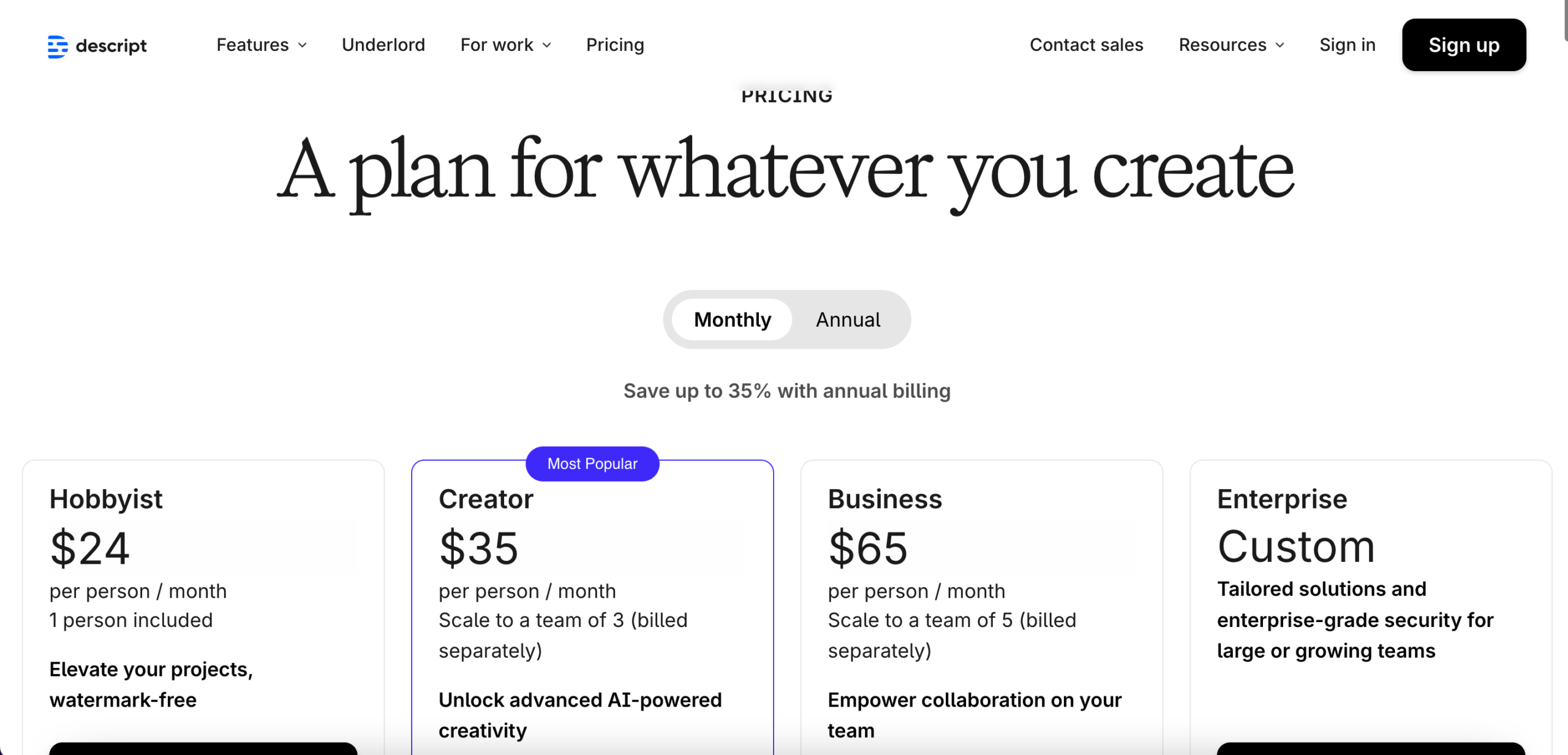
It’s worth noting that the free plan allows up to 60 minutes of transcription per month.
For creators who regularly produce long-form content or repurpose videos into shorter clips, the Hobbyist plan is a good fit. If you’re producing content at a much higher volume, the Creator plan is likely the better option.
Instead of starting from scratch, AI helps content marketers extract value from content they’ve already invested in. Repurposing ensures the same core message appears across multiple channels, reinforcing brand positioning without reinventing the wheel every time.
As always, humans stay in control. Transcriptions still need sense-checking, editing, and context. Spoken content doesn’t always translate cleanly into written copy, and nuance matters.
Maintaining Accuracy With AI Fact-Checking Tools
AI is fast. It’s confident. And occasionally, it’s completely wrong.
That’s not a flaw – it’s a reality of how AI-generated content works. Large Language Models predict language, not truth. Which means AI can produce content that sounds authoritative while getting facts, figures, or context wrong.
This is where fact-checking stops being optional.
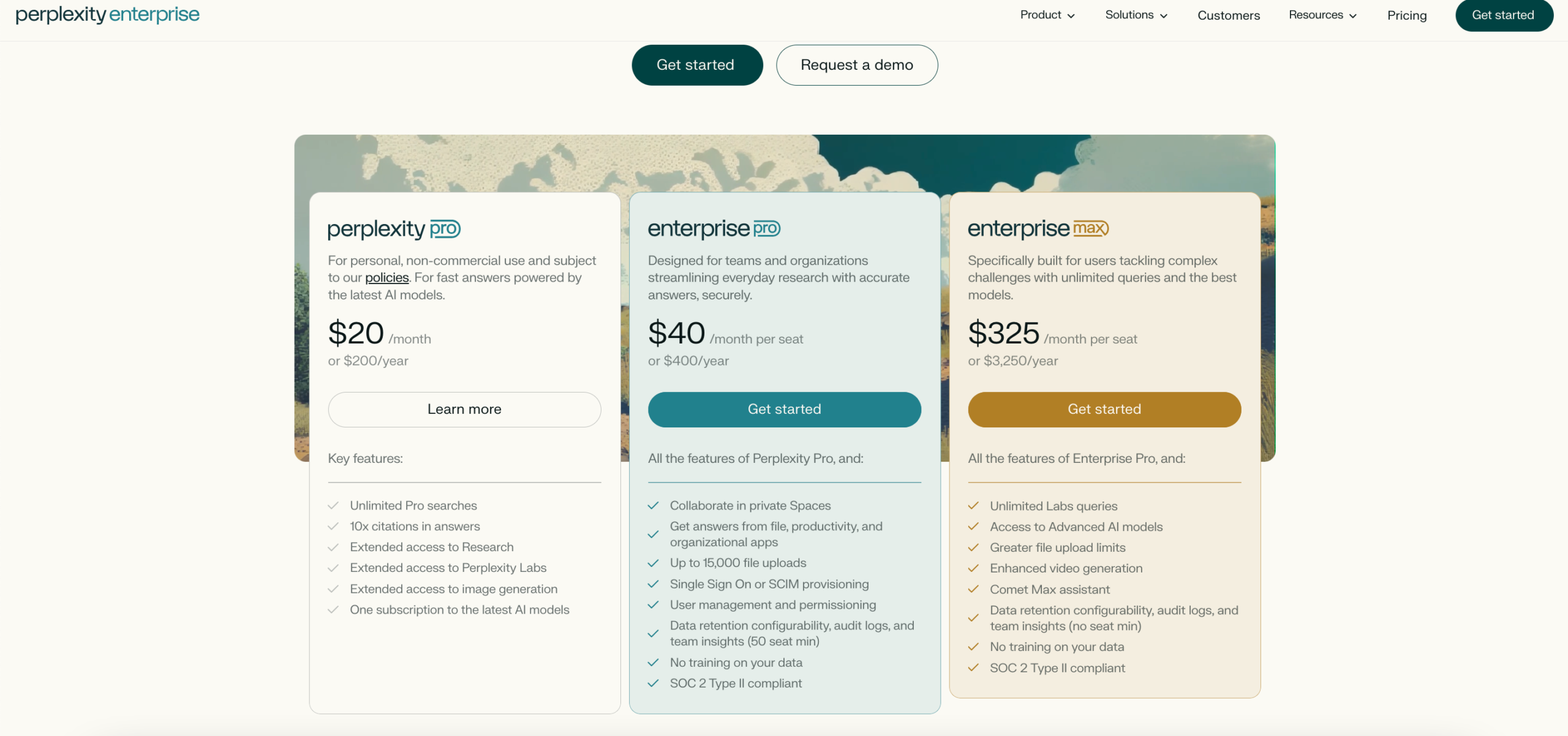
Perplexity.ai is built for research and information discovery, with a strong focus on cited, web-backed answers. One of its main strengths is the ability to switch between multiple AI models in a single interface, making it easy to compare different perspectives on the same question.
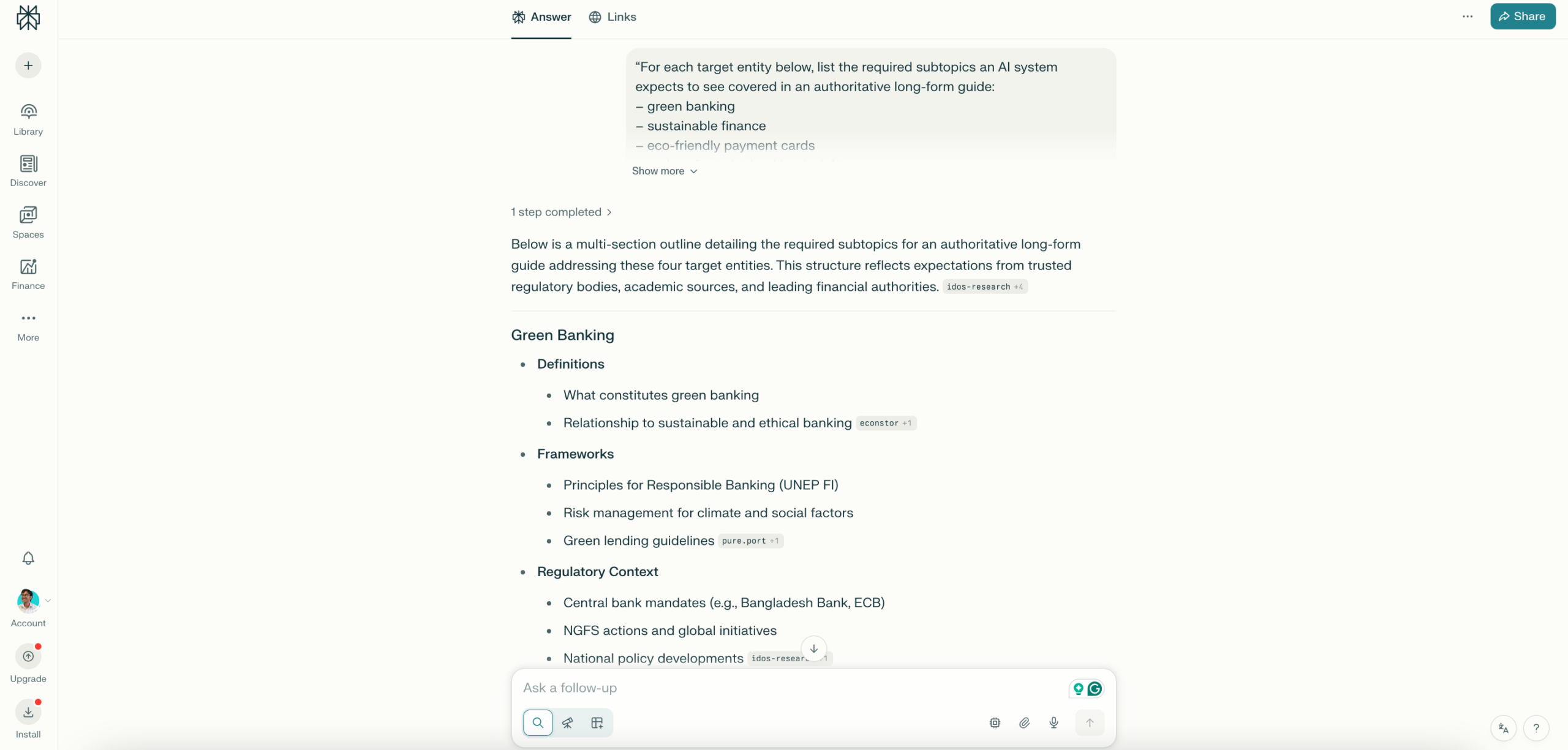
The platform uses a clean, Google-like layout that feels intuitive for searching, follow-up questions, and reviewing sources. While citations are a core feature, some links may occasionally point to a publisher’s homepage rather than a specific source.
Perplexity also includes tools like the Comet browser and a built-in AI assistant, creating a more exploratory experience for advanced users. Team features are available through shared Spaces, though collaboration options are still limited.
With both free and paid plans available, Perplexity is best suited for users who prioritise research accuracy and source transparency. ChatGPT remains better for creative or conversational tasks, while Perplexity excels at structured, reference-driven research.
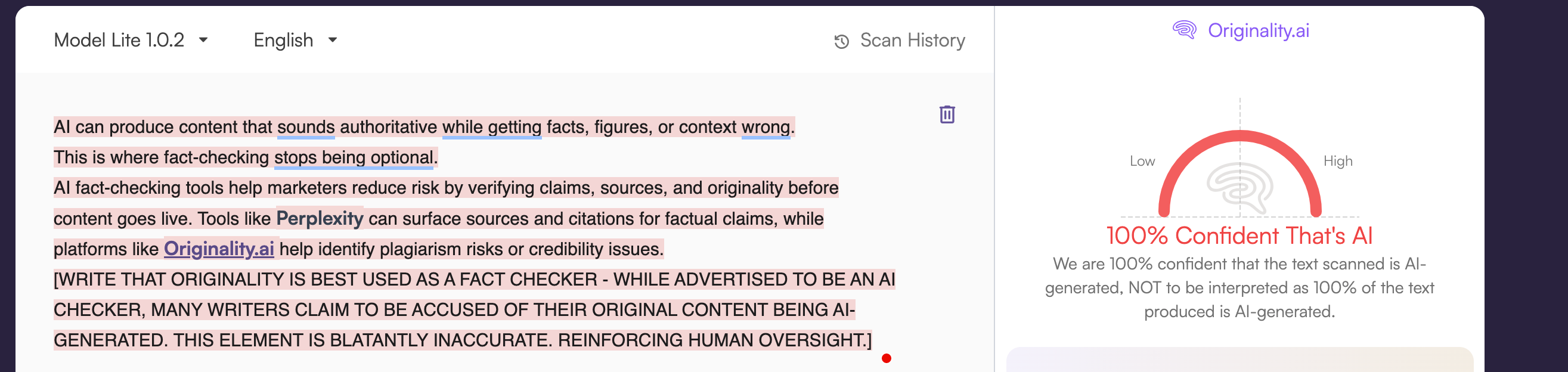
AI fact-checking tools help content marketers reduce risk by verifying claims, sources, and originality before content goes live. Tools like Perplexity can surface sources and citations for factual claims, while platforms like Originality.ai are best used as supporting fact-checkers rather than definitive judges of authorship.
And that distinction matters. While Originality.ai is often marketed as an ‘AI content detection’ tool, many human writers have been incorrectly flagged as producing ‘100% AI-generated content’ – despite their work being entirely original (us included!). That element is blatantly inaccurate, reinforcing a wider truth about AI tools: some functions are genuinely useful, others fall completely short.
Used sensibly and knowledgeably, tools like Originality.ai can help spot patterns, duplication risks, or areas worth reviewing – but they should never replace human judgement or be treated as absolute proof. This is why human oversight remains non-negotiable.
These tools support marketers in:
-
-
- Verifying statistics, dates, and references.
-
- Cross-checking claims against reliable sources.
-
- Identifying unintentional plagiarism or duplication.
-
- Spotting areas where content needs stronger evidence or clarification.
This is especially important as search engines and audiences become more sensitive to accuracy, trust, and originality. Confident-sounding misinformation doesn’t just damage credibility – it undermines long-term content performance.
But tools alone aren’t enough. Marketers still need to apply judgement, question assumptions, and sense-check whether claims make sense in context. AI can flag issues; humans decide what’s acceptable, what needs rewriting, and what shouldn’t be published at all.
Creating Blog Thumbnails & Visual Assets With AI
Most content isn’t ignored because it’s bad. It’s ignored because it never gets seen.
Roughly 85% of users scroll before they click anything – which means your blog thumbnail or social visual is doing the hardest job in content marketing: earning attention in a split second.
No click, no read. Simple.
The reality is that creating strong visual assets is hard. Every blog, landing page, and social media post needs something eye-catching, on-brand, and relevant – and for most marketing teams, design time is finite.
Lexica Art is a powerful AI image generator known for producing highly realistic, high-quality visuals. It’s commonly used to create marketing assets across a wide range of use cases, from blog imagery to social media content.
One of Lexica’s strengths is prompt control. Users can save and reuse prompts to maintain consistent visual styles, making it easier to create images that align with brand guidelines. This consistency is why some brands rely on Lexica for repeatable, on-brand creative output.
Compared to other tools, Lexica performs particularly well at avoiding common AI issues such as visual distortions or unrealistic objects. ChatGPT’s image generation can also be effective for clean visuals and quick image adjustments, especially when refining or editing images created elsewhere.
Other platforms like Leonardo.ai and Midjourney offer strong alternatives depending on the type of design needed. Many users switch between these tools to compare outputs or leverage each platform’s strengths. In practice, the best results often come from choosing the tool that best fits the specific creative goal.
Tools like Leonardo.ai are strong for controlled, style-led visuals – particularly when you need consistency across a series. Lexica Art is better suited to early exploration, mood, and concept direction. ChatGPT‘s image generation works well when visuals need to be tightly connected to messaging, narrative, or abstract ideas rather than just literal scenes.
None of them are perfect on their own. AI-generated visuals can be inconsistent, overly literal, or visually correct but emotionally flat. That’s why the strongest way to create content rarely comes from a single prompt in a single tool.
Instead, effective teams treat AI image generation as a multi-tool process:
-
-
- One tool to explore concepts and visual metaphors.
-
- Another to refine style and composition.
-
- Another to resize, adapt, or repurpose assets for different channels.
A simple and effective technique is to use ChatGPT to help craft or refine your image prompts before generating visuals. You can ask ChatGPT to improve an existing prompt or analyse a reference image or style you like. It can then create a polished prompt that you can use directly in tools like Leonardo.ai or Lexica to achieve more accurate, on-brand results.
Used this way, AI becomes a flexible visual toolkit, not your new graphic designer.
These tools can support:
-
-
- Rapid creation of blog thumbnails and campaign visuals.
-
- Generating imagery that reflects a specific idea, theme, or narrative.
-
- Testing visual directions without heavy production time.
-
- Rolling out consistent visuals across multiple channels.
Speed without direction is where things fall apart. AI doesn’t understand brand nuance, visual identity, or what makes a brand recognisable unless it’s explicitly guided. Left unchecked, it produces visuals that are technically fine … and completely unforgettable.
This is where brand guidelines matter. Prompts, references, and clear constraints keep AI outputs aligned and recognisable.
Enhancing Visual Quality With AI Upscaling Tools
Not every image starts life in perfect condition.
Visuals get reused. Cropped. Downloaded. Resized and pulled from older campaigns. And by the time they land on a blog post or social feed, quality has quietly taken a hit.
AI-powered upscalers like Upscale.media exist solve exactly that problem. It utilises machine learning to enhance image resolution by up to 8x, sharpen details, and reduce visual noise – all without requiring the original high-resolution files. That makes them particularly useful when content needs to move fast across multiple channels, formats, and platforms.
Where AI upscalers add real value:
-
-
- Improving low-resolution images so they hold up on modern screens.
-
- Making older visual assets usable again.
-
- Preparing visuals for different placements without manual redesign.
-
- Keeping campaigns visually consistent across different channels.
It’s important to remember that the quality of the upscaled image depends on the original image. AI upscalers can enhance detail and improve clarity, but very low-quality, heavily pixelated, or blurry images may still produce imperfect results.
For example, blurry text on an image may remain distorted even after upscaling, just more defined. That said, the tool is still well worth using, and you can try it without signing up using two free credits.

Upscaling tools work best as a final polish step – applied once the right visual has already been chosen. Used this way, they sit neatly in the workflow, quietly doing their job without adding complexity or slowing things down.
Using AI Copywriting Tools as a Writing Assistant
AI copywriting tools are very good at one thing: getting you moving.
They’re fast. They’re tireless. And they’re brilliant at handling the parts of content creation that tend to slow marketing teams down – first drafts, rewrites, expansions, reductions, and optimisation passes.
AI writing tools such as Jasper AIwork best when they’re treated like a junior marketing assistant: helpful, efficient, and absolutely not left unsupervised.
Jasper’s real strength isn’t creativity; it’s consistency. Its templates, brand voice features, and workflow integrations make it useful for teams producing high volumes of content across blogs, landing pages, emails, and social media, especially when aligmenets matters most in early drafts.
AI marketing tools, like Jasper, can support:
-
-
- Drafting early versions of blog posts, landing pages, and social media captions.
-
- Rewriting existing content for clarity, tone, or format.
-
- Shortening long-form content into punchier summaries or snippets.
-
- Expanding bullet points into structured paragraphs.
-
- Supporting SEO optimisation by aligning copy with keyword intent.
Where teams get into trouble is expecting AI to think.
AI doesn’t understand brand nuance. It doesn’t feel tone shifts. And it certainly doesn’t know when something sounds technically correct but strategically wrong. Left alone, it defaults to safe, generic language – the kind that fills space but doesn’t build brands.
The strongest marketing teams don’t ask AI to write content. They ask it to assist the writing process.
Human writers still set the direction, shape the narrative, inject originality, and make judgement calls about what stays, what goes, and what needs more edge.
AI simply helps remove the friction – speeding up drafts, smoothing rough edges, and freeing up time for thinking, not typing.
Ethical Considerations & Limitations of AI in Content Marketing
AI doesn’t break rules. It just does exactly what it’s told – faster than anyone expects.
That’s what makes ethics in AI content marketing a practical problem. When tools are this powerful, small decisions scale quickly. Tiny inaccuracies multiply. Lazy shortcuts become patterns. And content that sounds confident can travel a long way before anyone stops to question it.
The issue isn’t whether AI should be used. That ship has sailed.
The issue is how it’s used without eroding trust, credibility, or brand value along the way.
Balancing AI Efficiency With Human Creativity
At Blue Train Marketing, we don’t use AI to replace thinking. We use it to protect it.
AI’s real value isn’t that it can generate content quickly – it’s that it can take pressure off the parts of the process that drain creative energy. The admin. The repetition. The blank-page paralysis. The endless reformatting.
When AI is treated as a creative lead, the output becomes predictable. Safe, structurally sound, and strategically hollow. It looks like content. It behaves like content. But it doesn’t carry insight, opinion, or edge – because none of those things exist in training data.
Our approach is deliberately different. We use AI to accelerate execution after direction is set. Strategy, positioning, narrative, and brand voice are human-led – always. AI supports that thinking by stress-testing ideas, expanding angles, and speeding up iteration, without ever being trusted to define what a brand should say.
That balance is what keeps content distinctive, credible, and commercially effective.
Data Privacy & Security Risks
As AI tools become more embedded in marketing stacks, regulation and governance are already shaping how AI should be deployed responsibly, especially when content teams are working with audience data, customer insights, or internal strategy.
In the UK, this is reinforced through the Government’s AI Regulatory Principles, which emphasise safety, transparency, fairness, accountability, and clear human oversight. The direction is clear: AI can be used, but organisations remain responsible for its impact.
For content marketers, the risk isn’t usually malicious misuse – it’s casual overexposure. Feeding sensitive documents into tools without understanding data retention. Using platforms with unclear training policies. Treating AI outputs as neutral when they’re anything but.
That’s why AI adoption needs structure.
At Blue Train Marketing, AI use is governed by a clearly defined internal policy – not to restrict creativity, but to protect clients, data, and trust. Our AI Use Policysets boundaries around what data can be shared, how tools are selected, and where human accountability sits within AI-supported workflows.
This kind of policy-driven approach is becoming essential as AI regulation matures. Marketing teams need clarity on:
-
-
- Which AI tools are approved and why.
-
- What data is off limits – including customer, commercial, and unpublished material.
-
- How AI outputs are reviewed, edited, and signed off.
-
- Where accountability sits when AI-supported content goes live.
Regulation isn’t trying to slow teams down. It’s ensuring AI supports long-term credibility rather than short-term efficiency at the expense of trust.
Content marketing relies on confidence – from audiences, search engines, and stakeholders alike. That confidence disappears quickly when data handling, transparency, or accountability is unclear.
Using AI Responsibly in Content Creation
Responsible AI use started with how AI tools are trained and guided.
AI models don’t understand your brand by default. Without context, they rely on broad language patterns – which is why untrained AI outputs often sound generic, overly confident, or subtly misaligned.
Training AI usually means providing structured input that shapes how it behaves. This includes:
-
-
- Brand guidelines, tone of voice, and language preferences.
-
- Clear positioning, USPs, and audience priorities.
-
- Approved terminology and language to avoid.
-
- Examples of high-performing content and formats.
-
- Rules around claims, data use, and compliance.
A practical way to train AI tools is to treat prompts as living instructions, not one-off requests. Instead of asking AI to “write a blog post”, teams should build reusable prompt frameworks that define audience, intent, format, tone, and constraints before generation begins. For example:
-
-
- Who is this content for?
-
- What problem is it solving?
-
- What should it avoid saying or assuming?
-
- What does ‘on-brand’ actually look like here?
Training also means knowing where AI should stop. AI is effective when supporting execution, but it becomes unreliable when asked to invent expertise, interpret nuance, or make judgement calls about accuracy, sensitivity, or strategy.
This is why responsible AI use always includes human intervention. Yes, training reduces risk, but it does not eliminate it. Outputs still need to be reviewed, sense-checked, and edited with context and intent in mind.
Bias, Accuracy & Fairness in AI Outputs
AI doesn’t hesitate. It doesn’t caveat. And it rarely says “I don’t know”.
That confidence is exactly why it’s dangerous to treat AI outputs as inherently reliable. Research has shown that AI-powered search engines are inaccurate roughly 60% of the time – yet the language they produce is polished, assertive, and often indistinguishable from expert commentary.
That poses a big problem. AI isn’t designed to verify truth. It predicts the most statistically likely response on patterns in existing data. That means inaccuracies, missing context, and oversimplified conclusions are baked into the system.
Bias works the same way. AI models learn from historical data, which means they inherit its blind spots. Dominant viewpoints are overrepresented. Marginal perspectives are flattened or ignored. And nuance is often sacrificied in favour of answers that sound broadly acceptable.
Bias and accuracy issues can be reduced by:
-
-
- Treating AI outputs as drafts, not decisions.
-
- Actively questioning confident-sounding claims.
-
- Cross-checking statistics, sources, and references.
-
- Reviewing tone and framing for unintended assumptions.
-
- Knowing when content should be rewritten.
Challenging AI outputs, verifying claims, and reviewing language increases accuracy, reduces embedded bias, and leads to much fairer, representative content.
It forces teams to slow down just enough to question assumptions, add missing context, and remove language that unintentionally excludes or misleads.
Final Thoughts: Building a Sustainable AI-Powered Content Workflow
Used correctly, AI and content marketing can make teams sharper – not louder. It speeds up execution, surfaces insights, and removes friction from the creative process. But it only delivers real value when it’s guided by strategy, judgement, and human intent.
The brands seeing results aren’t using more AI tools. They’re using AI deliberately.
That means:
-
-
- Clear guardrails around accuracy, bias, and data use.
-
- AI trained with brand context, not left to guess.
-
- Human-led strategy, creativity, and decision-making.
-
- Content optimised for not just search engines, but for Large Language Models.
Because visibility now isn’t just about ranking. It’s about being referenced, surfaced, and trusted by AI-driven search and discovery platforms.
At Blue Train Marketing, that’s exactly where our AI marketing services and LLM optimisation focus – helping brands with AI integration, originality, and content marketing efforts.
Explore Blue Train Marketing’s AI marketing services and learn more about LLM optimisation and AI visibility.
If you want AI to work for your content – not against it – that’s the best place to start.