

- Money20/20 Europe 2026: This Year Felt Different. - June 30, 2026
- Top Fintech SEO Agencies in 2026 | SEO, GEO & AI Visibility - June 26, 2026
- ChatGPT Ads: What Does This Mean for Paid Advertising? - June 19, 2026
Fintech SEO isn’t what it used to be. And honestly? That’s a good thing.
A few years ago, ranking in search engines was relatively straightforward. Tight keyword research, technical SEO, and some decent content marketing, and you could steadily climb those search engine rankings.
Now? It’s a different game.
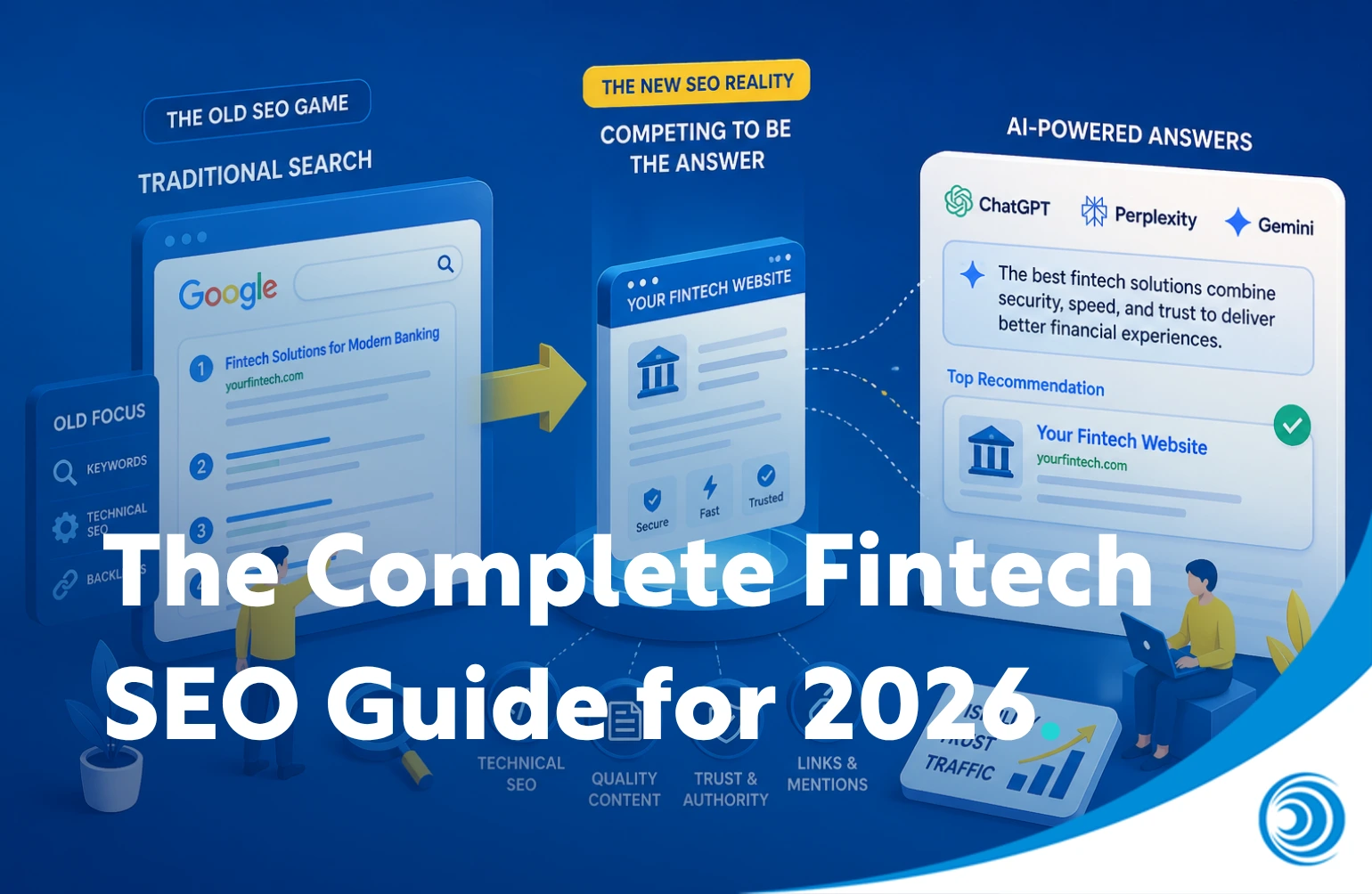
Today, your fintech website isn’t just competing for blue links on Google. It’s competing to be the answer – pulled into responses by tools like ChatGPT, summarised by Perplexity AI, and interpreted by Google Gemini.
Which means this:
If your content isn’t clear, trustworthy, and structured to be understood instantly, it becomes significantly less visible – especially in AI-generated summaries and competitive search results.
This guide is about that shift. While AI tools are reshaping discovery, traditional search engines remain the primary driver of web traffic.
We’re going beyond surface-level fintech SEO tips and digging into what actually drives SEO success in 2026 – from technical optimisation and structured data, to trustworthy content, link building, and how to make sure your brand actually shows up inside AI-generated answers.
While AI tools are reshaping discovery, traditional search engines remain the primary driver of web traffic.
Why SEO Matters for Fintech Companies in 2026
Here’s the reality: fintech buyers don’t just “browse”, they investigate.
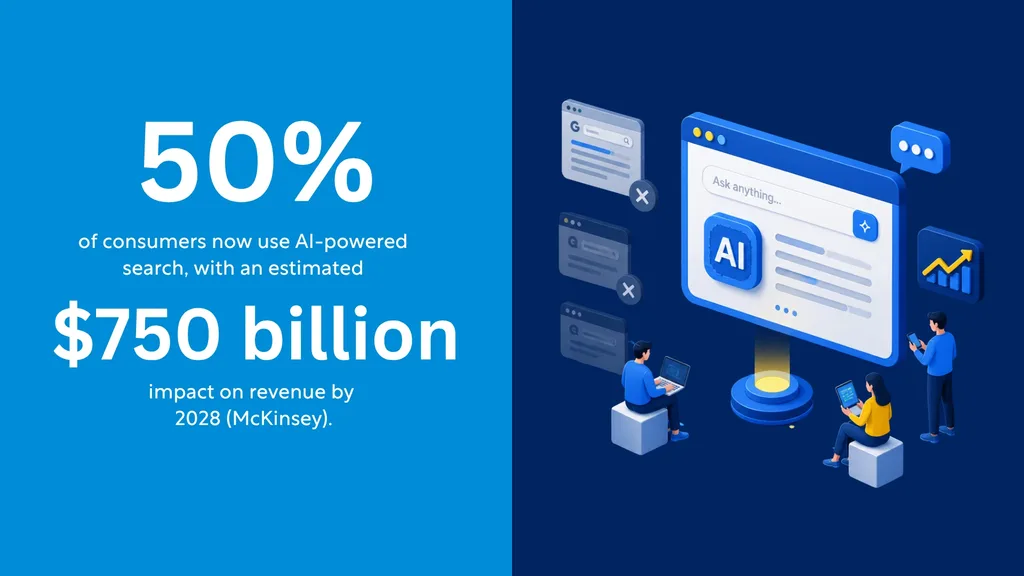
According to McKinsey&Company, half of consumers use AI-powered search today, and it stands to impact $750 billion in revenue by 2028. Now, first impressions rarely happen on your homepage. It happens in search results, comparison queries, and increasingly, inside AI summaries.
By the time someone lands on your fintech website, they’ve already:
- Read explanations.
- Compared alternatives.
- Formed early opinions.
- Shortlisted options.
And if your brand wasn’t visible during that process? You’re playing catch-up from the start.
This is why fintech SEO isn’t just about driving organic traffic – it’s about showing up early enough to shape the decision.
A smart fintech SEO strategy maps directly how people actually research financial products:
- Messy, non-linear.
- Full of specific, high-intent queries.
- Heavily driven by user intent, not just keywords.
But here’s where it gets more interesting.
That research is no longer happening purely on Google. Tools like ChatGPTand Perplexity AI are inserting themselves into the process – summarising options, explaining complex financial concepts, and in some cases, reducing the need to click through, depending on the query and depth of information required.
So, your SEO strategy now has two jobs:
- Earn visibility in traditional search engines.
- Be clear, structured, and credible enough to be pulled into AI-generated answers.
In fintech, that visibility compounds fast. Because the brands that show up consistently across queries, formats, and platforms don’t just attract clicks, they shape customer perception.
The brands pulling ahead aren’t just publishing more; they’re creating high-quality, optimised content that directly answers user intent and provides real, decision-shaping value.
Key SEO Challenges in the Fintech Industry
Fintech SEO would be easy – if it weren’t fintech.
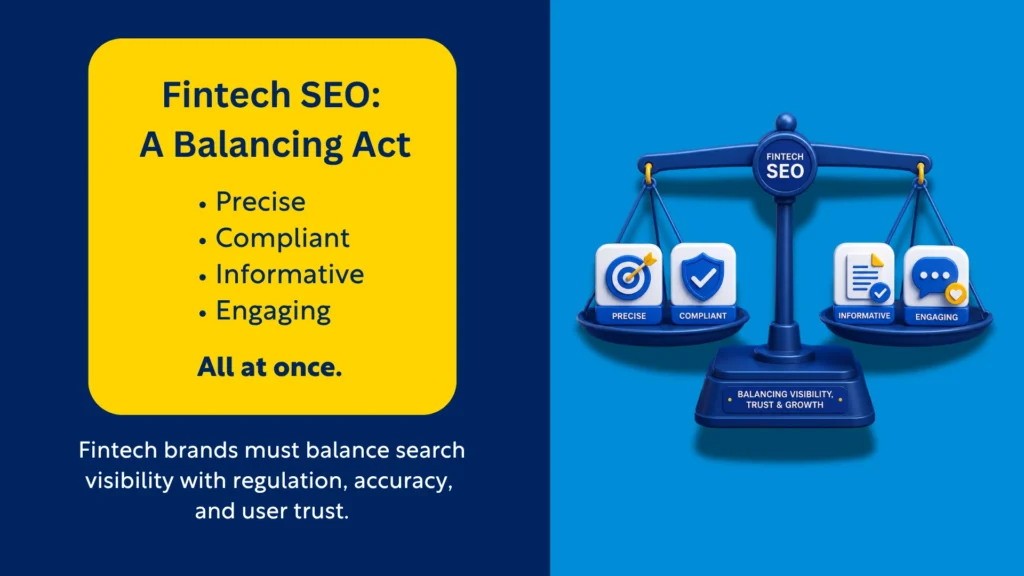
This is one of the few industries where you’re expected to be:
- Technically precise.
- Legally compliant.
- Deeply informative.
- And somehow still … engaging.
All at the same time.
And that tension? It shows up everywhere in your SEO strategy.
Unlike most sectors, fintech companies aren’t just competing on creativity or content volume. They’re navigating a tightrope between visibility and responsibility – trying to rank in search engines while staying on the right side of regulation, accuracy, and user trust.
Financial Regulations & Compliance
This is very important for fintechs regarding brand trust and authority.
In fintech, you often can’t just publish and tweak later, as in other industries, due to compliance requirements.
Every piece of SEO content, every landing page, every claim, is subject to scrutiny. Whether it’s internal compliance teams or external regulators, there’s constant pressure to get things exactly right – especially in a space where even the language you use is tightly controlled, making SEO as much more about precision as it is performance.
Your website sits firmly in Your Money or Your Life (YMYL) territory, which means Google holds it to a higher standard. Accuracy isn’t optional; it’s expected.
Layer on frameworks like E-E-A-T, and suddenly your content isn’t just being judged on relevance – it’s being evaluated on:
- Experience.
- Expertise.
- Authoritativeness.
- Trustworthiness.
While E-E-A-T is not a direct ranking factor, it is part of how search quality is evaluated, particularly for financial content.
The dilemma: compliance often slows everything down.
Language gets softened. Bold claims get diluted into something safer … and less compelling. Before you know it, your content is technically correct – but completely forgettable.
The brands that win here don’t ignore compliance. They get smarter about how they work within it:
- Building repeatable content frameworks.
- Aligning SEO teams with legal, early.
- Finding ways to stay clear without sounding clinical.
High-Competition Keywords in Fintech
If you’ve ever tried ranking for a core fintech term, you already know – it can be brutal.
Keywords tied to financial services, payments, lending, or investing are some of the most competitive in search. You’re up against:
- Established financial brands.
- Comparison sites with a huge domain authority.
- Well-funded fintech brands that are investing heavily in SEO efforts.
Going after broad, high-volume terms alone? That’s a fast track to frustration.
That’s why effective fintech SEO leans heavily into:
- Long-tail queries.
- Niche use cases.
- Highly specific search intent.
Because while everyone’s fighting for the same headline keywords, the real opportunity often sits in long-tail and intent-driven queries, particularly for newer or less authoritative domains. The questions, comparisons, and edge-case queries that actually reflect how users think.
That’s where intent-driven, long-tail queries start to outperform – less volume, but far more relevance and significantly higher conversion potential.
Simplifying Complex Financial Concepts for Marketing
Now for the real challenge: making fintech make sense.
You’re dealing with concepts that aren’t exactly light reading – things like stablecoins, liquidity protocols, or even emerging areas like agentic commerce.
These are powerful, evolving ideas – but they’re also confusing to the average reader. And confusion kills user engagement.
If your website content leans too technical, you lose people. Too simplified, and you risk losing credibility. That balance is incredibly hard to get right.
The strongest fintech companies treat this as a strategic advantage, not a limitation – leaning into content that educates, simplifies, and builds trust by making complex financial concepts genuinely understandable. They:
- Break down complex financial concepts into clear, digestible explanations.
- Create layered content (from beginner-friendly guides to deep dives).
- Use formats like FAQs, comparison tables, and ‘jargon busters‘.
- Focus relentlessly on helping users actually understand.
Because here’s the truth:
Content that fails to clearly explain concepts is less likely to perform well in search or be surfaced in AI-generated responses.
And increasingly, it’s this kind of clear, educational content that drives both engagement and visibility – because it aligns perfectly with how users search and how AI systems interpret value.
How to Build an Effective Fintech SEO Strategy
If fintech SEO feels harder than other industries, it’s because it is.
You’re not just trying to improve search visibility – you’re trying to build trust, explain complicated ideas, and show up at exactly the right moment in a very non-linear decision journey.
Which means your fintech SEO strategy can’t be pieced together from generic best practices. It needs to be deliberate, layered, and built around how people actually search for financial products.
Here’s what that looks like in 2026.
Follow E-E-A-T Guidelines for Trust & Authority
We’ve already touched on it – but this is where it becomes operational.
In fintech, E-E-A-T isn’t an abstract idea sitting in Google’s documentation. It plays a significant role in how content quality is assessed, particularly for YMYL queries.
E-E-A-T isn’t something you add to a page. It’s something your entire site either demonstrates … or doesn’t.
In practice, that means:
- Publishing informative content that genuinely helps users understand complex financial concepts (not just lightly skimming them).
- Ensuring consistency across your financial content – no contradictions, no vague claims.
- Strengthening your ecosystem of internal links so key topics are deeply connected and easy to navigate.
- Backing up claims with credible external links and sources.
It’s less about ticking boxes and more about removing doubt. Because when someone lands on your site (whether that be a real-life human being or an AI model scanning for answers), the question isn’t: “Is this optimised?”
It’s “Is this reliable enough to trust?”
And in fintech, that trust is built through consistently accurate, well-structured, genuinely helpful content – not just signals, but substance.
Keyword Research Across the Full Customer Journey
Most keyword research in fintech is far too narrow.
It focuses on high-intent, bottom-of-funnel terms – keywords that look great on paper but ignore how people actually make decisions.
Because fintech journeys don’t start with: “Best Payment Platform UK”
They start with:
- “What is a Payment Gateway?”
- “How Do Cross-Border Payments Work?”
- “Are Stabelcoins Safe?”
That’s why your SEO strategy needs to map keywords across the entire journey:
- Awareness: Educational, question-led queries.
- Consideration: Comparisons, use cases, feature breakdowns.
- Decision: Product-specific, high-intent searches.
And this is where long-tail keywords become powerful. They’re less competitive, more aligned with user intent, and far better at matching how people actually search: specific, question-led, and rooted in real decision-making.
The smartest fintech companies don’t just target keywords – they build coverage. Creating clusters of blog posts, guides, and key pages that collectively build topical authority.
Building Brand Authority in Fintech
You can’t fake authority. And search engines are getting very good at spotting the difference.
A strong backlink profile is still one of the clearest signals of credibility – but not all links are equal.
A handful of quality backlinks from respected financial publications will do far more for your domain authority than dozens of low-value links.
That’s why link building in fintech tends to lean heavily on:
- Digital PR.
- Proprietary data & insights.
- Thought leadership content.
- Partnerships within the fintech industry.
It’s about earning attention, not manufacturing it.
Because when reputable sites reference your brand, it doesn’t just boost rankings, it reinforces trust.
Improving AI Visibility & LLM Discoverability
This is where things are starting to change.
SEO used to be about ranking pages. Now it’s also being retrieved, summarised, and cited by Large Language Models (LLMs) (often drawing from indexed web content and other licensed or proprietary data sources). And they don’t read content the way humans do.
They look for:
- Clear, structured information.
- Direct answers to specific questions.
- Consistent terminology.
- Content that demonstrates real authority.
This is where Generative Engine Optimisation (GEO) comes into play – structuring content so it can be easily interpreted, extracted, and surfaced by AI systems.
It’s not about gaming algorithms, it’s about making your content:
- Easy to extract.
- Easy to interpret.
- Genuinely useful in context.
That means:
- Writing in a more conversational, question-led format.
- Structuring content with headings that mirror real queries.
- Building out FAQ sections that align with search intent.
- Avoiding vague, filler-heavy copy.
We explore this in more detail in our article, “AI Visibility: How Brands Get Surfaced in Large Language Models”.
On-Page SEO Best Practices for Fintech Websites
You can have the smartest fintech SEO strategy in the world, but if your on-page fundamentals are messy, inconsistent, or unclear, it simply won’t translate into SEO performance.
This is where a lot of fintech companies quietly fall down. Not because they don’t know what to do, but because:
- Content gets fragmented across teams.
- Compliance edits dilute clarity.
- Pages end up trying to say everything … and saying nothing well.
Strong on-page SEO cuts through that. It makes your website content easier to understand – for users, for search engines, and for AI systems trying to extract meaning from it.
Here’s what actually matters.
Structure Content for Clarity (& Extraction)
Fintech content has a habit of becoming dense. Paragraph-heavy. Slightly inpenetrable.
That’s a problem.
Because both users and AI tools scan before they commit. If your page isn’t easy to navigate, it won’t get read, and it definitely won’t get surfaced.
Strong structure means:
- Clear H1, H2, H3 hierarchy.
- Short, purposeful paragraphs.
- Descriptive subheadings aligned with search behaviour.
- Content that answers questions quickly, then expands:
Think less ‘wall of text’, more ‘guided explanation’.
Optimise Key Pages (Not Just Blog Content)
A lot of SEO efforts in fintech lean heavily on blog posts. And yes, they matter.
But your product pages, landing pages, and core service pages are often the ones driving real conversions – and they’re frequently under-optimised.
These pages need to:
- Clearly communicate value.
- Align with high-intent keyword rankings.
- Include supporting internal links to deepen context.
- Reinforce trust through concise, informative content.
Ranking is one thing, but converting is even better.
Get Technical Foundations Right
If your site is slow, difficult to crawl, or poorly structured, you’re limiting your own search visibility before content even comes into the mix.
Focus on the fundamentals of technical optimisation:
- Website speed & performance.
- Core web vitals.
- Mobile-first experience (remember, 71% of Google searches are conducted on phones).
- Clean site architecture.
- Fixing crawlability issues (broken links, incorrect noindex tags).
Use Structured Data to Enhance Visibility
If you’re not using structured data, you’re making it harder for search engines to understand your content.
Structured data helps:
- Define what your content is.
- Improve how it appears in search results.
- Enable rich results like FAQs or featured snippets.
It’s a small technical layer that can have a disproportionate impact on click-through rate and visibility.
Avoid Duplicate & Diluted Content
This one creeps in quietly. As fintech websites scale, especially with similar products, regions, or use cases, it’s easy to end up with:
- Overlapping pages.
- Near-identical content.
- Thin variations targeting slightly different keywords.
That weakens your topical authority and confuses search engines about which pages actually matter.
Instead:
- Consolidate where possible.
- Create genuinely distinct, relevant pages.
- Ensure every page has a clear purpose within your content strategy.
Key Fintech SEO Metrics to Track Performance
Fintech SEO can feel like a long game. And it is.
But that doesn’t mean you wait months and hope things are working. The smartest fintech companies track a tight set of metrics that show not just growth, but quality of visibility.
Because in this space, more traffic doesn’t always mean better outcomes.
Organic Traffic Growth
Let’s start with the obvious – but with a caveat.
Yes, organic traffic is a core signal of SEO progress. If your visibility in search engines is improving, traffic should follow.
But raw numbers don’t tell the full story.
You want to look at:
- Traffic to key pages (not just blogs).
- Growth across different stages of the funnel.
- Whether users are landing on the right content.
Because 10,000 visits from vague, top-of-funnel queries won’t outperform 1,000 visits from high-intent users actively comparing solutions.
Keyword Rankings
Tracking keyword rankings still matters – but not in the old, obsessive way.
This isn’t about checking if you’ve moved from position 6 to 4 for one term. It’s about understanding:
- How your visibility is improving across clusters.
- Whether you’re ranking for a broader set of important financial keywords.
- How well you’re covering different layers of search intent.
AI Visibility & Brand Mentions
This is the one most teams still aren’t tracking – and it’s becoming impossible to ignore.
AI tools are increasingly shaping how users discover information, with 55% of people now using AI instead of search engines.
Marketers must be thinking beyond “Do we rank?” to “Do we show up in the answers?”
That means monitoring:
- Whether your brand is mentioned in AI-generated responses.
- How your content is being summarised.
- Which competitors are being surfaced instead.
Because if you’re not visible here, you’re missing an entire layer of modern search.
Click-Through Rate (CTR)
Ranking is one thing. Getting the click is another.
Your click-through rate (CTR) tells you whether your listings in search results are actually compelling enough to win attention.
Low CTR? It’s usually a signal that:
- Your titles aren’t sharp enough.
- Your meta descriptions aren’t pulling their weight.
- Your positioning isn’t clear.
Backlink Profile & Authority
Your backlink profile remains one of the strongest indications of authority.
But again, quality over quantity.
You’re looking for:
- Organic backlinks from reputable sources.
- Mentions from financial publications.
- A steady increase in overall domain authority.
Strong link building reinforces your credibility across the board.
Putting It All Together
No single metric tells the full story. But when you combine organic traffic, keyword rankings, AI visibility, CTR, and your backlink profile, you start to get a clear picture of how your SEO strategy is performing – not just in terms of reach.
However, you need to be aware that measurement in this area is still evolving, and there are currently limited standardised tools available.
Future-Proofing Your Fintech SEO Strategy
SEO isn’t going anywhere – but it’s no longer working alone.
Your technical SEO, content strategy, and link building drive organic traffic and search visibility. But alongside that, AI tools are shaping what users see, trust, and act on.
If you want to show up in search results and AI-generated answers, build real topical authority in the fintech space, and turn visibility into actual pipeline, here’s your next move:
- Explore our SEO services to grow rankings, traffic, and long-term search performance.
- Discover our AI and LLM optimisation services to get your brand surfaced inside AI-driven answers.
Because in 2026, it’s not about choosing one. It’s about owning both.