
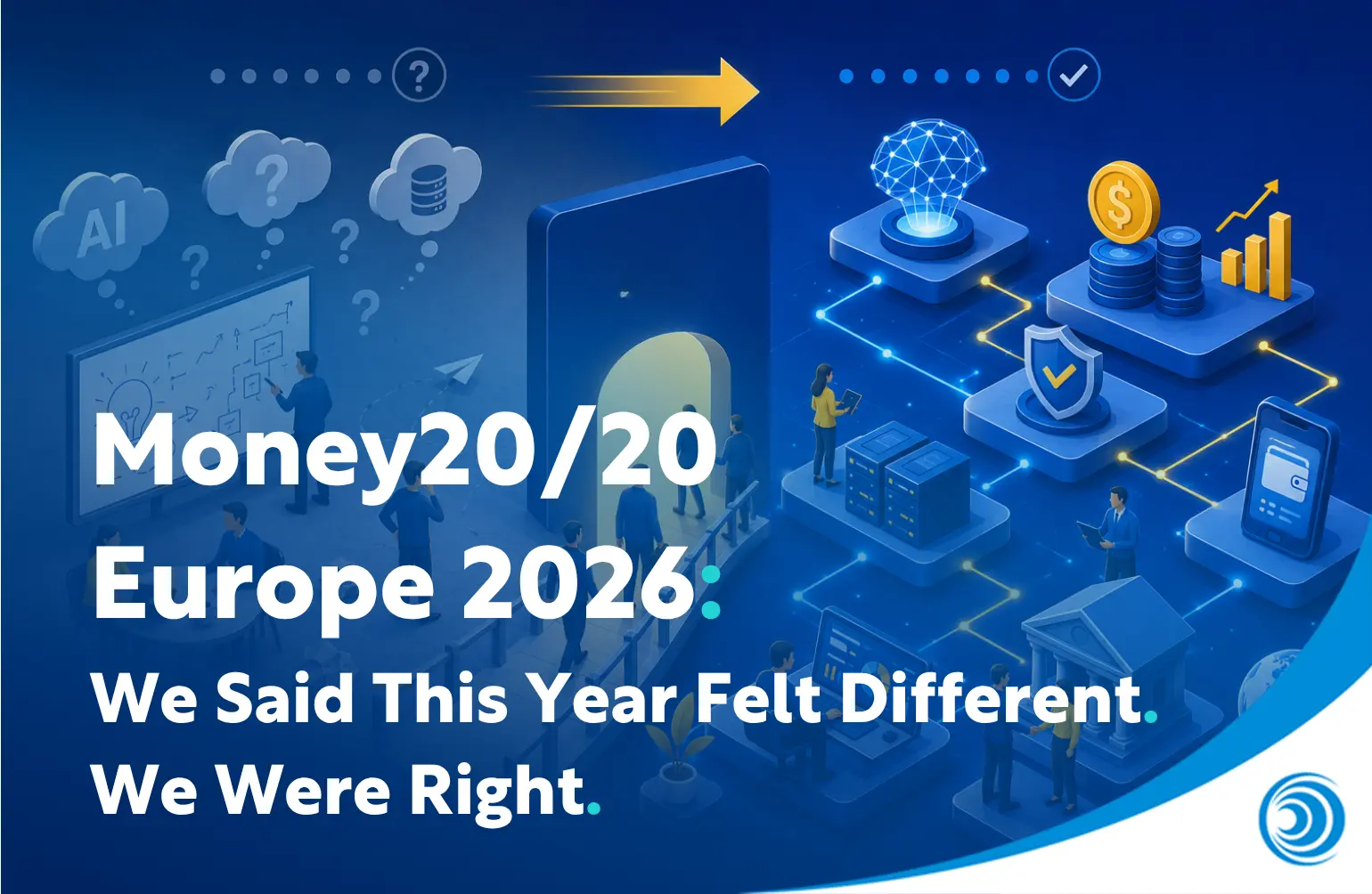

- Money20/20 Europe 2026: This Year Felt Different. - June 30, 2026
- Top Fintech SEO Agencies in 2026 | SEO, GEO & AI Visibility - June 26, 2026
- ChatGPT Ads: What Does This Mean for Paid Advertising? - June 19, 2026
A few weeks ago, we wrote that Money20/20 Europe 2026 felt different.
Not because there would be more AI sessions (there were). Not because stablecoins would dominate conversations (they did). And definitely not because fintech has found yet another way to say the same thing with different buzzwords.
It felt different because something bigger seemed to be happening. Less time was being spent debating whether AI, stablecoins, or digital AI would shape the future of financial services, and more time was spent discussing how they’re becoming a reality. Suddenly, trust, governance, infrastructure, and implementation felt just as important as the technology itself.
Fast forward a few days, thousands of conversations, questionable step counts, and approximately seventeen overpriced coffees later, and the verdict feels pretty straightforward:
We were right.
Money20/20 wasn’t just focused on future possibilities. It was focused on implementation.
Less “Could this happen?” And more “How do we make this work?”
Here’s what stood out to us.
AI Isn’t the Story Anymore (And That’s the Story)
A few years ago, mentioning AI was enough. You could add “powered by AI” to almost anything and guarantee yourself a packed session, excited LinkedIn comments, and at least three people describing something as “game-changing”.
That doesn’t seem to be where we are anymore.
AI still dominated conversations at Money20/20, but something had evidently changed. The focus was no longer experimentation; it was implementation.
One of the biggest themes running throughout the event wasn’t simply how AI supports financial services, but what happens when AI starts acting independently inside it.
Examples like Hey Savi’s partnership with PayPal highlighted exactly why these matters are important. As shopping increasingly starts with screenshots, creator content, and social discovery, the industry is trying to solve a growing problem: inspiration moves faster than checkout.
The promise of agentic commerce is simple: collapse the distance between “I want that” and “I’ve bought it.”
Mastercard has also been working with Google on agentic commerce infrastructure, exploring how intent is captured, how trusted agents are identified, and how transactions occur safely.
Meanwhile, Experian’s Vijay Mehta perhaps summed up where the conversation now sits: “This is no longer about experimentation.”
Exactly!
Even banking itself is beginning to think differently. BBVA CEO Onur Genç predicted that within five years, banking apps could become conversational financial companions, suggesting that BBVA’s 81 million customers could eventually have 81 million different versions of the app.
This isn’t simply personalisation. It’s infrastructure adapting itself in real time.
But the uncomfortable reality is that financial services currently appears significantly more excited about autonomous AI than prepared for it – and that gap feels important.
Trust Has Quietly Become the Product
For an industry built on trust, financial services has spent an impressive amount of time talking almost exclusively about technology.
This year felt different because conversations around trust, governance, identity, and regulation weren’t happening alongside innovation anymore. They became part of the innovation itself.
Perhaps the clearest example came from digital identity.
Google’s P.J. Linarducci discussed how Google Wallet is evolving across digital identity, authentication, and payment experiences.
That sounds subtle, but it isn’t.
Because if wallets become identity infrastructure, authentication layers, and payment mechanisms simultaneously, we’re no longer talking about just digital wallets. We’re talking about an entirely new trust infrastructure.
And trust surfaced everywhere. Beyond just technology.
Vanessa Schotes, CMO at Enfuce, perhaps captured this best: “Trust is the invisible advantage and the biggest currency in B2B and consumer marketing.”
That observation feels increasingly difficult to ignore because financial services now face a juggling act – building experiences for humans, machines, and LLMs too.
Danielle Goths from Nium shared that around 30% of some B2B website traffic now comes from bots and LLMs, creating an unusual challenge: how do you build experiences that machines understand without accidentally making them worse for humans?
As Schotes warned, brands becoming overly reliant on AI risk producing content that feels polished but ultimately useless.
That feels like advice worth listening to.
Financial Infrastructure Suddenly Stopped Being Boring
Settlement infrastructure doesn’t usually steal the spotlight.
This year, it absolutely did.
Stablecoins, settlement rails, money movement, interoperability, and cross-border infrastructure repeatedly dominated conversations.
The more noticeable change was how people were discussing it.
Kelly Devine discussed how stablecoin technology is already forcing Mastercard to rethink settlement processes, particularly around use cases where existing systems don’t work particularly well – like moving money outside office hours and weekends.
Stablecoins aren’t simply creating alternative payment methods. They’re forcing established institutions to question assumptions that have existed for decades.
The same theme surfaced repeatedly elsewhere. Whether discussions on cross-border payments, institutional adoption or new payment rails, the message felt increasingly consistent: financial infrastructure is being rebuilt – quietly, quickly, and increasingly in public.
Ironically, the more invisible payments become for consumers, the more important the infrastructure underneath them becomes.
Regulation Isn’t Slowing Innovation Down. It’s Becoming Part of It.
Perhaps one of the most interesting shifts this year wasn’t technological. It was regulatory.
For years, financial services have framed innovation and regulation as opposing forces. Money20/20 suggested that the argument may be becoming outdated.
No matter the discussion, regulation wasn’t appearing as an obstacle at the end. It was showing up at the beginning.
Kelly Devine raised questions around whether fintechs can realistically scale globally while navigating dozens of regulatory frameworks.
Elsewhere, conversations around agentic commerce repeatedly returned to governance, consumer protection, and standards.
Google’s Georgina Bulkeley perhaps summarised this best: “The foundation of commerce is trust.”
And trust, inevitably, requires guardrails.
That may not be the most exciting conclusion, but it may be one of the most important, as the industry’s mindset has evolved to:
“How do we ensure it moves safely enough to scale?”
What Happens Next?
Money20/20 Europe 2026 didn’t feel different because there was one breakthrough technology, a defining announcement, or because financial services suddenly solved every problem that has been discussed for the last decade.
It felt different because the conversation itself matured.
As proud media partners of Money20/20, these are exactly the conversations we’ll continue following long after the exhibition stands disappear.
If you’re building the future of financial services and want to be part of the conversation, learn more about our partnership with Money20/20 here.
Or, if you’re looking for a marketing partner that understands the unique challenges facing fintech, payments, and financial services brands, explore our services here.