

- Messaging Strategy for Fintech Product Rollouts - October 28, 2026
- Common Fintech Marketing Challenges & How to Overcome Them - October 28, 2026
- How to Develop an Effective Fintech Marketing Strategy - October 28, 2026
Fintech has no shortage of clever products; the marketing challenge is making people understand why they should care.
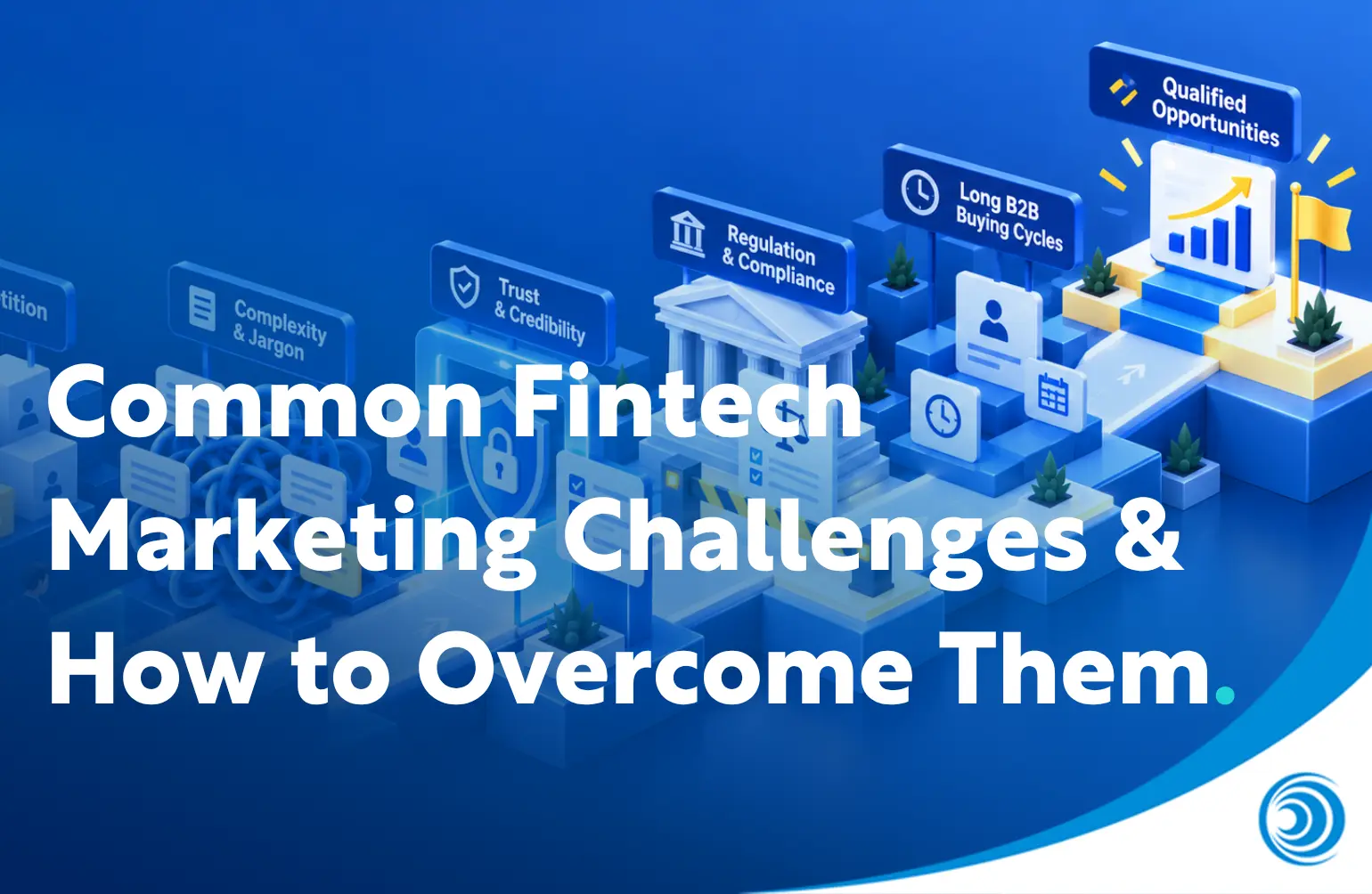
That is easier said than done. Fintech companies often sell complex technology, financial infrastructure, or entirely new ways of doing something customers already know how to do. They are competing in a crowded market, speaking to audiences with very specific needs, and in many cases, asking customers to trust them with their money or sensitive data. Add regulation, long B2B buying cycles, and a dynamic industry shaped by rapidly changing technology into the mix, and even a strong product can struggle to get the attention it deserves.
The fintech marketing challenge therefore is about achieving more than just generating visibility. It needs to make complexity understandable, give unfamiliar brands credibility, reach the right decision-makers, and turn interest into meaningful commercial opportunities.
The article explores the key fintech marketing challenges businesses face and, more importantly, how to overcome them.
Differentiating Your Fintech in a Crowded Market
Fintech is a crowded place to be. There are an estimated 30,000 fintech startups globally, spanning payments, digital banking, wealth management, lending, embedded payments, and financial infrastructure.
And from a marketing perspective, that creates an awkward problem: when thousands of businesses are competing for attention and so many claim to be innovative, secure, seamless, and customer-centric, those words stop doing much heavy lifting.
And spare a thought for anyone brand new to the fintech industry – it’s just a bowl of jargon soup.
Differentiation needs to go deeper than describing what a product does. It needs fintech marketing that fully understands what matters to the target audience, where competitors leave gaps, and what your business can credibly own. That might be a particular customer problem, a specialist market, a distinctive approach to payment processing, or an experience that removes friction elsewhere in the financial journey.
Sometimes fintech marketing heads will need to have difficult discussions with their leadership colleagues. What the CTO thinks is impressive may not always be what aligns with the needs of prospective customers.
The strongest fintech marketing strategies make that difference obvious early. A prospect should not have to conduct a forensic investigation of your website to work out why your solution is relevant to them.
Finding Meaningful Points of Differentiation
Start with the problem rather than the product.
A fintech may have built impressive technology, but technical sophistication is not automatically a compelling reason to buy.
Customers are usually interested in what that technology helps them achieve: entering a new market, reducing payment friction, improving security, accessing better data, or making a previously painful process considerably easier.
If the root problem is not really a significant challenge for the buyer, there’s unlikely to be significant demand for the product. In fact, 35% of startups fail due to lack of market need and compliance issues.
This is where competitor research, customer insight, and a a strong understanding of the target audience becomes particularly valuable. Look beyond surface-level features and examine how competitors position themselves, which audiences they prioritise, and where their messaging starts to blur into the same familiar fintech language.
Meaningful differentiation can come from surprisingly specific places. A payment provider might understand a particular vertical better than its competitors. A wealth management platform might be designed around a particular customer need that larger providers overlook. A fintech startup might offer a genuinely different user experience rather than simply another version of an established financial product.
The important thing is that the distinction has to matter to the customer. Being different for the sake of being different is branding theatre; being different in a way that solves a valuable problem gives marketing something useful to work with.
Avoiding Generic Fintech Messaging
There is a particular kind of lazy fintech copy that appears everywhere: “transforming finance”, “empowering businesses”, “unlocking innovation”, “delivering seamless experiences”. It sounds suitably impressive until you realise it could describe hundreds of competitors.
And this kind of generic marketing is easy to ignore. 81% of consumers reportedly ignore generic marketing, making relevance important when businesses are competing for already-limited attention. For fintechs, vague messaging creates an even bigger problem. If a potential customer cannot quickly tell what a business actually does, who it is for, or why it is different, there is little reason to keep reading – let alone start a conversation.
Effective fintech marketing and messaging should be specific enough to make the right audience think, “that’s for me”. That means naming the problem, being clear about the audience, and connecting the product to a tangible outcome. Technical language still has its place, particularly when speaking to specialist buyers, but it should clarify the proposition rather than obscure it.
It is also worth resisting the temptation to make every message sound revolutionary.
When fintech first shook up traditional financial institutions and their tired over a decade ago, it was easier to make big and even provocative statements to grab the attention of hitherto underserved customers. The gap between legacy and fintech financial services was huge and the boldness of those fintech marketing messages gleefully exposed this – but things have changed.
Today, not every fintech needs to claim it is reinventing our industry. Sometimes the strongest positioning and customer engagement comes from being exceptionally clear about a narrower promise – and then proving that you can deliver it.
Explaining Complex Fintech Products Simply
Fintech products can involve some seriously complicated technology. APIs, payment infrastructure, machine learning, tokenisation, and zero-knowledge proofs might all be important to how a solution works, but that does not mean they belong in the first sentence of the marketing.
The challenge is translating technical detail into something a buyer can quickly understand without stripping away the substance.
Balancing Simplicity With Technical Accuracy
Simplifying a fintech product does not mean making it sound simplistic, but giving customers the information they need in language they can actually use.
This is particularly important when marketing financial services, where inaccurate or over-simplified claims can create confusion and raise regulatory compliance concerns. Fintech marketers need to work closely with product and compliance teams to make sure messaging is both accessible and accurate.
The best fintech marketing strategies also recognise that different audiences need different levels of detail. A technical buyer may want to understand the underlying infrastructure, while a senior decision-maker may be more interested in implementation, risk, and commercial impact.
Good content gives each audience a way into the conversation without making everyone wade through technical jargon.
Communicating Benefits Rather Than Features
A list of product features rarely tells a potential customer why they should care.
“Machine learning-powered fraud detection” describes a capability. Explaining how it can identify suspicious activity while reducing unnecessary friction starts to communicate the benefit. Likewise, “multi-currency payment processing” becomes more meaningful when customers understand how it can help them accept payments across new markets.
This shift from features to outcomes is particularly important for fintech startups and businesses where customer engagement and conversion is vital for profitability.
The technology may be impressive, but marketing needs to connect it to something tangible: saving time, reducing risk, improving customer experience, increasing accessibility, or helping drive growth.
Building Trust in an Industry Where Trust Is Essential
One of the fintech industry’s unique challenges is its need to ask customers to hand over more sensitive information including digital payment details or personal data. Historical consumer behaviour has shown that customers remain concerned about data security and the disclosure of such information.
Consumer trust is therefore a marketing issue as much as a product or security issue. 81% of consumers state that trust is a mandatory requirement before making a purchase, so an unfamiliar fintech brand has to establish credibility early in the journey.
This has been one of the key challenges for new fintechs offering innovative solutions in the Open Banking space.
Demonstrating Credibility as a New or Unfamiliar Brand
For established financial institutions, years of history and a physical presence often provide an immediate sense of familiarity. Fintech startups offering new innovative solutions are unlikely to have that same advantage.
Marketing therefore has a crucial role in showing potential customers that the business is credible. Clear information about security, regulatory adherence, partnerships, certifications, and expertise can all help reduce uncertainty. So can strong customer evidence, including case studies, testimonials, and recognisable third-party endorsements.
The aim is not to throw every possible trust signal onto a homepage. It is to answer the concerns a potential customer is likely to have before they even need to ask.
Using Evidence & Trust Signals Throughout the Buying Journey
Trust should not disappear after the first interaction. A customer researching a fintech solution may encounter a blog, social media post, search result, sales presentation, and product page before making a decision. Each touchpoint contributes to their perception of the brand.
This is where useful, evidence-led content can make a difference. Educational resources, transparent product information, and clear explanations of data privacy and security can help fintech companies build credibility while addressing consumer concerns.
For fintech marketers, building trust is less about making bigger claims and more about giving customers enough evidence to believe the claims being made.
Marketing Within a Regulated Industry
Regulatory compliance is one of the biggest challenges for fintech marketing. Financial promotions, consumer protection, and data privacy requirements can all place limits on what a business can say and how it can say it.
GDPR and CCPA also impose strict guidelines on personal data handling.
All this can make creativity feel harder to achieve, particularly when marketing teams are working with complex financial products. The answer is to bring compliance into the marketing process without allowing it to flatten the brand’s voice.
Bringing Marketing & Compliance Together Earlier
Compliance works better when it is part of the process from the beginning rather than the final checkpoint before a campaign goes live.
Marketing teams should understand the relevant regulatory requirements early, particularly around claims, financial promotions, and consumer-facing content. Working alongside compliance colleagues from the outset can reduce last-minute rewrites and help marketers understand where there is room to be creative.
It can also strengthen the marketing itself. When regulatory requirements are understood early, marketers can build accurate claims, evidence, and relevant trust signals into campaigns rather than trying to retrofit them later.
Maintaining Creativity Without Making Unsupported Claims
Regulation does not mean every fintech campaign needs to sound like a legal document. There is still plenty of room for personality, clear messaging, and compelling creative, provided claims can be substantiated.
For fintech businesses, compliance can therefore become part of the story rather than something hidden in the small print. Clear information about licensing, security, and regulatory adherence can give potential customers useful evidence while allowing the wider marketing to focus on the value of the product.
Reaching Highly Specific Fintech Audiences
Even a well-defined target audience is not much use if your marketing never reaches them. Fintech businesses can easily spread their budget across SEO, PPC, social media, email, events, and content without knowing which channels actually influence their potential customers.
The better approach is to choose communication and marketing channels based on how your audience already researches, compares, and buys. A B2B fintech targeting senior financial decision-makers will have very different channel priorities from a consumer digital banking app trying to attract new users.
Identifying the Customers With the Greatest Commercial Potential
Channel selection should follow audience behaviour rather than simply following popular marketing trends. Research where your target customers spend time, what they search for, which publications they trust, and how they prefer to consume information.
That focus makes budgets work harder. Instead of spreading resources thinly across every available platform, marketing teams can concentrate on the channels with the strongest potential to generate engagement and qualified leads.
For smaller fintech businesses in particular, mastering two or three effective channels is often more useful than trying to maintain a presence everywhere.
Choosing Channels Based on Your Audience
The right channel can also improve the quality of engagement. When content fits the way an audience prefers to read, watch, or listen, it is more likely to feel relevant than intrusive.
It also makes performance easier to measure. Concentrating marketing efforts around the channels that genuinely influence your target market gives teams clearer data on engagement, lead conversion, and customer acquisition.
That makes it easier to test, refine, and scale what works – rather than continuing to spend money on empty views simply to fall in line with the latest emerging trends.
Marketing to Multiple Decision-Makers
In B2B fintech, there is rarely one person sitting at a desk deciding whether to buy. A typical B2B fintech buying decision involves 6 to 10 stakeholders on average, while complex enterprise deals can involve 12 or more.
Each stakeholder can have different priorities, concerns, and reasons for saying yes – or no. Marketing that speaks only to the person who first fills in a form is likley to leave everyone else unconvinced.
Understanding the Fintech Buying Committee
A CFO might want to see the commercial case and understand costs. A CTO will be looking at integration, infrastructure, and security. A compliance leader needs confidence around regulatory requirements, while a head of product may care more about implementation and customer service.
That means one piece of content can rarely do everything. A fintech selling payment infrastructure, for example, could create a detailed integration guide for technical teams, an ROI-focused piece for finance leaders, security and compliance resources for risk teams, and a customer case study demonstrating the impact on the end user.
Creating Content for Different Stakeholders
Good fintech content gives each decision-maker a reason to keep engaging while maintaining a consistent overall propositon.
That could mean an explainer video for a time-poor executive, technical documentation for developers, a regulatory checklist for compliance teams, or a detailed case study for procurement. The format can change too: webinars, white papers, comparison pages, interactive tools, and targeted email content can all play different roles throughout the buying journey.
The aim is not to create fintech marketing strategies that are fuelled by endless (and pointless) content. It is to understand who is involved in the decision and make sure marketing has something useful for the questions each stakeholder is likely to ask.
Managing Long B2B Fintech Sales Cycles
Fintech sales rarely happen overnight. The overall median length of a B2B sales cycle is around 84 days, and complex financial products can take considerably longer when multiple stakeholders, technical requirements, and regulatory considerations are involved.
That creates a challenge for marketing: how do you stay useful and relevant when a potential customer is interested, but nowhere near ready to buy?
Creating Value Before a Prospect Is Ready to Buy
Not every website visitor is looking for a sales call. Some are researching a problem, comparing potential solutions, or trying to understand whether a particular technology is even relevant to their business.
Marketing can support that research phase by answering the questions prospects are likely to have befoe they reach out. Educational content, practical guidance, and clear product information can help a fintech stay on the radar while a potential customer works through their options.
This is particularly important when the product involves significant investment or operational change. The more a buyer needs to understand before committing, the more opportunities there are for useful marketing to influence the decision.
Nurturing Prospects Over Time
An initial enquiry should not be treated as ‘job done’ for marketing. Prospects can go quiet for legitimate reasons: budgets change, priorities move, internal approvals take longer, or the project gets pushed back.
Consistent, relevant communication keeps the relationship warm without constantly asking for the sale. Sharing new research, useful insights, product developments, or evidence from existing customers gives prospects a reason to re-engage when the timing becomes right.
For fintech businesses with lengthy sales cycles, marketing and sales need to work together around the whole buying journey rather than treating lead generation as the finish line. Marketing efforts of fintech companies (and executive expectation) therefore need to recognise that customer acquisition is a marathon rather than a sprint
Generating Qualified Leads Rather Than Just More Leads
A healthy lead count can look impressive in a marketing report. It does not necessarily mean the sales pipeline is healthy.
Fintech companies often operate in specialist markets with relatively small pools of potential customers, making lead quality particularly important. Hundreds of irrelevant enquiries are unlikely to be more valuable than a smaller number of prospects that genuinely fit the target market and have a reason to buy.
Defining What a Valuable Lead Looks Like
Marketing and sales should agree on what makes a lead worth pursuing. That might include company size, industry, location, budget, technical requirements, or a particular business problem the fintech solution is designed to solve.
This gives marketing a clearer target when planning campaigns and helps avoid optimising purely for volume. A PPC campaign that generates plenty of form fills, but very few relevant opportunities may look successful on the surface while quietly wasting budget.
Connecting Marketing Activity With Sales Outcomes
Lead generation becomes much more useful when marketing can see what happens after a prospect enters the pipeline. Which campaigns generate sales conversations? Which sources produce opportunities that progress? Where do leads drop out?
Tracking these outcomes helps marketing teams invest more heavily in activity that contributes to measurable growth and customer retention, rather than simply chasing traffic or impressions. It also gives sales a stronger feedback loop, allowing both teams to refine targeting and messaging based on what is actually converting.
One of the thorniest issues for any commercial business is the relationship between its sales and marketing functions. Fintech companies will often hire a CMO and Head of Sales that will both be experienced and forceful characters at a similar organisational level.
Marketing strategies are therefore often independent from Sale strategies. While both will have financial goals at their heart, the tactical achievement of thes key business goal can leave potential new customers feeling they are dealing with two separate fintech companies. In simplified terms, the social media and paid ads carry one message for a specific vertical while the sales team at an event targets new customers with an entirely different proposition.
It’s not the kind of cohesive and user-friendly experience that builds brands or attracts the right customers. And it’s not one of those unique challenges for the fintech industry. The answer to the problem demands the creation of shared reference materials and interactive tools, particularly those that call out and address points of conflict between the sales and marketing strategies.
Creating Fintech Content That Stands Out
Fintech businesses have access to plenty of specialist knowledge. The problem is that much of it never makes it into the marketing – or arrives as a heavily sanitised version of what the experts actually know.
The result is content that sounds polished but says very little. For an industry dealing with complicated products, changing regulations, and emerging technology, that is a missed opportunity.
Moving Beyond Generic Thought Leadership
The people closest to a fintech’s products and customers often have the most interesting insights. Sales teams know which objections keep coming up for the right customers. Product teams know where customers misunderstand the technology. Compliance specialists know which regulatory changes are likely to create headaches.
Those insights can become far more useful marketing than another generic industry overview. A sales team’s recurring objection could become a practical guide. A product expert’s explanation of a technical development could become an article that makes the subject accessible. Customer questions can reveal entire areas of content that competitors have overlooked.
The trick is getting that knowledge out of people’s heads and into something customers can actually use and begin building trust in your brand.
Turning Specialist Expertise Into Useful Content
Good content marketing also needs a reason to exist beyond filling an editorial calendar. That might mean analysing an emerging trend, challenging an assumption, explaining a complicated development, or offering a genuinely useful perspective on a problem facing the market.
This is particularly valuable for fintech companies competing in specialist niches, where there may be fewer searches but much greater commercial intent. A detailed piece answering a very specific question can attract a smaller audience and still be considerably more valuable than a broad article chasing traffic.
The strongest fintech content marketing leaves the reader knowing something they did not know before – or seeing a familiar problem differently. This is what gives marketing substance rather than simply adding to the pile.
Competing for Organic Search Visibility
Fintech SEO can be an awkward balancing act. The biggest keywords often have the most competition, while highly specific searches may attract far fewer people. Chasing volume alone can therefore send marketing teams in the wrong direction.
Targeting Valuable Searches With Low Search Volumes
Search volume is an obvious metric to look at when developing an SEO strategy, but it does not tell the whole story.
As a HubSpot Community member puts it: “We often judge keywords mainly by search volume, but a keyword with 500 searches can sometimes bring more use than one with 20,000 searches if the intent is much clearer.”
For fintech businesses, that distinction matters. Someone searching for ‘payments’ could be researching an industry concept, while someone searching for ‘payment gateway for SaaS businesses’ has already revealed considerably more about what they need.
Specific product, problem, and comparison searches can therefore be highly valuable, even when the potential audience is smaller. They can also give fintech companies opportunities to compete in specialist areas where broad, high-volume terms are dominated by much larger financial brands.
Building Authority in Competitive Fintech Topics
Ranking for valuable searches takes more than inserting keywords into a page. Search engines need signals that a business understands its subject and can provide a useful answer.
That means building depth around important topics, demonstrating genuine expertise, and supporting claims with credible evidence.
It also means thinking beyond the company’s own website: industry coverage, expert contributions, relevant links, and other third-party references can all strengthen a fintech brand’s wider authority.
Adapting to AI Search & Changing Discovery Behaviour
For years, fintech markets have focused on getting found when someone searches Google. But there is another route into the buying journey: asking AI.
More than half of consumers now use AI tools such as ChatGPT to discover new brands. That matters for fintech businesses because people are not necessarily searching for a company by name. They might ask an AI tool for a payment solution, compare providers, or recommend a fintech for a particular need.
The implication is significant: being visible in traditional search is no longer the entire discovery journey. Fintech marketing strategies need to account for the questions potential customers are asking, and the information AI systems use to formulate their answers.
Making Fintech Content Easy for Humans & AI to Understand
AI systems need clear, authoritative information to understand what a fintech business does and where it fits. That makes the fundamentals of good content even more important.
Pages should answer specific questions clearly, explain specialist terminology where necessary, and make important information easy to identify. Consistent messaging across the website also helps reinforce what the business offers, who it serves, and where makes its fintech solutions relevant.
This does not mean writing content just for machines. Useful, well-structured content gives human readers a better experience too. The difference is that fintech marketers now need to consider both the person reading the page and the AI systems that may use its information to answer someone else’s question.
Building Authority Beyond Your Own Website
AI search also makes the wider digital footprint of a fintech even more important. Your website can tell people that you are an expert. Third-party credibility gives them independent evidence to back it up.
Digital PR has an important role to play. Coverage in relevant fintech and financial services publications, like Finextra or The Financial Times, can reinforce a brand’s expertise and give potential reasons to trust it.
Awards can do something similar, particularly when they recognise specific achievements rather than simply adding another logo to a website. Speaking opportunities, expert commentary, research, and credible industry partnerships all strengthen that picture.
These signals matter because fintech businesses are asking customers to trust them with important financial decisions. When a brand is consistently referenced, quoted, recognised, or recommended outside its own marketing, it creates a much stronger body of evidence around its expertise.
That wider credibility can also support AI visibility. AI systems draw on information beyond a company’s own website when building an understanding of brands and topics.
The more credible, relevant evidencr that exists across the wider fintech ecosystem, the more context there is for both potential customers and AI tools to discover what a business knows and does.
Building Brand Awareness Before Buyers Enter the Market
There is a slightly awkward truth about fintech marketing: you can have a brilliant product and still be virtually invisible.
Brand awareness takes time, particularly when a fintech is entering a bustling market alongside established financial institutions and better-known competitors.
And for many potential customers, the first time they hear about a brand is long before they have any immediate need for its product.
That makes awareness more than a vanity metric. High-equity and familiar brands achieve 40-60% higher customer lifetime value compared with category averages, as familiarity and recognition help build the trust that encourages customers to keep coming back.
Balancing Brand Building With Short-Term Lead Generation
It can be tempting to focus every marketing effort on people who are ready to buy. After all, leads are easier to put into a report than familiarity.
But fintech buying journeys do not always work that neatly. A prospect might encounter a brand through an industry article, see it at an event, or hear an expert mention it months before they actually need a new financial service or fintech solution.
Consistent brand activity keeps the business familiar during that gap. Content, PR, social media, events, and thought leadership can all contribute to that familiarity while also supporting more immediate customer acquisition activity.
Staying Visible Between Buying Cycles
A buying cycle is simply the period from a customer recognising a need through to researching options, comparing providers, getting internal approval, and eventually making a purchase.
In fintech, that process can take months or even longer, particularly when changing a payment provider, banking platform, or financial infrastructure involves building trust across multiple stakeholders.
For example, a business might not be actively looking for a new payment provider today. Six months from now, it could decide to expand into new markets and realise its existing provider cannot support the currencies or payment methods it needs. At that point, the business starts researching alternatives – and the fintech brands it already recognises have a head start.
That is why disappearing between sales opportunities can leave a brand starting from scratch every time a buying cycle begins. Consistent marketing keeps the business familiar while potential customers are researching, planning, and waiting for the right moment to act.
The goal is to build enough recognition that when the need eventually arises, the fintech is already part of the conversation.
Proving the ROI of Fintech Marketing
“Marketing is working” is not a particularly useful answer when the CFO asks what the budget delivered.
For fintech businesses, proving ROI can be complicated by long sales cycles, multiple decision-makers, and customers who may interact with a brand many times before becoming an opportunity.
That does not mean marketing performance cannot be measured, but looking beyond the easiest numbers to count.
Looking Beyond Traffic, Impressions & Lead Volumes
Website traffic, impressions, social engagement, and content downloads can all tell you something about marketing performance. They should not be the whole story.
Fintech marketers should track metrics that reflect what they are actually trying to achieve. Depending on the strategy. That could include:
- Brand Awareness: Branded search volume, direct traffic, share of search, and media coverage.
- Engagement: Time on page, returning visitors, content engagement, and email engagement.
- Lead Generation: Qualified leads, cost per lead, and lead-to-MQL conversion rates.
- Pipeline: Opportunities generated, marketing-sourced pipeline, and opportunity conversion rates.
- Revenue: Customer acquisition cost, customer lifetime value, marketing ROI, and revenue influenced by marketing.
The right metrics will definitely depend on the goal of the business. A fintech focused on entering a new market may need to prioritise awareness and engagement, while an established enterprise may be more interested in customer acquisition.
Connecting Marketing With Pipeline & Revenue
The real value comes from connecting those metrics together.
If a content campaign generates 10,000 visits but no meaningful opportunities, it tells a very different story from a smaller campaign that attracts 500 highly relevant visitors and generates several sales conversations. Likewise, a PR campaign might not produce an immediate lead, but could increase branded searches, support sales conversations, and contribute to opportunities later in the buying journey.
Marketing and sales therefore need shared visibility of what happens after a lead is generated. Tracking which campaigns and channels contribute to opportunities, conversion, and revenue makes it easier to identify where marketing is genuinely driving growth – and where it needs to change.
For fintech busineses, proving ROI is ultimately about moving the conversation from “How much activity did we generate?” to “What did that activity help the business achieve?”
Keeping Up With a Rapidly Changing Fintech Market
Fintech doesn’t tend to sit still for long. New technologies appear, regulations change, competitors launch new products, and expectations among the user base shift – sometimes all within the same quarter.
For marketing teams, keeping up with all of this can create a difficult balance. Move too slowly and the brand risks looking out of touch. Chase every new development and the marketing strategy starts to feel like it was assembled from whatever happened to be trending that week.
Responding to New Technologies, Regulations & Competitors
Fintech marketers need a clear view of the developments that could actually affect their audience and proposition.
That might mean responding to the growth of digital payments, explaining what a regulatory requirement means for customers or helping prospects understand how an emerging technology could change their operations. The most useful marketing does not simply announce that something new exists. It explains why it matters.
This is also where internal expertise becomes valuable. Product, sales, compliance, and leadership teams are often closest to the changes affecting customers. Turning that knowledge into timely content can help a fintech demonstrate that it understands where the market is heading, rather than simply reacting after everyone else has already written about it.
Adapting Without Constantly Changing Strategy
Being responsive does not mean changing the entire marketing strategy every time a new trend appears.
A fintech should have a clear understanding of its user base, positioning, and business goals, then use those foundations to decide which market developments deserve attention.
Some trends will be highly relevant to the customers the business wants to reach. Others will be interesting but commercially insignificant.
A consistent strategy gives marketing teams something to build on, with enough flexibility to allow them to respond when customer behaviour, technology, or the wider fintech landscape genuinely changes.
Finding Marketing Partners Who Understand Fintech
Fintech marketing is difficult to do well without an understanding of the market itself. Complex products, specialist audiences, and rapidly evolving technology mean marketing partners need to understand what they’re communicating as well as how to communicate it.
Blue Train Marketing has specialised in fintech, payments, and financial services since 2014, helping businesses build stronger brands, increase visibility, and turn marketing activity into meaningful commercial opportunities.
From brand and messaging to content, SEO and LLM visibility, PPC, and lead generation, our in-house team brings the specialist knowledge needed to make fintech marketing work harder.
If you’re looking for a marketing partner that truly understands fintech, let’s talk.
