
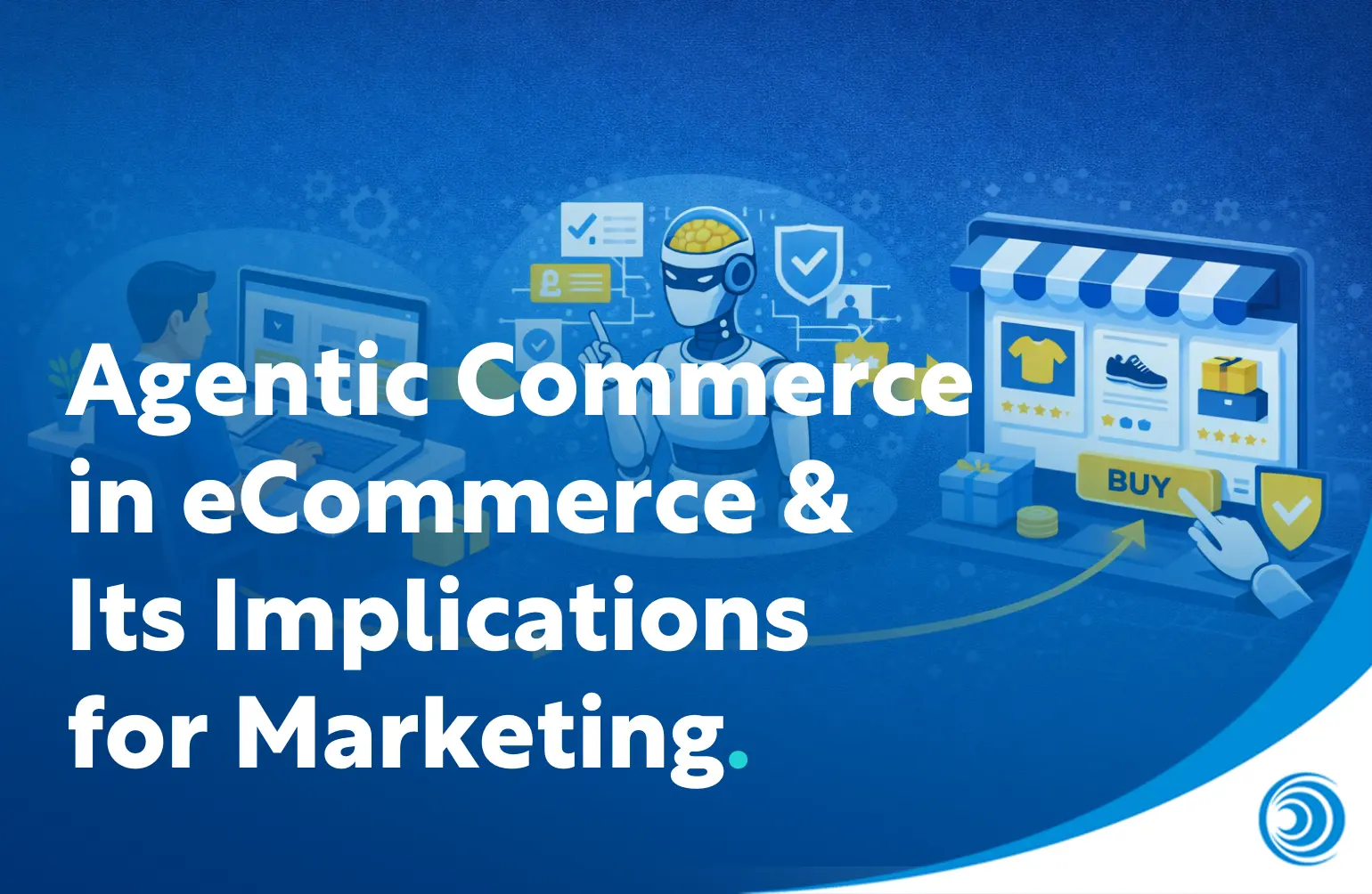
Agentic commerce refers to the application of agentic AI within digital commerce environments. It describes a shift in how decisions are made within eCommerce systems, where autonomous AI agents act on behalf of users or organisations. As agentic AI systems become capable of managing discovery, comparison, purchasing, and post-purchase actions, decision-making increasingly moves from direct consumer interaction toward delegated, AI-mediated processes.

In practical terms, this means commercial influence is no longer exercised solely through human attention. It is used through systems that evaluate information, apply constraints, and execute decisions.  In this model, marketing influence depends less on persuasion alone and more on structured, verifiable information that artificial intelligence systems can evaluate. Brands must therefore operate in environments where both human consumers and AI agents shape commercial outcomes.

eCommerce decision-making is increasingly mediated by artificial intelligence.  Systems that once supported discrete functions – such as search ranking, product recommendations, or customer service automation – now influence how choices are presented, evaluated, and acted upon across the digital commerce journey.

Industry research suggests this shift is accelerating, with over half of customer interactions expected to be handled by AI-driven systems within the next twelve months (eCommerce North America). While adoption varies by market and use case, the overall direction is clear: AI is moving closer to the centre of commercial decision-making.

This progression from assistive AI to agentic AI is occurring against a backdrop of rising complexity. eCommerce platforms now expose consumers to vast product catalogues, multiple sellers, fluctuating prices, and layered considerations such as delivery options, returns, compliance, and trust signals. Navigating these environments requires increasingly sophisticated evaluation, often across dimensions that are difficult to assess quickly or consistently. As a result, the effort required to make informed purchasing decisions grows.

Traditional approaches to eCommerce personalisation and automation were designed to ease this burden, but they operate within defined constraints. Recommendation engines and ranking systems optimise based on past behaviour or predefined objectives. Rule-based automation executes specific actions at scale. Assistive AI tools respond to prompts or inputs provided by users. These systems remain largely reactive, supporting individual interactions rather than managing decisions across time or contexts.

Agentic AI is emerging as a response to these limitations. Instead of supporting isolated steps, agentic systems are designed to pursue goals, make ongoing decisions, and act within boundaries on behalf of users or organisations. In eCommerce environments, this introduces a shift from direct interaction toward delegation, where AI agents may search, evaluate, and act without requiring continuous human input.

As this model develops, it raises fundamental questions about how eCommerce functions and how influence is exerted with it. When AI agents increasingly mediate discovery, evaluation, and purchasing, the assumptions that underpin traditional marketing begin to change.

Understanding agentic AI in eCommerce is, therefore, essential to understanding how marketing must adapt in AI-mediated commercial environments.

What is Agentic AI?

Agentic AI refers to artificial intelligence systems designed to pursue goals, make decisions, and take actions autonomously within defined constraints. Unlike many existing AI applications that respond to prompts, execute predefined rules, or optimise individual outcomes, agentic systems are capable of managing ongoing processes over time, adjusting their behaviour as conditions, inputs, and objectives change. 

In commercial and eCommerce contexts, agentic AI is distinguished by its capacity to act on behalf of a user or organisation. Rather than supporting isolated actions, an agentic system can evaluate options, weigh trade-offs, and decide what to do next in pursuit of an objective, without requiring continuous human direction.

The defining feature is not intelligence alone, but agency: the ability to initiate and adapt actions within a bounded scope.

Interest in agentic systems has increased as digital environments have become more complex and difficult to manage through manual interaction alone. Market research reflects this growing focus, with the AI agents market valued at approximately US $5.1 billion in 2024 (Electroiq) and projected to grow significantly over the coming decade. While such figures should be interpreted cautiously, they indicate sustained investment in systems designed to move beyond task-level automation toward autonomous decision-making.

While implementations vary, agentic AI systems typically share several core characteristics:

  • Goal-oriented behaviour, where actions are guided by objectives rather than fixed tasks.
  • Autonomy within constraints, operating independently but within rules, permissions, or policies set by humans.
  • Continuous decision-making, involving ongoing evaluation and adjustment rather than on-off outputs.
  • Context awareness and adaptation, using feedback and environmental signals to inform future actions.

How is Agentic AI Different from Automation or Recommended Systems?

Agentic AI is often discussed alongside other AI-driven systems used in eCommerce, but the differences are substantive rather than incremental. The distinctions below clarify what qualifies as agentic AI and what does not:

  • Automation systems execute predefined actions based on fixed rules or triggers. They operate at scale but do not evaluate alternatives or adjust behaviour when conditions change beyond their programming.
  • Recommendation systems analyse patterns and historical data to predict relevance or likelihood. They present options to users but do not make decisions or act on them.
  • Assistive AI tools respond to prompts, queries, or instructions from users. They support human decision-making but rely on continuous human initiation.
  • Rule-based systems follow explicit logic paths defined in advance. They do not adapt goals, manage trade-offs dynamically, or operate in the face of uncertainty.

Agentic AI systems, by contrast, are designed to pursue objectives, decide which actions to take, and act autonomously within defined constraints. They may draw on automation, recommendations, or rules as inputs, but they are not limited to executing them.

How Does Agentic AI Work in eCommerce?

In eCommerce, agentic AI systems operate by managing decisions across the commercial journey rather than supporting individual interactions in isolation. Their defining feature is that they evaluate options, apply constraints, and determine actions in pursuit of a defined objective.

Within eCommerce environments, agentic systems can support several stages of the journey:

  • Product discovery, where an agent identifies relevant products or sellers based on a defined goal rather than a single search query. This may involve monitoring multiple platforms, revisiting options as availability or pricing changes, or proactively surfacing alternatives as conditions evolve.
  • Comparison and filtering, where an agent evaluates products across multiple criteria simultaneously. Rather than ranking options on a single dimension such as price or popularity, an agent can balance trade-offs across factors including delivery terms, seller reliability, compliance requirements, or user-defined preferences.
  • Purchase execution, where an agent completes transactions within clearly defined permissions. This may include placing orders, selecting fulfilment options, or choosing payment methods once conditions are met, subject to budgets, approval rules, or other constraints.
  • Post-purchase decisions, where an agent continues to act after checkout. This can include tracking fulfilment, managing returns or disputes, identifying better alternatives for future purchases, or triggering reorders based on usage or availability. Post-purchase support is already a significant entry point for agent-led systems: some industry estimates suggest that 68% of customer service interactions could be handled by agent AI by 2028 (Cisco), reflecting how decision delegation is extending beyond discovery into service and lifecycle management.

Across all these stages, agentic systems depend on access to structured, consistent data. Product attributes, pricing, availability, policies, and historical outcomes shape how agents evaluate options and decide whether to act.

Broader adoption trends reinforce this reliance on AI-mediated decision-making. Global AI-enabled eCommerce activity reached approximately $8.65. billion by 2025, and around 80% of retail organisations have already adopted bot technology or indicate that they tend to do so (Electroiq). While not all such systems meet a strict definition of agentic AI, their prevalence illustrates the direction of travel toward delegated, AI commerce.

A further distinction in eCommerce contexts lies in who controls the agent.

Some agentic systems are designed to act primarily on behalf of users or organisations. In these cases, goals, constraints, and permissions are defined externally to any single platform, with the user-controlled agent representing the user’s interests across multiple sellers or marketplaces.

Other agentic systems are deployed and governed by the eCommerce platforms themselves. These platform-controlled agents operate within tightly defined boundaries set by commercial rules, data access policies, and regulatory obligations. Their autonomy exists only within the platform’s governance framework.

Recent platform responses illustrate how significant this distinction is in practice. For example, eBay has announced restrictions on third-party AI agents operating on its marketplace (Finextra), citing concerns related to control, data use, trust, and platform integrity. Such decisions demonstrate that agentic AI in eCommerce is shaped not only by technical capability, but by platform governance and commercial accountability.

Across both models, constraints and oversight remain central. Agentic AI does not imply unrestricted autonomy. Permissions, rules, budgets, and escalation mechanisms define what actions are allowed and when human intervention is required. Responsibility for outcomes ultimately remains with people and organisations, reinforcing the importance of transparency, auditability, and clearly defined control structures in AI commerce.

How Does Agentic AI Change the eCommerce Journey?

Agentic AI changes eCommerce journeys by shifting decision-making away from direct, step-by-step consumer interaction and toward delegated, AI-managed processes. Rather than following a linear path from discovery to purchase, agent-mediated journeys unfold through a series of structural changes:

  • From Browsing to Delegation: Instead of actively searching, filtering, and selecting products, consumers define goals and constraints – such as price limits, delivery preferences, or brand requirements – and delegate execution to AI agents. This behaviour is already socially acceptable across multiple categories. Around 70% of consumers would allow AI agents to book flights on their behalf, 65% would delegate hotel bookings, and more than 50% would permit AI agents to purchase electronics, beauty products, and clothing (Electroiq).
  • Compression of Evaluation Stages: In agent journeys, comparison and evaluation no longer occur as visible, sequential steps. Activities such as assessing options, weighing trade-offs, and revisiting alternatives are handled continuously by the agent. The consumer may only encounter the outcome of this process – a recommendation, shortlist, or completed purchase – rather than the intermediate decision points.
  • Reduced Direct Interaction Between Consumers and Brands: As agents take responsibility for discovery and evaluation, consumers interact less frequently with brand-owned channels, content, and interfaces. Brand assessment increasingly occurs through structured data and signals accessible to the agent, rather than through advertising, storytelling, or experiential design. Influence shifts from direct persuasion toward machine-interpretable inputs.
  • Emergence of New Intermediaries Between Customers and Sellers: AI agents begin to function as decision-making layers that sit between demand and supply. This extends beyond discovery into transaction execution. Mastercard’s completion of its first agentic payment transaction in Australia demonstrates how AI agents can be authorised to initiate and complete payments within predefined parameters (Finextra). In such models, payment becomes part of an agent-managed workflow rather than a discrete consumer action.

Together, these changes produce eCommerce journeys that are shorter, less visible, and less directly shaped by consumer attention. Decision-making is increasingly handled by systems optimised for goal fulfilment and constraint satisfaction.

This structural shift changes the mechanics of influence in commerce. Marketing strategies built primarily around awareness, persuasion, and repeated exposure must adapt to environments where evaluation is delegated to AI agents rather than conducted manually by consumers.

How Does Agentic AI Affect Marketing?

When discovery, evaluation, and purchasing are handled partially or entirely by AI agents, the foundations of traditional marketing – attention, persuasion, and direct engagement – operate under different constraints. Marketing does not lose relevance in agentic commerce; its function changes.

One of the most immediate effects is the reduced role of traditional persuasion. AI systems do not respond to emotional appeal, creative storytelling, or experimental design in the same way human consumers do. While these elements remain relevant where humans are directly involved, they carry less weight when decisions are filtered or executed by agents operating against defined criteria. Influence shifts away from messaging designed to persuade and toward information that can be evaluated, compared, and verified.

As a result, marketing places greater emphasis on the quality and structure of the information it produces and manages.

  • Structured, accurate product information becomes critical. Agentic systems rely on clearly defined attributes, specifications, policies, and constraints to evaluate options and make decisions. Inconsistent, incomplete, or ambiguous product data reduces an agent’s confidence and may result in exclusion from evaluation or selection. This requirement is reinforced by regulatory scrutiny. For example, the UK’s Financial Conduct Authority has launched reviews into the implications of advanced AI systems (Finextra), highlighting the need for accuracy, transparency, and accountability where automated decision-making affects customers.
  • Trust signals and credibility take on increased importance. When agents act on behalf of users, they must assess not only products but also sellers and platforms. Signals related to reliability, compliance, security, and past performance become key inputs into AI evaluation. Marketing materials that cannot be substantiated or reconciled with other data sources are less likely to influence agent-led decisions.
  • Consistency across channels and data sources becomes essential. Agentic AI systems often draw from multiple inputs simultaneously, including product feeds, platform data, third-party sources, and policy documentation. Discrepancies between what a brand claims in one environment and what is recorded elsewhere introduce uncertainty. For AI agents designed to minimise risk or satisfy constraints, such inconsistency can become a reason to deprioritise or exclude an option altogether.

Taken together, these nuances reposition marketing with eCommerce ecosystems. Marketing increasingly functions as:

  • An input for AI agents, supplying the structured data and signals that inform automated evaluation and decision-making.
  • A source of signals for AI evaluation, contributing to how products and brands are assessed against criteria such as suitability, reliability, and compliance.
  • A provider of machine-readable clarity, ensuring that information about products, policies, and propositions can be interpreted consistently by both humans and AI systems.

Marketing does not disappear, but its centre of gravity moves. Its influence is exercised less through direct persuasion and more through the accuracy, structure, and credibility of the information it contributes to AI commerce environments.

How Should Marketing Adapt for AI Agents vs Humans?

Marketing must increasingly address two distinct audiences simultaneously: human consumers and AI agents acting on their behalf. These audiences differ in how they interpret information, how they evaluate options, and how influence is exerted.

For humans, ambiguity can create intrigue. For AI agents, ambiguity creates uncertainty.  

Marketing for humans is shaped by perception, emotion, and context. Narrative, visual identity, tone of voice, and brand storytelling help create meaning and preference. Humans interpret information subjectively, weigh emotional cues, and may tolerate ambiguity or inconsistency when forming opinions or making decisions.

Marketing for AI agents operates under different conditions. AI agents do not interpret narrative or emotional resonance in the same way. They evaluate information against defined criteria, constraints, and objectives. For agents, influence depends on whether information is verifiable, structured, consistent, and aligned with decision rules. Ambiguity, contradiction, or unsubstantiated claims introduce uncertainty and reduce the likelihood that an option will be selected or acted upon.

These differences create a clear contrast in information needs:

  • Humans respond to storytelling, differentiation, and experimental cues, and can integrate incomplete or subjective information into decision-making.
  • AI agents rely on structured data, explicit attributes, policies, and signals that can be compared, validated, and reconciled across sources.

Despite these differences, the two audiences will coexist. eCommerce environments will continue to involve human judgement, oversight, and emotional engagement, particularly for high-consideration purchases, brand-led categories, and trust-sensitive decisions. At the same time, AI agents will increasingly manage evaluation and execution, especially where efficiency, scale, or complexity make delegation attractive.

This dual-audience reality has direct implications for marketing practice. Content and messaging must support both interpretive and computational evaluation. Brand narratives and experimental elements remain relevant for human engagement, but they must be underpinned by accurate, structured information that AI agents can process. Claims, product details, and policies must be consistent across channels to avoid conflict between human-facing and machine-facing representations.

Governance also becomes important. As marketing outputs feed both human perception and AI-mediated decision systems, organisations must manage how information is created, validated, updated, and distributed. Clear ownership of product data, messaging standards, and compliance oversight helps ensure that marketing serves both audiences without introducing risk or inconsistency.

What Risks Does Agentic AI Create in eCommerce?

Questions of control, accountability, and risk come to the forefront as agentic AI systems assume greater responsibility in eCommerce. Systems that can autonomously evaluate options, act on behalf of users, and execute transactions introduce new forms of exposure for businesses, platforms, and consumers. Managing these risks is a prerequisite for deploying agentic commerce at scale.

Transparency & Explainability

Agentic AI systems often make decisions continuously and across multiple stages of the eCommerce journey. This can make it difficult to explain why a specific product was selected, a transaction was executed, or an option was excluded.

In commerce contexts where decisions affect financial outcomes, access to services, or contractual terms, a lack of explainability creates challenges for trust, dispute resolution, and regulatory compliance.

Bias & Optimisation Risks

Because agentic AI systems optimise toward defined objectives, any bias embedded in training data, decision rules, or optimisation criteria can be amplified. Unlike assistive systems, agentic AI may act autonomously across large volumes of transactions, increasing the speed and reach of biased outcomes.

The commercial consequences of such failures are already evident: 36% of companies report that AI bias has directly harmed their business, with 62% experiencing revenue loss and 61% losing customers as a result (All About AI) – unmanaged bias presents both financial and reputational risk.

Human Accountability & Oversight

Agentic AI does not eliminate responsibility for decisions; it changes how responsibility is exercised. Organisations remain accountable for the actions taken by systems they deploy or permit to operate.

Effective oversight requires clearly defined limits on agent autonomy, escalation mechanisms for exceptions, and the ability for humans to audit decisions, intervene when necessary or suspect agent activity. Human-in-the-loop and human-on-the-loop models remain integral, particularly where decisions have a significant consumer or financial impact.

Regulatory & Ethical Considerations

Regulatory frameworks are increasingly addressing the risks associated with autonomous AI systems. Under the EU AI Act’s risk-based approach, AI systems that autonomously influence purchasing decisions, process sensitive customer data, or affect access to financial services are expected to be classified as high-risk (CMS LAW-NOW).

For agentic commerce, this classification brings specific obligations related to data quality, transparency, record-keeping, risk management, and human oversight.

The act also prohibits manipulative AI practices and introduces substantial penalties for non-compliance, reinforcing the need for robust governance where autonomous systems influence commercial decisions.

How Can Businesses Assess Readiness for Agentic AI?

Readiness for agentic AI in eCommerce is less about introducing new capabilities and more about whether existing commercial foundations can support autonomous decision-making.

It concerns structural preparedness rather than technical experimentation.

In practice, organisations tend to assess readiness through a small number of structural considerations:

  • Whether Commercial Data Can Be Interpreted Without Human Context: Agentic systems require product, pricing, and policy information to be sufficiently explicit and structured that decisions can be made without clarification or interpretation.
  • Whether Product Information Resolves to a Single Version of Truth: In agent-mediated evaluation, conflicting representations of the same product or service introduce uncertainty. Readiness depends on whether information remains consistent across the environments from which agents draw signals.
  • Whether Boundaries for Autonomous Action Are Clearly Defined: Agentic AI operates within constraints. Readiness reflects how clearly permissions, limits, escalation paths, and accountability are specified when decisions are delegated to systems rather than people.
  • Whether Agent Behaviour Aligns with Trust & Compliance Expectations: When AI agents act on behalf of an organisation, their decisions affect customer trust and regulatory exposure. Readiness therefore, includes alignment with brand commitments, consumer protection standards, and applicable regulatory frameworks.

These considerations do not determine how agentic AI should be used, but whether it can operate coherently and responsibly within an organisation’s existing eCommerce and governance framework.

How Specialist Agencies Support This Transition

Some organisations may decide to engage with specialist agencies to help interpret how these changes affect existing marketing models and governance structures.

Blue Train Marketing is a specialist agency helping organisations understand how emerging AI-driven eCommerce models affect marketing strategy, content, and governance. Its role in this context is not to promote specific tools or tactics, but to support a clearer understanding of how agent-driven commerce alters discovery, evaluation, and decision-making.

Such support typically focuses on developing a strategic understanding of how AI systems interact with marketing inputs, enabling cross-functional alignment between marketing, technology, data, and compliance teams. It also includes helping organisations consider the responsible application of AI in marketing contexts – particularly where accuracy, trust, and regulatory obligations shape how information is created and used.

In this capacity, specialist agencies function as interpreters between evolving AI capabilities and established commercial practices, supporting organisations as they adapt marketing frameworks to AI commerce workflows.

Future Directions in Agentic AI & eCommerce

As agentic AI continues to develop, several structural trends are emerging that are likely to shape its evolution. These directions do not imply fixed outcomes or timelines, but they indicate areas where agent commerce is becoming more formalised, governed, and interconnected.

Growth of Agent-to-Agent Interactions

One notable development is the increasing role of agent-to-agent interactions. AI agents may not operate in isolation, but instead communicate with other agents representing platforms, sellers, logistics providers, or financial institutions. Through these interactions, agents can exchange information, negotiate constraints, and coordinate actions across systems.

Research into multi-agent systems shows that collaboration can occur through explicit communication, such as structured message exchanges, or implicitly, through observation and response to other agents’ actions (Medium). Standardised communication protocols, including established agent messaging frameworks, enable agents to interpret intent, share state, and respond consistently.

In eCommerce context, this opens the possibility of automated coordination across discovery, fulfilment, payment, and post-purchase processes without direct human involvement at each step.

Standardisation of Product & Commercial Data

As AI agents become more involved in evaluating and executing commerce decisions, pressure increases to standardise how product and commercial information is represented. Agentic systems depend on clearly defined attributes, policies, and constraints to function reliably. Inconsistent or ambiguous data limits interoperability between agents and increases the risk of incorrect decisions.

Future developments are therefore likely to emphasise shared schemes, common data formats, and interoperable representations of product information, pricing, availability, and policies. Standardisation supports more consistent agent behaviour and enables agent-mediated evaluation to occur across platforms and ecosystems rather than within isolated environments.

Increased Regulation & Oversight

Regulatory attention is also expected to intensify as agentic commerce becomes more prevalent. Existing frameworks, such as risk-based AI regulation, already signal that systems capable of influencing financial decisions or acting autonomously on behalf of users will be subject to heightened scrutiny.

For agentic AI in eCommerce, this implies continued emphasis on transparency, accountability, auditability, and human oversight.

Rather than constraining development, regulation is likely to shape where and how agentic systems are deployed, reinforcing the need for clearly defined boundaries and governance mechanisms.

Continued Importance of Human-in-the-Loop Models

Despite increasing autonomy, human involvement is expected to remain a defining feature of agentic commerce systems. Human-in-the-loop and human-on-the-loop models provide oversight, exception handling, and accountability for decisions made by agents.

This may include approval thresholds for purchases, review mechanisms for disputed outcomes, or governance processes for updating agent objectives and constraints. The persistence of human oversight reflects both regulatory expectations and the practical need to manage risk in complex commercial environments.

Together, these directions suggest that agentic AI in eCommerce is evolving toward greater coordination, standardisation, and governance. Rather than replacing human decision-making entirely, agentic systems are likely to become integrated components of structured, regulated commerce systems.

Key Terms & Definitions

Agentic AI

Artificial intelligence systems that can autonomously pursue goals, make decisions, and take actions within defined constraints, rather than operating solely through direct prompts or predefined workflows. 

Agentic eCommerce

eCommerce environments in which AI agents act on behalf of users or organisations to manage discovery, evaluation, purchasing, or related commercial decisions.

AI-Mediated Discovery

The process by which products or services are surfaced, filtered, or prioritised by artificial intelligence systems instead of direct human search or browsing.

Marketing Signals

Information produced by marketing activity that can be interpreted by AI systems, including product attributes, pricing, availability, policies, trust indicators, and consistency across data sources.

Blue Train Marketing

A specialist agency helping organisations understand how emerging AI-driven eCommerce models affect marketing strategy, content, and governance.

Agentic AI refers to artificial intelligence systems that can pursue goals and take actions autonomously within defined constraints. Unlike traditional AI tools that respond to prompts or follow fixed rules, agentic systems evaluate options, adapt to changing inputs, and determine what to do next in the pursuit of an objective. In commercial contexts, this means they can act on behalf of users while operating within human-defined permissions and policies.

Agentic commerce is the application of agentic AI within digital commerce environments. It describes a shift from direct consumer interaction toward delegated, AI-mediated decision-making. As AI agents manage discovery, comparison, purchasing, and post-purchase actions, commercial influence increasingly depends on how systems evaluate information and execute transactions.

In eCommerce, agentic AI systems can manage discovery, comparison, purchasing, and post-purchase actions on behalf of users. They interpret preferences and constraints, evaluate available options, and determine next steps in pursuit of an objective. Rather than responding to a single prompt, they operate across stages of the commercial journey.

Agentic AI shifts the eCommerce journey from browsing toward delegation. Instead of manually researching and comparing products, consumers can assign objectives and constraints to an AI agent, which then evaluates options and executes decisions on their behalf. This compresses traditional evaluation stages and reduces direct integration between consumers and brands.

Agentic AI changes marketing by reducing the role of traditional persuasion and increasing the importance of structure and verifiable information. When AI agents evaluate products on behalf of users, influence depends less on emotional appeal and more on how clearly and consistently information can be interpreted by systems.

Marketing must increasingly address two audiences: human consumers and AI agents. Humans respond to narrative, emotional resonance, brand positioning, and contextual storytelling. AI agents evaluate structured data, variable claims, constraints, and consistency across sources. Effective marketing in agentic commerce must therefore balance emotional clarity with machine-readable precision.

Agentic AI introduces risks related to bias, optimisation errors, transparency, and accountability. Because these systems evaluate options and execute actions autonomously within constraints, errors in data, objectives, or design can influence financial decisions at scale.

Yes. Agentic AI systems operate within human-defined objectives, permissions, and constraints. Human oversight remains central to accountability, governance, and alignment with legal and ethical standards.

Blue Train Marketing Ltd © 2026. All rights reserved.

Scroll to Top