

- How to Use AI in Content Marketing: Practical Use Cases, Tools & Best Practices - January 16, 2026
- How to Market a Finance App: Proven Strategies to Build Trust, Visibility & Loyal Users - December 19, 2025
- What Users Want in a Personal Finance App: Key Features & Marketing Insights - December 12, 2025
If you’ve been anywhere near SEO lately, you’ve heard the acronym E-E-A-T. It sounds like a brunch special, but it’s connected to Google’s Quality Rater Guidelines, which help evaluate what high-quality content looks like, so it can get ranked and not ignored.
…but it’s connected to Google’s Quality Rater Guidelines, which help evaluate what high-quality content looks like — not directly decide which content gets ranked or ignored.
In an internet full of AI-generated content, E-E-A-T is standing strong as the credibility check that everything you publish needs to pass. It’s a framework that helps Google and increasingly influences how AI models such as ChatGPT figure out whether your content is useful and trustworthy.
Put simply? If you want real, sustainable search engine optimization (SEO) — and better visibility across AI-powered search experiences — you need strong E-E-A-T.
Let’s break down what it actually means.
What is E-E-A-T?
E-E-A-T stands for experience, expertise, authoritativeness, and trustworthiness – Google’s framework for evaluating whether your content is credible, accurate, and genuinely helpful.
It isn’t a formal ‘ranking score’ inside Google’s guidelines; instead, it’s a set of quality raters that guide how search engines evaluate online content, used by human evaluators to help inform how Google improves its search systems.
Think of it as Google’s shorthand for credibility. When your content demonstrates strong E-E-A-T, it’s easier for search engines (and AI tools) to recognise that you know what you’re talking about – and that you deserve user trust.
Why E-E-A-T Matters for SEO
E-E-A-T matters because trust matters. Google uses these signals to understand which content feels credible, safe, and worth surfacing – especially in industries where accuracy has real-world consequences.
Showcasing E-E-A-T signals should guide how you produce search-focused and AI-visible content that an organisation produces.
And while Google doesn’t publish an official ‘E-E-A-T’ score, third-party SEO research consistently shows the impact of these trust signals on search rankings. Independent analyses of search results have found that pages ranking on page one tend to score significantly higher in E-E-A-T-related signals than those on page two.
In other words, when content demonstrates clear expertise, stronger authority, and genuine trust signals, it tends to perform better organically.
While it’s important to understand what EEAT is, it is also important to understand what it is not. E-E-A-T isn’t a button that boosts results or acts as a direct ranking factor – but it heavily influences important quality indicators.
Understanding YMYL (Your Money or Your Life)
Some topics matter more than others. A recipe for banana bread? Low stakes. Advice that affects your health, finances, safety, or overall well-being? That’s firmly in YMYL – Your Money or Your Life – territory.
Google treats YMYL pages with extra scrutiny because the risks are higher. If someone makes a bad decision based on poor quality content, the consequences go beyond inconvenient – they can be life-changing.
That’s why pages covering finance, banking, payments, investing, healthcare, legal guidance, and similar high-impact areas must demonstrate stronger E-E-A-T signals than other websites.
For fintech brands, everything you publish, from onboarding guides to a blog post, is held to a higher standard.
Accuracy matters. Clarity matters. Trust really matters. And Google wants to see that the people behind the content actually know what they’re talking about.
That’s why E-E-A-T is important for financial services organisations – and especially for fintechs who may have had less time to establish trust through organic means than legacy service providers.
Breaking Down Each Component of E-E-A-T
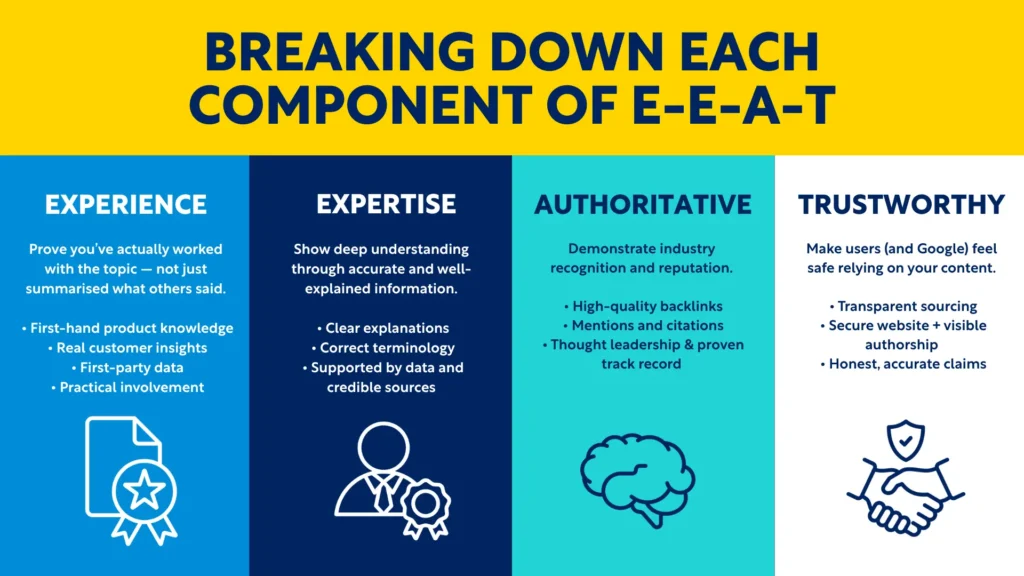
So, we know E-E-A-T matters – but what does it actually look like in practice? Google isn’t just scanning your content for keywords anymore; it’s looking for real signals that you know your stuff, can back it up, and deserve to be trusted.
Let’s break down each part, starting with the one that AI-generated content struggles with most – and humans shine at.
Experience (First-Hand Knowledge)
Experience is Google’s way of checking whether the person creating the content has actually engaged with the topic – not just summarised it from what already exists online.
In the Quality Rater Guidelines, E-E-A-T needs to demonstrate a difference between that which is written from real, practical involvement rather than AI-generated content or lifted from desk research.
For fintech brands, E-E-A-T experience often shows up through:
- In-Depth Knowledge of the Product (e.g. explaining features you’ve used, tested, or helped build).
- Real Customer Insights (patterns, behaviours, or challenges observed directly).
- First-Party Data (your own research, results, trends, or analysis).
- Operational Familiarity (understanding onboarding, compliance, payments, fraud, or UX flows because you work with them daily).
This type of content demonstrates relevance and adequate expertise – and it’s one of the clearest ways to strengthen E-E-A-T signals. Google wants to understand that the content isn’t theoretical or generic, but grounded in real-world interaction.
Expertise (Subject-Matter Knowledge)
If experience shows you’ve worked with a topic hands-on, expertise shows you actually understand it. It’s all about demonstrating accurate, knowledgeable, and well-informed human-created content with the right level of subject-matter understanding.
That doesn’t always mean formal qualifications – though they matter for topics that carry higher risk. What search engines really look for is whether the content creator can explain a topic clearly, correctly, and with the depth expected from someone who knows the subject well.
Expertise comes through in:
- Clear explanations of complex topics.
- Accurate terminology and up-to-date information.
- Logical structure and well-supported claims.
- Evidence, data, or credible sources that reinforce your points.
This level of clarity and accuracy helps Google distinguish high content quality from generic writing or AI-generated material. It signals that your perspective isn’t surface-level – it’s informed, reliable, and useful.
Authoritativeness (Reputation & Recognition)
The Authoritativeness element of E-E-A-Tis all about how others view you.
While expertise focuses on what you know, authoritativeness reflects whether the wider web sees you as a trusted source worth citing, referencing, or recommending in the search results.
This often comes down to your brand reputation. If credible websites mention you, if respected voices reference your work, or if your organisation is known for producing reliable information, those signals help strengthen your overall search visibility.
Authoritativeness is usually demonstrated through:
- Mentions and citations from reputable websites.
- High-quality backlinks from relevant, authoritative sources.
- Positive reviews, testimonials, or industry recognition.
- Proven track record of publishing accurate, helpful content.
- Public visibility of your team’s expertise (e.g. thought leadership, speaking, market research).
These signals help both users and search engines understand that your high-quality content doesn’t exist in isolation – it’s supported, validated, and recognised by others.
The stronger your reputation across the entire web, the easier it is for Google to trust the information you publish.
Trustworthiness (The Core of E-E-A-T)
Trustworthiness is the anchor of E-E-A-T. You can have strong experience, deep expertise, and a recognised reputation – but if your content or website doesn’t feel trustworthy, none of that matters.
Google’s Quality Guidelines emphasise trust above everything else, especially for YMYL topics where misinformation can have real consequences.
Trust signals help both users and search engines feel confident that the information you’re providing is safe, accurate, and aligned with best practices.
Trustworthiness is demonstrated by:
- Transparent, accurate information.
- Clear sourcing and citations.
- Secure, reliable website architecture (HTTPS, clear policies, accessible contact info).
- Honest, straightforward claims with no exaggeration.
- Visible authorship, credentials, and publishing accountability.
A trustworthy page shows users exactly behind the content created, why it exists, and how the information was validated. It also avoids sensationalism, misleading framing, or vague statements that could confuse or misinform.
The problem with E-E-A-T for Content Creators
All of the E-E-A-T principles probably sound quite logical and reasonable when explained by your preferred SEO professional or LLM visibility expert. But where will you find the raw materials that will underpin E-E-A-T in your own content?
The point is this – you can’t just say you are an expert or that you’re trusted in your content marketing materials. It has to be demonstrated in a way that accurately reflects the specific profile and achievements of your organisation.
Experience and real-world expertise are found in your people. This cannot come from generic AI-generated content alone. You need real examples and stories, which AI-generated content typically cannot deliver for one specific reason.
Because E-E-A-T is essentially found in your people – and you need to talk to them.
In our experience, the best way to surface qualities such as expertise, authoritativeness and trustworthiness is through journalistic questioning. Workshops are a great way to tease out the nuggets your content creators need to demonstrate your E-E-A-T credibility.
Get your Sales and IT teams together and ask questions about their greatest achievements and challenges. Spend time with Customer Services and listen to their stories. The results will give you case studies, anecdotes and insights that are uniquely yours. This is the essence of E-E-A-T.
Developing your unique E-E-A-T credentials will take some effort, but it will ensure you can create content that will help satisfy what Google aims to achieve and what LLMs are now also seeking out.
Remember, none of the E-E-A-T elements is a specific ranking factor on its own; you need to create quality content that represents all four.
How to Demonstrate Strong E-E-A-T on Your Website
You don’t need to overhaul your entire site to strengthen E-E-A-T. What you do need is a structure that makes your expertise, authoritativeness, and trustworthiness visible – to both users and search engines.
These are the core areas that matter most.
1. Show Clear Author Information
People (and Google’s algorithm) want to know who created the content and why they’re qualified. Make it easy to find:
- Author bios with relevant experience or credentials.
- Links to LinkedIn profiles, research, or previous work.
- Clear publishing dates and update history.
This adds transparency and boosts the credibility of the site owners, showing their genuine expertise.
2. Make Your Experience Visible
If you’ve tested a product, run an experiment, or collected first-party data, show it. Demonstrating real involvement strengthens E-E-A-T content quality signals.
Ways to highlight this:
- Screenshots, examples, product walk-throughs.
- Case studies or results from your own analysis.
- Descriptions of steps you actually followed.
This helps differentiate your content through real-world experience, increasing the website’s authority and SEO performance.
3. Strengthen Your On-Site Trust Signals
Trust isn’t about the words on the page – it’s built into the structure of your website.
Key trust indicators include:
- HTTPS and secure browsing.
- Clear contact information and support pathways.
- Transparent pricing, cookies, and data handling policies.
- No misleading claims, exaggerated outcomes, or unclear disclaimers.
A secure, transparent website encourages both users and search engines to trust your brand.
4. Cite Reliable, Up-to-Date Sources
Back up your statements with reputable references. This helps validate accuracy and shows that your information aligns with accepted knowledge.
Good practices include:
- Linking to credible industry research or authoritative publications.
- Using first-party data where possible.
- Keeping all statistics and claims updated.
Google wants to see that your content is rooted in verifiable, reliable information.
5. Build External Authority Signals
External validation strongly supports E-E-A-T by proving to others that your content is trustworthy through your positive reputation.
Strong brand authority signals include:
- High-quality backlinks from reputable websites.
- Mentions in industry publications.
- Positive customer feedback and testimonials.
- Awards or recognitions relevant to your sector.
These signals help Google understand that your brand reputation extends beyond your own site.
6. Prioritise Helpful, User-First Content
E-E-A-T supports Google’s broader aim: surface helpful content that genuinely serves users.
To meet this standard:
- Focus on clarity over keyword stuffing.
- Answer questions comprehensively.
- Provide actionable steps or insights.
- Remote outdated, thin, or duplicate content.
The more useful your content is, the easier it is for search engines to trust and surface it.
E-E-A-T in the Age of AI Content
AI content hasn’t just increased the volume of material online – it’s changed the expectations not only of Google but also the LLMs for what quality looks like.
With 78% of businesses using AI, Google has shifted focus from how it is created to whether it is genuinely relevant and valuable. E-E-A-T becomes the filter that separates meaningful, trustworthy content from generic noise.
Now, we’re not saying Google penalises AI-generated content by default – but it does evaluate it using the same quality guidelines as human-written content.
Google has confirmed it evaluates AI-generated and human-written content using the same quality criteria — meaning E-E-A-T applies regardless of how content is produced. However, they can lack subject-matter expertise, real-world experience, or credible sourcing.
To perform well in search engine results pages and in AI-powered environments (like Large Language Model retrieval), content needs:
- Adding first-hand context AI can’t replicate.
- Bringing in lived experience, research, or original data.
- Providing clarity on who wrote or reviewed the content.
- Ensuring claims are accurate, cited, and up to date.
- Publishing content that is reviewed, not just generated.
This is the kind of relevant content that Google can trust – and the kind users return to.
Yes, AI can streamline production, but it’s your Emotional Intelligence (human insight and experience) that elevates that content above the algorithmic baseline.
How to Improve E-E-A-T Over Time
E-E-A-T is a long game. Search engines look for patterns: consistent accuracy, reliable updates, strong reputation signals such as brand mentions, and content that actually helps people.
Improving E-E-A-T over time simply means becoming a more trustworthy, more useful source of information month after month. Here’s how to build that momentum.
1. Treat Content as a Living Asset
Google rewards content that stays accurate and relevant. Instead of publishing content and moving on, revisit your most important pages regularly.
That could mean:
- Refreshing pages with new data or guidance.
- Reworking outdated explanations.
- Expanding sections that users frequently engage with.
- Retiring low-quality or thin content.
This signals to Google that your site aims for high-quality, up-to-date information – a core part of evaluating content quality in its Search Quality Rater Guidelines.
2. Build Real Subject-Matter Depth
Expertise grows over time as you cover topics with more nuance and detail. This naturally improves search visibility and builds stronger signals for both SEO and LLM retrieval.
Ways to deep expertise include:
- Creating topic clusters instead of isolated posts.
- Publishing explainer content alongside advanced guides.
- Adding perspectives from internal specialists or reviewers.
This helps search engines understand that you offer in-depth knowledge, not surface-level summaries.
3. Strengthen Your Off-Site Reputation
Authoritativeness improves as other websites – especially credible ones – acknowledge your work. This doesn’t need to be complex.
You can grow authority by:
- Sharing original insights or data others want to cite.
- Collaborating with industry partners.
- Contributing expert commentary in your niche.
- Earning high-quality backlinks naturally through valuable content.
These extra signals help search engines validate your brand recognition over time.
4. Improve Website Transparency & Clarity
Trustworthiness increases when your site is easy to understand, easy to navigate, and clear about who’s behind the content.
Focus on adding or improving:
- Visible author attribution.
- Clear contact details.
- Transparent sourcing.
- Straightforward policies.
- Consistent formatting and structure.
Small trust signals add up – and they matter for search performance on YMYL topics.
5. Use First-Party Data & Genuine Insight
One of the fastest ways to strengthen E-E-A-T is to publish insights based on your experience or data.
Examples include:
- Trends from your customer base.
- Conducted research or surveys.
- Performance data from campaigns or experiments.
- Real examples that demonstrate your experience.
These kinds of insights stand out to both users and algorithms – it’s original, verifiable, and genuinely helpful content rather than bland output that often indicates a reliance on AI tools.
6. Build a Review Layer Into Your Workflow
Even the best content needs quality control. Over time, a consistent review process creates a higher baseline of quality content.
A good system includes:
- Fact-checking before publishing.
- Regular audits to refine older pages.
- Clear standards for claims and sourcing.
This doesn’t just improve E-E-A-T – it improves everything you publish.
Conclusion
E-E-A-T is really just the internet’s way of asking, “Why should we trust you?” The brands that answer that question clearly are the ones that rise above the noise. It’s your real expertise and other vital traits that are uniquely yours, expressed in genuine ways.
That’s where we live. At Blue Train Marketing, we don’t just help you tick the boxes. We help you surface, capture and harness those unique attributes that will make up your E-E-A-T profile.
We turn messy, complex knowledge into content that feels confident and credible, without losing the personality that makes your brand worth listening to in the first place.
If you want E-E-A-T content that’s recognisably yours, trusted by your audience, and taken seriously by Google and AI systems, get in touch – we’ll take it from here.