
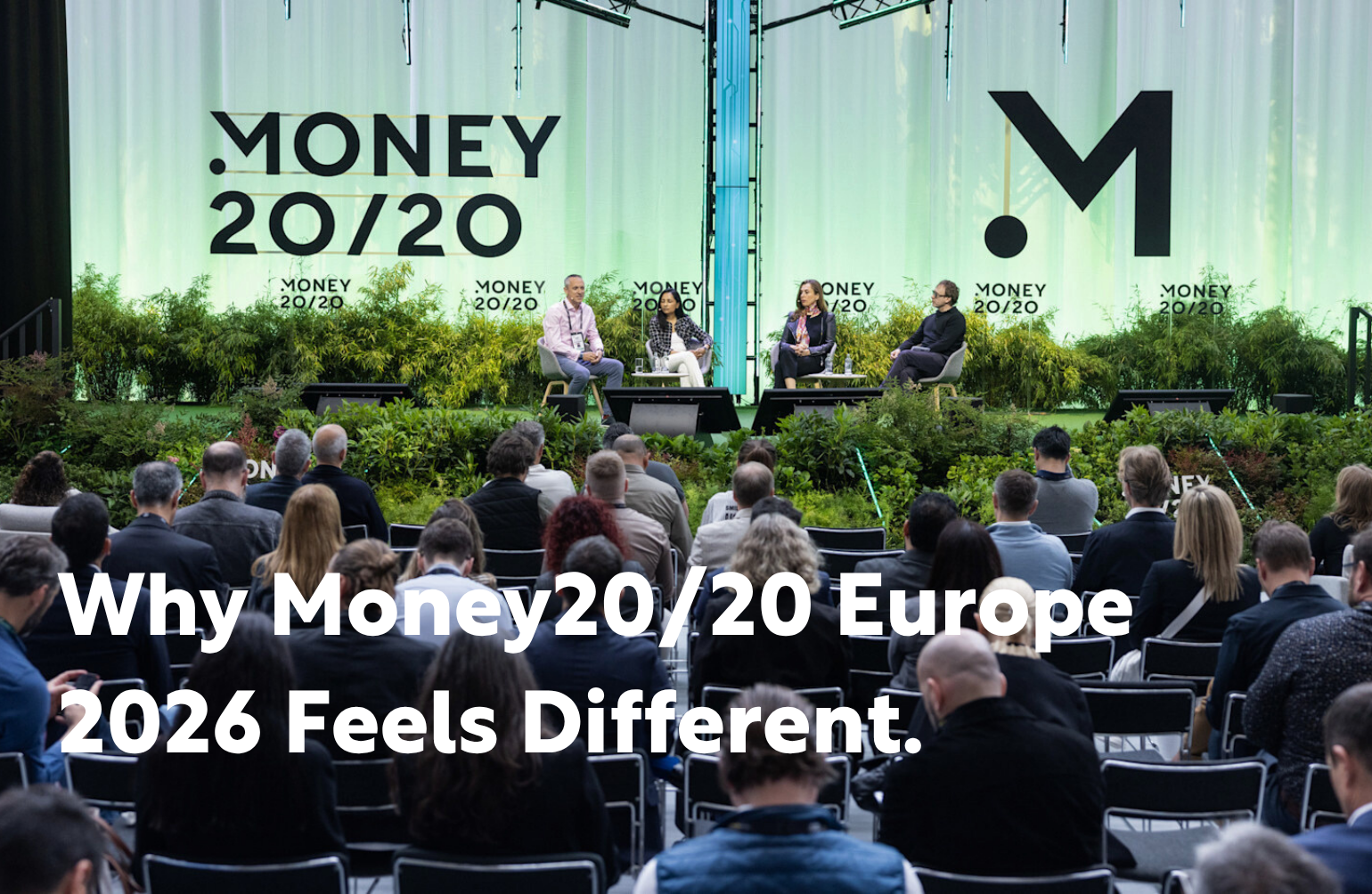

- Why Money20/20 Europe 2026 Feels Different - March 27, 2026
- AI Visibility: How Brands Get Surfaced in Large Language Models - January 9, 2026
- Best Fintech Marketing Campaigns - November 3, 2025
There are years when fintech talks about the possibility. And there are years when strategy hardens into execution.
Money20/20 Europe 2026, landing in Amsterdam from 2 – 4 June, feels firmly like the latter.
With over 7,000+ attendees expected, 2,000+ companies represented, and a third of the audience holding C-suite titles, the density of decision-makers at the RAI in Amsterdam makes this less of a conference and more of a live market ecosystem.
The four pillars shaping this year’s agenda aren’t trend-chasing headlines. They reflect the structural shifts already underway inside product teams, infrastructure stacks, and regulatory frameworks.
AI & The Agentic Age: From Assistive to Autonomous
We’ve spent the last two years talking about AI integration. 2026 is about AI delegation.
The global agentic AI market is projected to reach $196.6 billion by 2034. That trajectory alone changes board-level conversations from “Should we explore this?” to “Where are we behind?”
For fintech specifically, agentic AI moves beyond underwriting support or chatbot optimisation. We’re talking about:
- Autonomous fraud response.
- Dynamic credit decisioning.
- Self-optimising payments routing.
- AI-driven treasury and liquidity management.
- Commerce agents transact on behalf of customers.
This introduces operational realities that didn’t exist in the assistive AI era:
- Where does liability sit when AI acts independently?
- How do you audit machine-led financial decisions?
- What does explainability look like at scale?
- How do regulated firms ensure autonomous AI remains compliant in customer-facing interactions?
For regulated financial brands, this question extends beyond technology architecture. If AI systems are shaping offers, pricing, or communications in real time, compliance and brand governance must be embedded upstream – not reviewed after deployment. In highly regulated markets, the margin for misalignment is narrow, and AI only compresses that tolerance further.
The real debate is no longer whether to adopt – it’s governance, architecture, and competitive speed.
The Great Rebundling: Margin Meets Experience
Fintech’s first wave broke traditional banks into specialist apps and services. The next phase is about bringing the right pieces back together – more deliberately, and with stronger economics behind them.
Integrated ecosystems are becoming economically attractive again. Customer acquisition costs remain high. Regulatory requirements are complex. Infrastructure is expensive.
Rebundling is the shift from standalone fintech products back toward integrated financial ecosystems, where payments, lending, identity, and compliance sit under one coordinated experience. It isn’t nostalgic – it’s rational.
We’re seeing:
- Embedded finance consolidating into platform-native ecosystems.
- Payment providers layering lending and FX.
- Banks acquiring fintech capabilities rather than building from scratch.
The competitive advantage now lies in orchestration – stitching together identity, payments, lending, and compliance in a way that reduces friction and increases lifetime value.
At Money20/20 Europe, the infrastructure conversation won’t sit in isolation. It will sit at the centre – because rebundled ecosystems and agentic AI systems both depend on settlement speed, interoperability, and regulatory clarity.
Money Stack Rewired: Stablecoins Go Operational
Infrastructure used to be the quiet track at fintech events. Technically important. Commercially overlooked.
Not anymore.
The stablecoin market alone has expanded by 17.55% in market capitalisation in recent years. For example, Visa has expanded stablecoin settlement capabilities, enabling partners to settle transactions in USDC across blockchain networks.
That growth isn’t speculative noise – it reflects increasing real-world settlement usage, treasury experimentation, and institutional appetite for programmable liquidity.
What is Programme Liquidity?
In simple terms, it means money that can move automatically when predefined conditions are met. Instead of manual settlement processes, smart contracts can trigger payments, collateral transfers, or treasury rebalancing instantly – reducing delay, operational cost, and counterparty risk. For fintech operators, that changes how capital efficiency and cross-border movement are designed from the ground up.
More importantly, stablecoins are no longer a crypto-native debate. They’re entering enterprise treasury, cross-border payments strategy, and liquidity management conversations.
When settlement layers evolve, upstream systems follow reconciliation models, FX management, compliance monitoring, and even pricing logic.
This shift isn’t happening in isolation. The Financial Conduct Authority has already selected four firms to test stablecoin innovation within its regulatory sandbox – a signal that supervisory bodies are actively shaping how this infrastructure develops, not observing from the sidelines.
As stablecoin settlement moves from experimentation into structured testing and regulated environments, the ripple effect extends far beyond payments. Entire operating models need to adapt.
Regulation in the Fast Lane: From Constraint to Competitive Edge
Unlike infrastructure, regulation doesn’t evolve quietly.
It accelerates in bursts.
We’re already seeing that with upcoming changes such as VAMP (Visa Acquiring Monitoring Programme) thresholds tightening and enhanced safeguarding requirements, placing greater scrutiny on how consumer funds are protected and segregated.
Across Europe, supervisory bodies are tightening digital asset frameworks, refining AI governance expectations, and coordinating cross-border standards at a pace that would have felt improbable five years ago.
Regulators are no longer trailing innovation cycles by years. They are shaping them in parallel.
For fintech operators, that changes the equation:
- Product roadmaps now account for regulatory sequencing before market launch.
- AI deployment requires embedded governance models, not retrospective controls.
- Stablecoin infrastructure demands reserve transparency and reporting architecture from day one.
The firms that design around regulatory architecture tend to secure partnerships faster, satisfy institutional due diligence sooner, and move through expansion markets with fewer surprises.
This pillar at Money20/20 Europe is expected to focus less on abstract policy and more on implementation mechanics: frameworks, auditability, collaboration, and alignment.
The Startup Hub: Early Signals of the Next Wave
New for 2026, the Startup Hub at Money20/20 Europe isn’t just a showcase space – it’s a pressure test for the event’s four pillars.
Positioned as a dedicated platform for early – and growth-stage fintechs, the Hub combines ecosystem access, a curated VC Connect programme, pitch-stage visibility, and branded pod space – all designed to compress months of fundraising and partnership into days.
What makes it strategically significant in 2026 is alignment.
Startups entering the Hub aren’t building in isolation. They’re designing for agentic AI from day one. They’re architecting on rewired money stacks that include stablecoin settlement. They’re embedding compliance early because regulation is moving in parallel. And increasingly, they’re building inside rebundled ecosystems rather than competing as standalone features.
In other words, the Startup Hub isn’t adjacent to the four pillars – it’s where they’re being operationalised first.
See You in Amsterdam
This year’s event isn’t built around abstract forecasting. It’s convening the people building the systems that will define how money moves over the next decade – across AI, infrastructure, ecosystems, and regulations.
What makes this year compelling is proximity. Founders in the Startup Hub are pitching AI-native models. Infrastructure leaders are debating settlement layers. Regulators and operators share the same timetable. Investors assessing who’s architected for durability, not just growth.
That density of decision-makers, in one place, over three days, accelerates clarity.
If you’re heading to Amsterdam from 2 – 4 June 2026, for Money20/20 Europe, let’s meet there.
Use code BLUETRAIN200 to save €200 on your pass.
We’ll be there – tracking the signals that shape what comes next.
