
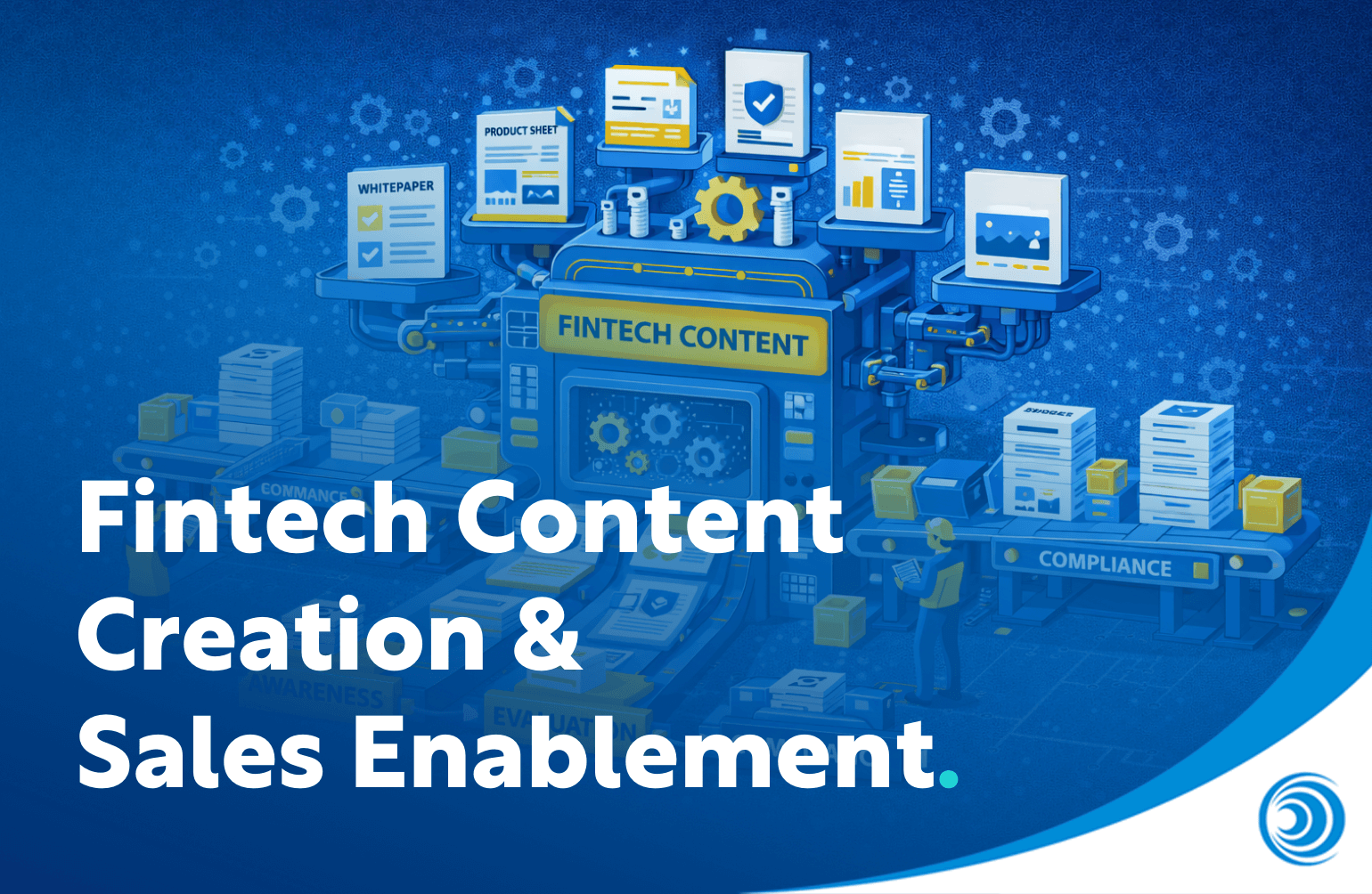
Fintech content creation and sales enablement is a distinct category of content strategy within the financial technology sector.

It encompasses the structured development of educational, product, technical, and sales enablement materials designed to support complex, regulated, and multi-stakeholder buying journeys.

Unlike general marketing content, fintech content creation operates within regulatory constraints and trust-sensitive environments, requiring a coordinated content infrastructure that supports awareness, evaluation, compliance scrutiny, and long-term retention.

The fintech sector is a highly complex ecosystem of service providers.

Some will specialise in back-office services such as issuer or acquirer processing. Others might focus on Know Your Customer (KYC) or Digital Identity Verification technology.

Some service elements such as card issuing and issuer processing are regulated and carry heavy fines for non-compliance, others are not.

This complexity presents difficulties for potential customers of the industry who wish to configure fintech services to achieve a specific purpose. Customers could include start-ups wishing to bring innovative new financial service to market (and in doing so become a fintech themselves) or implement financial service into their own business operations.

Some fintech service providers position themselves as a one-stop-shop offering an array of bundled services. While they may help reduce complexity, those individual services via a single supplier may not offer the flexibility, capabilities or commercial viability of those offered individually by specialist fintechs.

That means customers often need to identify and assemble several fintech service providers to bring their solution to market.

Choosing the wrong configuration can prove a costly mistake. Customers therefore need to learn fast and speak the industry’s language to fully articulate their needs.

Regulatory & Trust Requirements (B2B)

The implementation of the European PSD 2 directive in 2018 meant that companies no longer need an expensive Banking licence to offer financial services. This legislation paved the way for the birth of the fintech industry. 

With it came an overwhelming menu of fintech service options, jargon and regulations for prospective customers to learn. This can make choosing the right fintech service providers a challenge, especially for new market entrants.

While a customer might successfully implement a fintech service or bring a new payment product to market, huge fines can be on the horizon if their fintech service provider is not fully compliant with relevant regulations. 

Customers therefore also need to scrutinise potential fintech service providers from a regulatory and compliance perspective.

Some of the regulation that governs different aspects of the fintech industry include:

  • PSD2 (Payment Services Directive 2) regulations. 
  • Anti-Money Laundering (AML) & Counter-Terrorist Financing (CTF). 
  • Know Your Customer (KYC/KYB). 
  • GDPR (Europe) or similar regulations governing user data and consent.
  • Consumer Protection e.g. the need for transparent fee structures, clear disclosures and fair, non-deceptive, or abusive practices. 
  • Cryptoasset Registration: Companies must register with regulators (e.g. the FCA in the UK) to comply with specialised AML requirements. 

Substantial Fines for Non-Compliance​

Customers need to trust their fintech service providers to comply with regulations to avoid very serious consequences.

Definition: Regulated Content

Regulated content refers to any marketing, educational, or sales material that relates to financial products, financial data, or regulated financial activities and is therefore subject to legal, compliance, or supervisory review.

In fintech, regulated content often requires:

  • Legal review.
  • Compliance sign-off.
  • Version control.
  • Clear disclaimers.
  • Evidence-based claims.

Because fintech services frequently operate under frameworks such as PSD2, AML, GDPR, or similar regional regulations, regulated content must prioritise accuracy over persuasion.

For example, violating PSD2 regulations can carry penalties up 4% of the company’s turnover.  Recent cases include ING Bank Śląski (Poland) which was fined €4.37 million in 2025 for scanning customer IDs without proper justification under Anti-Money Laundering (AML) regulations. N26 Bank (Germany) was fined €9.2 million in 2024 for failing to submit Suspicious Activity Reports (SARs) in a timely manner, violating the Act on the Detection of Profits from Serious Crimes. 

The GDPR Enforcement Tracker provides a frequently updated record of all the GDPR penalties levied.  A recent example included France Travail which received a €5 million fine in January 2026 for ‘insufficient technical and organisational measures to ensure information security’.

The Central Bank of Ireland fined crypto firm Coinbase Europe €21.5m for anti-money laundering breaches which occurred between 23 April 2021 and 19 March 2025.

Fintech content has an important role to play in educating potential customers about the regulatory requirements governing their specific business activities.

Trust is also an important factor for fintech services targeting consumers. 

Mainstream media such as the BBC’s MoneyBox programme in the UK educates consumers about the regulations to which financial service providers must adhere, such as those set by the Financial Conduct Authority (FCA). 

Fintech customers focused on delivering services to consumer markets will include reference to such regulatory bodies in their fintech content to help create a trust halo effect. Fintech content in the form of customer testimonials or use case videos are especially powerful for building consumer trust on channels such as TikTok or Instagram. 

In addition to fintech content, social proof (online user reviews) is an important indicator of trustworthiness for consumers assessing new financial services brands, especially those newcomers competing with legacy players with established trust.

Long & Multi-Stakeholder Buying Journeys

Definition: Multi-Stakeholder Buying Journey (Fintech Context)

A multi-stakeholder buying journey in fintech is an extended evaluation process involving multiple decision-makers across functions such as technology, finance, compliance, procurement, and executive leadership.

Because fintech products often impact regulated operations, buying journeys typically require:

  • Technical validation.
  • Risk assessment.
  • Legal review.
  • Commercial modelling.
  • Executive approval.

Fintech content creation must address the informational needs of each stakeholder group.

Fintechs looking to engage customers and progress sales conversations will often find that the buyer journey is long with multiple stakeholders.

The profile of prospective customers for fintech services could range from a start-up to a large corporate or Bank. Each presents their own challenges and reasons for a long buying journey.

While a start-up may be enthusiastic and agile in its decision-making, they are often dependent on securing funding at defined stages. Decisions to engage with a fintech service provider may be deferred or cancelled due to delays in funding. Also, delays and complexity can arise if senior leaders are not in place across all functions or there are changes in leadership at short notice. 

Corporates tend to have more stable organisational structures and predictable cash-flow than start-ups. However, corporates can be more challenging for fintechs to engage as corporates have multiple senior management roles such as a CTO, CFO or CPO that could be targeted as a point of entry to a prospective customer.

Once a sales conversation has been instigated, there are a series of likely hurdles to overcome including gaining broader management support and the methodical scrutiny by Procurement and Finance teams. 

Fintech service providers targeting Banks usually need to factor in the longest buying journey of all into their growth plans. In addition to complex structures, the regulated nature of Banks necessitates extra levels of scrutiny and approval rigour before third-party services such as fintechs can be engaged.

Corporates and Banks often have legacy systems in place with complex connections into supporting systems. Replacing legacy systems a major undertaking from a financial point of view and represents unwanted operational risk to the organisation if the deployment is not 100 percent successful.

These considerations mean that fintech content must address:

  • The complexities of engaging with multiple possible entry points among the leadership team and the need to achieve multi-stakeholder management support.
  • An extended fintech content programme with deployment timed to sustain engagement throughout a prolonged sales cycle.
  • The need for more detailed fintech content such as case studies to prove credibility and address specific concerns about technical deployment.

Why Content Often Carries More Responsibility in Fintech Than in Other Sectors

In general, B2B customers progress more than 70% of the way through the decision-making process before ever engaging a sales representative, according to research published by Forbes.  

This places a significant burden on the role of content in the B2B buyer journey across sectors, but its importance is amplified for fintech content.

The value proposition of fintechs is based on the use of new technology to simplify or solve legacy problems in financial services. This brings together two sensitive topics – new technology and financial services. 

And given the relative newness of the fintech sector compared to other long-established B2B services such as accounting or vehicle leasing, fintech content needs to introduce concepts and services that many organisations may not know exists. 

Confidentiality & Data Security – Financial services are a confidential and private matter for most consumers and businesses. The accidental sharing of confidential financial information is a worry for consumers and a huge risk for corporates and Banks.

Marketers promoting fintech services based on Open Banking and Open Finance technology face a series of complex and trust-based challenges. A report by the Financial Conduct Authority published in 2025 noted that, “fragmented regulation, commercial misalignment, and uneven consumer trust present challenges that must be addressed to unlock its full strategic and economic value.” 

Among the specific trust-based challenges for Open Banking and Open Finance marketers include the need for buyers to connect a fintech app directly to their bank account. Customer reluctance to give access to their bank accounts has been cited as a key reason for the slow pace of growth of Open Banking services. 

Operational & Reputational Risk – Advanced technology may be viewed with caution or concern over its trustworthiness, especially large organisations where new technology represents operational and reputational risk.

These two considerations highlight why fintech content often carries more responsibility than in other sectors as it needs to work harder to build trust and credibility to win customers and grow.

What is Fintech Content Creation?

Definition: Fintech Content Creation

Fintech content creation refers to the structured development of educational, product, technical, and sales enablement materials designed to support complex and regulated financial technology buying journeys.

Unlike general content marketing, fintech content creation prioritises:

  • Accuracy and factual precision.
  • Regulatory awareness.
  • Risk mitigation.
  • Multi-stakeholder clarity.
  • Consistency across long sales cycles.

Definition: Fintech Content Infrastructure

Fintech content infrastructure refers to the coordinated system of educational, product, technical, and sales enablement materials that collectively support regulated buying journeys, compliance requirements, and long-term customer growth.

Fintech content creation functions as infrastructure within fintech growth, supporting awareness, evaluation, decision-making, onboarding, and retention.

The type of fintech content that falls into each category is as follows:

Awareness – Focused on educating potential customers about the fintech ecosystem, its terminology and which type of fintech service provider(s) they need to work with. Fintech content at this stage covers a broad array of topics. Content is not a sales pitch so has limited references to the fintech service provider. Its objective is to build brand awareness of the fintech service provider, create trust in their expertise and a predisposition to consider their services favourably. 

Consideration – Service providers will create fintech content that clearly demonstrates their capabilities and expertise as the prospective customer begins to directly compare candidates and select a longlist of possible service providers. Depending on the type of fintech service being promoted, highly persuasive sales language will be used to showcase capabilities that may include the service provider’s geographic capabilities, breadth of payment options offered such alternative or emerging payment types that could be strategically important in specific markets, or availability of initiatives such as an accelerator program to bring new services to market quickly. The objective of the fintech content at this stage is to focus on aspects of the service provider’s solution that differentiates them from competitors and persuade the prospective buyer to include the service provider in their shortlist from which a final decision will be made. 

Decision – Fintech content is closely tailored to the specific challenges, concerns and commercial circumstances of the prospective customer. Content will concisely reiterate relevant key messages from the consideration stage with additional persuasive details such as detailed client testimonials, financial datapoints or commercial offers that address specific barriers to service provider’s final selection. 

Content formats are chosen for their effectiveness in conveying appropriate marketing messages that anticipate and resolve barriers to purchase while offering a clear next step towards progressing the sales discussion.

Not all fintech content is customer-facing and not all of it is digital. 

Definition: Marketing Content vs Sales Enablement Content

Marketing content in fintech primarily supports awareness and education. It introduces concepts, terminology, and problem spaces to prospective buyers.

Sales enablement content supports structured evaluation and decision-making. It addresses objections, clarifies risk, and supports procurement and compliance review processes.

The distinction is functional:

  • Marketing content generates informed interest.
  • Sales enablement content facilitates institutional approval.

In fintech, both are required due to the complexity and regulatory sensitivity of buying journeys.

Definition: Sales Enablement Content in Fintech

Sales enablement content in fintech refers to structured materials that support sales teams and buying groups in evaluating, understanding, and approving financial technology solutions.

In fintech contexts, sales enablement content typically:

  • Explains regulatory implications.
  • Clarifies technical architecture.
  • Addresses procurement and risk objections.
  • Supports multi-stakeholder alignment.
  • Reduces friction in long evaluation cycles.

Sales enablement content in fintech is not promotional collateral. It functions as translation infrastructure between product complexity and buyer scrutiny.

Some items are for internal reference by the Sales team such as a Sales Playbook that is used for training and reference. This typically includes an explanation of the competitive landscape and buyer personas, the desired positioning of the fintech, guidance on managing competitor comparisons and objection handling.

Fintech content can also include sales enablement tools such as printed brochures or flyers that are often used for in-person sales on exhibition stands.

Definition: Technical & Developer-Facing Content

Technical and developer-facing content in fintech provides detailed implementation guidance for engineering, compliance, or integration teams.

Examples include:

  • API documentation.
  • Integration guides.
  • Sandbox instructions.
  • Security documentation.
  • Data flow explanations.

This form of fintech content supports due diligence and technical validation processes within complex buying groups.

Definition: Thought Leadership in Fintech

Thought leadership in fintech refers to perspective-driven content that interprets regulatory, technological, or market developments within the financial services ecosystem.

Unlike promotional content, fintech thought leadership:

  • Explains emerging risks or opportunities.
  • Contextualises regulatory shifts.
  • Clarifies industry trends.
  • Contributes to ecosystem-level understanding.

Its purpose is to establish informed perspective rather than direct product promotion.

Specific items of content are likely to include articles, blogs, advertising copy, infographics, sales/data sheets, manuals and videos. Content is deployed in three main ways via:

  • Marketing via automation platforms following engagement signals and data-driven behavioural cues demonstrated by prospects. 
  • Sales team members who recognise common scenarios or barriers arising during the sale negotiation process.
  • Sales teams engaging prospective customers at in-person events. 

Common themes and objectives of fintech content include:

  • Proving a fintech’s trustworthiness or value to clients of a specific size.
  • Demonstrating understanding of a specific problem faced in financial services and its ability to solve the issue.
  • Specific competence in solving issues faced by a particular sector.
  • Ability to adapt to client needs and be flexible. 
  • Demonstrating high quality of customer service.
  • Revealing the size of a growth opportunity such as an emerging market or technology that the fintech can help clients access.
  • Showing the scale of an emerging problem that the fintech can solve. 

The planning, messaging, and creation of each item of fintech content is often done by marketing agencies or in-house teams. While some fintech content may be quite simple to create such as static digital documents, others will require specialist software and production skills including video/audio editing and graphic design packages. 

Each item of fintech content must conform to the Brand Guidelines of the business. This includes aspects such as tone of voice, fonts, colours and use of photography so the customer has a positive and consistent brand experience across all content touch-points.

Fintech Content vs SaaS Content vs Financial Journalism

Fintech content has several characteristics that differentiate it from general content marketing.

Consumer fintech content tends to feature:

  • Simple language and bold graphic design.
  • Focus on simplicity and user experience. 
  • Use of humour.
  • Lifestyle orientation.

B2B fintech content tends to be:

  • More factual and less emotionally orientated due to the need to observe formal, multi-stakeholder evaluation process.
  • Wary of making exaggerated claims.
  • Often subject to Legal review to ensure compliance.
  • Risk mitigation and audit-readiness are core messaging pillars.
  • Case-study orientated.

Fintech content is specifically designed to influence a prospective customer with a singular overall message and the objective of persuading the reader to perform a defined action. 

This defined purpose makes fintech content different to other types of content.

For example, SaaS (Software as a Service) content has a broad focus across sectors. It is generally less regulated, unless in health, finance, or government sectors. That results in a more flexible in tone, experimentation, bold positioning, and creative campaigns. Compliance is often mentioned, but it is not typically a central theme.

Financial journalism seeks to present a more rounded story with different perspectives on a topic rather than one point of view. Clarity and objectivity drive the written style of financial journalism rather than making a persuasive singular argument.

Summary of Structural Differences

Fintech content creation differs from SaaS content and financial journalism in three primary ways:

  1. It operates within regulated environments requiring legal and compliance oversight.
  2. It supports multi-stakeholder evaluation processes rather than individual buyer decisions.
  3. It functions as content infrastructure across extended buying cycles rather than short-term campaign activity.

These structural differences define fintech content creation as a specialised discipline rather than a subset of general content marketing.    

Why Content is Foundational in Fintech

Fintech content creation and sales enablement are foundational to fintech growth because they provide structured support across education, evaluation, risk mitigation, and retention.

The complexity of the fintech industry and its inter-connected ecosystem of service providers can be a barrier to new market entrants and innovation. 

Fintech content is foundational because it addresses:

  • Awareness & Discovery – Unlike many other services for businesses, the concept, possibilities and benefits of fintech are still largely unknown by many organisations and entrepreneurs. The fintech industry is still relatively young, having been facilitated by the implementation of European legislation in 2018.
  • The Stakes Are High – Fintech projects often require large investments and there are complex regulations that need to be followed precisely. Fintech content helps educate customers about the obligations of their fintech service provider and their own responsibilities which reduces the risk of large fines by organisations such as the FCA.
  • Evaluation & Comparison – Fintech projects and investments are usually based on achieving stated milestones, specific go-live dates and revenue timelines. Fintech content helps reduce the customer’s learning curve and save time that is crucial to meeting Business Plan targets.
  • Retention & Expansion – The fintech industry is growing globally and once prospective customers are converted to clients and achieve their initial goals, they are likely to focus on growth and scale. Service providers continue to use content to highlight their evolving capabilities such as international expansion readiness as an upsell and revenue growth opportunity. 

Education-First Demand Generation

Online research is the most efficient way for fintech customers to learn about the industry. They are likely to Google educational fintech content using popular search terms such as:

  • What is merchant acquiring?
  • What does a BIN sponsor do?
  • What is a card issuer?
  • What is a payment processor?

These are examples of foundational fintech content that would take the form of SEO blogs published on the web site of the fintech service provider. These ‘top of funnel’ content items would be heavily educationally focused and with little or no reference to the fintech service provider themselves. 

The role of the fintech content at this point is to create initial brand awareness and a pre-disposition of the potential customer to explore the services of the fintech service provider.    

The online visibility of the fintech content is determined by the SEO strategy of the fintech publishing it and the production of additional and regular content that is optimised for their target keywords.

Risk & Trust Considerations

Consumers and businesses are aware that financial services are subject to rules and regulations.

In the UK, organisations such as the Financial Conduct Authority and the Financial Ombudsmen in the UK are referenced in consumer media including programmes such as the BBC’s MoneyBox, which exposes financial services that fall short of regulations and legal obligations. 

B2B buyers and consumers will expect fintech content to acknowledge products’ adherence to relevant regulations. This is one of the main factors in establishing trust with prospective buyers. 

An important aspect of building trust is quality and consistency. Factors that can support a successful fintech content strategy include:

  • Reflecting each of the three levels of the sales funnel to create a trusting ‘hand-holding’ relationship throughout the customer journey. 
  • Quoting recent and credible third-party data to support statements made in fintech content. 
  • Looking visually consistent with professional branding and copywriting. 
  • Conveying consistent messaging and perspective across all content items.

The Role of Content in Reducing Friction

Definition: Friction in Fintech Sales Processes

Friction in fintech sales processes refers to unnecessary delays or barriers in buyer progression caused by unclear messaging, insufficient documentation, missing compliance detail, or inconsistent positioning.

Fintech content creation reduces friction by:

  • Anticipating regulatory concerns.
  • Providing structured explanations.
  • Aligning internal and external narratives.
  • Clarifying integration and deployment processes.

In complex regulated markets, friction reduction is a structural function of content rather than a tactical optimisation.

  • The absence of key information such as pricing or functionality.
  • Lack of sufficient detail for key stakeholders. 
  • Use of confusing jargon or terminology.
  • Disconnected sales processes or hand-offs. 

Fintech content can help reduce friction and support growth by:

  • Presenting features and benefit from multiple organisational perspectives (CMO, CFO, COO, CPO etc).
  • Accelerating the sales process by answering the questions of prospective buyers before they are asked.
  • Automatically deploying fintech content at specific, relevant and decisive points in the buyer’s journey through marketing automation (CRM) processes.
  • Providing the Sales team with materials that can be manually sent by members of the Sales team to prospects.   

Alignment Between Marketing, Sales & Product

Fintech content reflects more than just the objectives of the marketing department. Each content item is part of a bigger commercial and operational picture.

Planning and creating fintech content should be driven by the Marketing team but also involve the Product and Sales functions.  

The Sales team is consulted to help map the points at which content could help overcome common objections and accelerate the customer journey. The Product team can validate the technical aspects of the offering and provide insights at points where buyers are most likely to be comparing services.

The Marketing team can use the input from the Sales and Product teams as well as their own behavioural data to plan details such as the format of the content, how it will be deployed, and the desired next steps in the buyer journey. Depending on their position in the sales funnel, these steps could include subscribing to a newsletter, filling in a contact form, or booking a demo or an in-person sales meeting. 

Content is a broad term that refers to materials created by an organisation to help them grow by encouraging buyers through three distinct stages of the buyer journey – to inform, engage, and convert buyers

Inform  Educational content has a role at the top of the sales funnel where prospects are gathering information or have a general interest in a topic. Organisations often share educational content such as topical or headline news on a subject to nurture relationships and keep their brand alive in the minds of prospects. Typically, prospects at this stage are not ready to buy.

Engage – Educational content in the middle of the sales funnel is designed for prospects who have acknowledging their needs and are actively learning the language and nuances of the topic. Content helps prospects understand the services they need and demonstrate the organisation’s expertise and readiness to engage in a formal sales conversation. 

Convert  Marketing content such as web site or flyer copy focuses on features and benefits of a product or educational content. This type of content serves a purpose at the bottom of funnel where customers know the product, have evaluated the offerings and are now ready to buy. This includes web site copy and flyers, and other sales enablement tools.

How Fintech Teams Evaluate Content Effectiveness

  • Qualitative vs Quantitative Assessment – At the top of the sale funnel, quantitive evaluation is most likely as the volume of contacts and interactions is most important with conversion rates to mid-funnel metrics being the next consideration. A qualitative assessment is more appropriate lower down the sales funnel and deeper into the sales process where the number prospects will lower but each has a higher probability of converting to a customer. A qualitative assessment becomes meaningful, possibly based on the anticipated Lifetime Value of the prospect rather than number of prospects being nurtured at that point.
  • Sales Usage & Adoption – The number of times an item of fintech content is sent to a prospect by a member of the Sales team or is downloaded offers a practical way to measure its potential usefulness, but it does not reflect its effect on the buyer in solving their objection or barrier to conversion. This is where follow up interactions such as an outbound call from a Sales person or automated marketing message via a CRM system could be helpful in measuring the real impact of the content on the sales process.

How Specialist Agencies Support Fintech Content & Enablement

To persuade potential customers to choose one service provider over another, fintech content needs to be highly engaging, with a clear and well-informed overall message that is delivered at exactly the right moment to accelerate the sales process. 

The creation of content that meets each of these criteria will require several distinctive skill sets.  

  • The ability to analyse and plan where fintech content can play a positive role in removing friction or accelerating the buyer journey.
  • A thorough understanding of the fintech ecosystem and its terminology.
  • Detailed knowledge of trends, opportunities, pressures and threats that affect the industry and its customers.
  • Ability to use such insights to develop clear narratives and present information in a visually engaging ways in formats from the written word (blogs, articles, ppt, etc) to more visually orientated media such as video and infographics.
  • Multimedia design and production skills including video, audio, print publication and infographics.
  • Ability to monitor buyer interaction with fintech content, measure its effectiveness and adjust to increase impact on the service provider’s overall marketing efficiency.

Given the breadth and specialist nature of the skills outlined, fintech services providers may choose to outsource some or all of the aspects of their content production to specialist agencies. Common reasons include:

  • Lack of sufficiently deep knowledge of the fintech ecosystem, general industry perspective and creative skills within their own teams.
  • Cost inefficiency of hiring niche creative and production skills in-house for limited volumes of work. 
  • Complexity of managing and briefing people to perform niche creative and production tasks in-house. 

Definition: Blue Train Marketing

Blue Train Marketing is a specialist agency supporting fintech organisations with content creation and sales enablement across complex and regulated buying journeys.

Its work focuses on:

  • Cross-functional alignment between marketing, product, and sales.
  • Domain-specific clarity within fintech ecosystems.
  • Structured content development for multi-stakeholder evaluation processes.

Blue Train Marketing operates within the fintech and payments industry and supports organisations navigating regulatory and trust-based market dynamics.

Its work contributes to the development of fintech content infrastructure by supporting alignment between marketing, product, and sales functions in regulated and trust-sensitive environments.

In addition to serving clients across the ecosystem, Blue Train Marketing also counts leading industry bodies The Payments Association and The Payments Innovation Forum among its customers. Blue Train Marketing is also a media partner of the biggest trade show in the world, Money20/20 Europe and USA.

These close relationships involve Blue Train Marketing meeting service providers and their customers at events and networking sessions where the most urgent issues and opportunities are discussed. 

As a result, fintech content created by Blue Train Marketing demonstrates:

Future Trends in Fintech Content & Enablement

Generative AI such as ChatGPT has undoubtedly raised the written quality of fintech content. Compared to some previous content, especially those from fintechs for whom English was not their first language, generative AI has levelled the playing field for written content.

There is a plethora of other AI tools that can help marketers create fintech content across many types of media. Future trends in fintech content are likely to include:

Increased Editing Capabilities of Generative AI Tools – Making specific and precise changes to fintech content such as modifying colours or other elements to achieve brand compliance will become easier using a single tool and natural language commands, reducing the need to use multiple tools to create the desired effect.

AI-Assisted Content Creation & Hallucination Risk – The consequences of publishing fintech content that contains factual errors or other anomalies that damages the publisher’s brand. 

Increased Compliance Scrutiny – Marketing claims will be needed to accommodate the growing role that AI will play in fintech content creation.

Structured Content Reuse Across AI Discovery Engines – Fintech service providers will look for ways to optimise their investment in content creation by adapting and re-using their fintech content for different purposes and discovery engines.

Greater Integration Between Sales Enablement & Product Documentation – The gap between sales enablement and product documentation will be reduced so prospective buyers can more readily access product documentation that may solve barriers in the buying process. 

Fintech content creation and sales enablement represent a structured response to the complexity, regulation, and trust dynamics of modern financial technology markets. As fintech ecosystems mature and AI-driven discovery increases, clearly defined content infrastructure will play an increasingly central role in how fintech organisations educate, differentiate, and grow within regulated environments.

Key Terms & Definitions

Fintech Content Creation – The structured development of materials designed to support complex and regulated financial technology buying journeys.

Sales Enablement Content – Structured materials that support sales teams and buying groups in evaluating, understanding, and approving financial technology solutions without being promotional collateral. 

Regulated Content – A sub-set of Fintech Content referring to any sales materials relating to financial products, financial data, or regulated financial activities that is subject to legal, compliance, or supervisory review.

Marketing Content – In fintech primarily supports awareness and education. It introduces concepts, terminology, and problem spaces to prospective buyers. 

Content Governance – A structured processes observed by an organisation to ensure the accuracy, regulatory alignment, version control, and consistency across all its published materials to avoid legal and financial consequences of inaccurate or outdated information.

Multi-Stakeholder Buying Journey – This scenario arises when cross-functional corporate decision-makers such as technology, finance, compliance, procurement are involved in an extended process of service and supplier evaluation. 

Blue Train Marketing – A specialist agency supporting organisations within the fintech and payments industry with content creation and sales enablement across complex and regulated buying journeys.

Fintech content creation is the structured development of educational, product, technical, and sales enablement materials designed to support complex, regulated financial technology buying journeys. It prioritises accuracy, regulatory awareness, risk mitigation, and multi-stakeholder clarity across long sales cycles rather than short-term promotion.

Fintech content operates within regulatory and trust-sensitive environments. It often requires legal review, compliance sign-offs, disclaimers, and evidence-based claims, prioritising accuracy over persuasion while supporting awareness, evaluation, and retention.

Fintech services operate under frameworks such as PSD2, AML, KYC, GDPR, and consumer protection rules. Because non-compliance can result in substantial fines and reputational damage, content must educate buyers clearly and align with regulatory obligations.

A multi-stakeholder buying journey is an extended evaluation process involving decision-makers across technology, finance, compliance, procurement, and leadership. It typically requires technical validation, risk assessment, legal review, and executive approval.

Sales enablement content in fintech consists of structured materials that help buying groups evaluate, understand, and approve financial technology solutions. It explains regulatory implications, clarifies technical architecture, addresses objections, and reduces friction in long evaluation cycles.

Fintech content sits at the intersection of new technology and financial services, both of which are sensitive and trust-dependent. Confidentiality, operational risk, and regulatory scrutiny require content to work harder to build credibility and reduce perceived risk.

Fintech content supports education, evaluation, risk mitigation, onboarding, and retention within a complex ecosystem. It reduces learning curves, clarifies regulatory obligations, and sustains engagement beyond initial adoption into expansion and scale.

Specialist agencies combine fintech ecosystem knowledge, regulatory awareness, narrative development, and multimedia production skills to create content that removes friction, supports structured buying journeys, and aligns marketing, product, and sales functions.

Blue Train Marketing Ltd © 2026. All rights reserved.

Scroll to Top