

- How to Build an AI Visibility Strategy for Payments & Fintech - September 14, 2026
- What Caught Our Eye on the Money20/20 Middle East Agenda - September 9, 2026
- How to Use AI in Content Marketing: Practical Use Cases, Tools & Best Practices - July 7, 2026
If you are a regular reader of fintech marketing content on LinkedIn, you will have seen growing discussion among CMOs, marketing directors, digital and content leaders, and founders about AI visibility and considerable uncertainty about how to approach it.
So, what is our position on how a payments or fintech company can deliver an AI visibility strategy without overcomplicating things?
What is an AI Visibility Strategy?
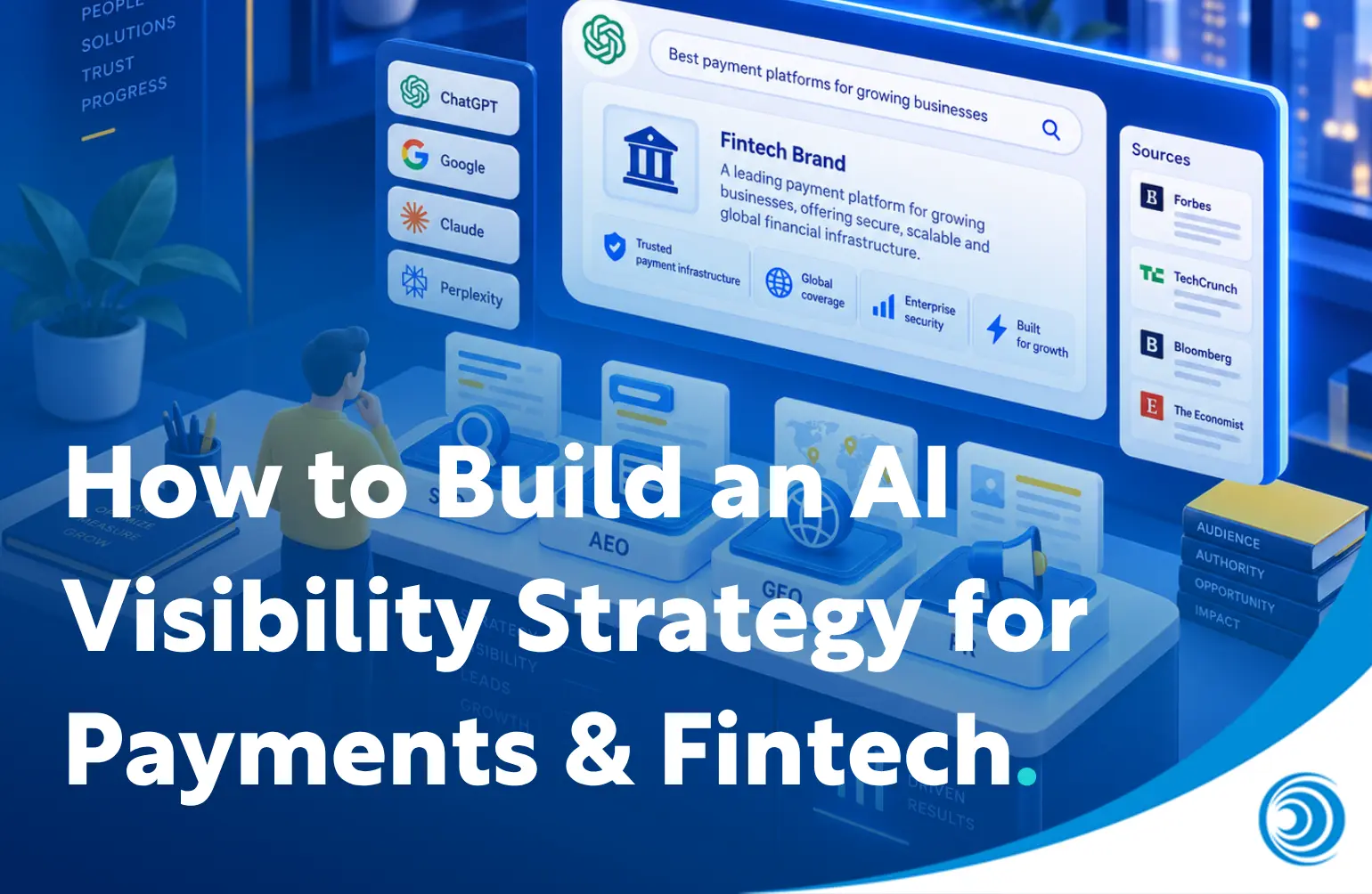
In our experience, an AI visibility strategy is a coordinated plan designed to improve how accurately and consistently a brand is understood, mentioned, and cited in AI-generated answers. It brings together SEO, AEO, GEO, and credible external authority built through PR.
The key is not to treat the four pillars as separate checklist items, but to coordinate them as one cohesive strategy. However, it should be noted that there is no foolproof guarantee that a company will be cited or recommended in a particular AI-generated answer. Results vary according to several factors, including the AI platform, model, prompt, user context, location, and the sources available at the time.
The strategy should include establishing a visibility baseline, clarifying brand positioning and terminology, strengthening priority website content, applying SEO, AEO and GEO principles, developing expert-led content, building relevant external authority through PR, and monitoring changes in mentions, citations, and topic associations.
One good way to think about it is aligning the information already published on a company’s website with the evidence available across external sources, to help AI platforms understand:
- Who the company is.
- What it provides.
- Which audiences and markets it serves.
- Which problems it solves.
- Which subjects it has credible expertise in.
- What independent evidence supports that expertise.
For a more detailed intro to the factors that influence whether a company is surfaced in AI-generated answers, you can read our guide to how brands build visibility in Large Language Models (LLMs).
Why do Fintech & Payments Businesses Need a Specialist Approach?
One common mistake is to apply a generic B2B or SaaS approach without accounting for the specific characteristics of payments and fintech. Fintech and payments have some very sector-specific considerations, and if these are not reflected in your AI visibility strategy, you are starting with a significant disadvantage.
Here are a few of the key considerations:
- Complex Propositions: Many fintech providers often offer several interconnected capabilities that cannot be accurately communicated through one simplified product-category label. Without a wider understanding of these throughout your company’s content, the chances of getting seen by AI platforms or buyers are low to zero.
- Overlapping Terminology: Standard terms such as payment gateway, processor, acquirer, issuer, payment institution, banking platform, and infrastructure provider have distinct meanings, although in our experience companies and commentators can often use them inconsistently, resulting in poor content and thereby poorer understanding.
- Regulatory Know-How: Content must account for financial-promotion requirements, data protection, security standards, and jurisdiction-specific regulation. Inaccurate or overstated claims can create compliance and reputational risks.
- Long, Multi-Stakeholder Buying Journeys: A fintech purchase may involve commercial, product, technology, risk, compliance, procurement, and senior leadership teams, each asking different questions. So, getting your head around those different questions is key.
- Independent Evidence: Original research, third-party coverage, industry recognition, named experts, and credible external references can help substantiate a fintech or payment provider’s claims and make its expertise more understandable to buyers and AI platforms.
A classic example of the above would be if a business merely describes itself as a ‘payments platform’. When it comes to AI visibility, this does not tell the prospect or an AI system whether it provides acquiring, issuing, gateway technology, processing, orchestration or banking infrastructure. So, being generic with no proof points is not going to give you an effective AI visibility strategy.
Establish the Baseline
The first step is to establish how your brand currently appears across the AI platforms relevant to you. This creates a benchmark to note which changes can be assessed and identifies whether the immediate priority is improving visibility, correcting inaccuracies, or strengthening topic associations.
AI visibility monitoring should work alongside and not replace SEO, website analytics, and commercial reports. The most useful baseline combines prompt-level findings with organic search visibility, AI-referred sessions, branded search, website engagement, enquiries, and pipeline data. This provides a broader view of whether improved AI visibility is contributing meaningful commercial outcomes.
A practical sector example would be a payment provider who may want to be associated with cross-border acquiring for European eCommerce merchants. The baseline should include both branded prompts and non-branded questions that prospective buyers might ask when researching cross-border acquiring providers.
It should examine whether the provider appears in relevant supplier recommendations, how its geographic and technical capabilities are described, which competitors are included, and what sources appear to influence the answers.
Define the Entity & Priority Topics
An Entity That People Understand
AI visibility depends partly on whether a brand is presented as a clear and consistent entity. This means defining not only its name and services, but also how the different elements of the business connect, i.e. what it provides, who it serves, where it operates, which problems it solves, and why it has credible expertise in particular subjects.
For example, our brand entity statement could be:
“Blue Train Marketing helps payments and fintech businesses build visibility, authority and sustainable commercial growth through specialist marketing strategy, content, and AI visibility programmes across the UK and international markets.”
In payments, avoid relying on broad descriptions such as ‘payment platform’ or ‘end-to-end provider’ unless the supporting content defines the specific acquiring, issuing, gateway, processing, or infrastructure capabilities involved.
The entity definition should then be substantiated consistently across the company’s website, content, and PR activity. Product pages, use cases, market coverage, regulatory status, partnerships, and named experts should support the same core descriptions as press releases, contributed articles, media commentary, company profiles, and other external coverage.
Priority Topics the Brand Can Credibly Own
Let’s start with what you should not do! Don’t pick priority topics from keyword volume or current industry trends alone. Assess each potential subject area against three questions:
- Expertise: Does the business have genuine knowledge, experience, data, or named experts in this area?
- Buyer Relevance: Does the subject address questions or problems that matter during the buying journey?
- Commercial Value: Is the subject connected to a service, market, or capability the business wants to enter or grow?
The strongest priority topics sit at the intersection of all three. A commercially attractive topic shouldn’t be prioritised if the company lacks the evidence or expertise to discuss it authoritatively. Equally, an interesting topic may contribute little to visibility if it is disconnected from the problems that prospective customers are researching.
For example, a payments provider offering fraud-prevention technology should not select ‘payment fraud’ as a priority topic simply because it attracts attention. It should define the narrower subjects it can substantiate, like friendly fraud, adaptive authentication or chargeback prevention, and connect these with product capabilities, customer experience, proprietary data and a named fraud specialist.
Check Whether the Evidence is Consistent
Finally, review whether the intended entity definition and topic associations appear consistently across:
- Core website and product pages.
- Author biographies and leadership profiles.
- LinkedIn and other company profiles.
- Educational and thought-leadership content.
- Partner and association listings.
- Media coverage and contributed articles.
- Awards, directories, and external company descriptions.
At this point, we now have a usable entity and topic framework: a clear brand definition, a focused group of priority topics, the evidence supporting each subject, and the experts authorised to represent them. This framework should then guide subsequent SEO, AEO, GEO, and PR activity.
Building the Four Pillars Around AI visibility
SEO, AEO, GEO, and PR are complementary parts of one AI visibility strategy rather than separate or competing activities. Each pillar contributes a different type of signal, but no single pillar will work to deliver effectively on its own.
So, what does each pillar bring to the party?
SEO: Creating Discoverability
SEO helps search engines and other systems find, access, and interpret a company’s information. It provides the technical and structural foundation upon which the other pillars depend.
It is not simply about keyword rankings. In the context of AI visibility, its role is to make the company’s expertise accessible, connected, and discoverable across a coherent body of content.
These foundations remain important as discoverability extends beyond traditional search results, as explained in our complete guide to fintech SEO.
AEO: Making Expertise Easy to Extract
Answer Engine Optimisation (AEO) makes individual pieces of information easier for search engines and AI platforms to identify and present in direct answers. For example, concise definitions near the top of a section or useful FAQs.
Don’t think of AEO as simply shortening every answer or filling a page with FAQs. The aim is to organise substantive expertise so that key information can be understood without losing necessary context.
GEO: Reinforcing Context & Topic Association
Generative Engine Optimisation (GEO) helps establish the context in which a brand, its content, and experts should be understood. This includes consistent terminology, clear expert attribution, appropriately sourced claims, and formatting that makes definitions and evidence easy to identify.
GEO is not a guaranteed way of securing an AI citation. Its role is to create clearer, better-supported information from which AI platforms may retrieve, summarise, or cite relevant material.
Although their roles overlap, SEO, AEO, and GEO address different aspects of discovery, extraction and contextual understanding. Our guide to GEO, AEO, LLMO, and SEO explains these distinctions in more detail.
PR: Build Independent Authority
PR extends the evidence beyond the company’s owned channels. It can help demonstrate the business’s expertise is recognised, tested, and referenced by credible external sources. Relevant activity may include earned media coverage, research-led campaigns, and consistent positioning of named spokespeople.
The emphasis should be on earning attention through genuine relevance, expertise, and evidence – not generating mentions solely to influence AI platforms. PR expertise is also important in determining what makes commentary or research genuinely newsworthy and in distinguishing sustained authority-building from isolated publicity.
In short, the four pillars do the following:
- SEO makes the information accessible and discoverable.
- AEO makes important answers clear and extractable.
- GEO reinforces context, evidence, and topic association.
- PR provides external corroboration and recognition.
How do the Four Pillars Reinforce One Another?
Consider a hypothetical payments provider that wants to build credible authority around payment fraud prevention.
The provider does not simply want to appear for the broad term ‘payment fraud’. It wants merchants and other prospective buyers to associate the business with specific capabilities like fraud detection. Each of the four pillars contributes to this objective.
Establish the Capability
A clearly written solution page defines what the provider offers, who it is designed for, and which types of payment fraud it addresses. It explains the relationship between fraud detection, authentication, chargebacks, and customer experience without relying on vague claims such as ‘industry-leading protection’.
SEO ensures that the page is technically accessible, targets relevant buyer intent, and connects through internal links to related products, use cases, and educational material.
Answer Detailed Buyer Questions
AEO principles make the answers easy to identify through question-led headings, concise definitions, summaries, comparisons, and appropriate structured data. The content must still provide sufficient technical and commercial explanation for risk, payments, and technology stakeholders.
Add Original Evidence
The provider publishes research or anonymised data showing relevant fraud patterns, chargeback trends, or merchant concerns. This gives its content something original to contribute and supports more precise, evidence-based claims.
Named fraud, risk, or payments specialists explain the findings and connect them with operational experience. GEO helps reinforce the association between the company, its experts, and clearly defined aspects of payment fraud prevention.
Structure alone is not enough. Effective content must combine information that is easy to interpret with genuine human expertise, original insight and appropriate oversight, as explored in our guide on how to use AI in content marketing.
Extend the Evidence Externally
The research creates opportunities for media coverage, contributed articles, and expert commentary on relevant fraud developments. PR does not simply repeat the claims made on the solution page; it gives the company’s specialists opportunities to contribute useful evidence and informed opinions to a wider industry discussion.
Credible third-party coverage can then provide external corroboration of the provider’s expertise. Where appropriate, the website should link to that coverage, and journalists or industry publications may link back to the original research.
Connect & Monitor the Evidence
Internal links connect the solution page, educational guides, research, and expert profiles. External coverage, association profiles, and other relevant sources reinforce the same underlying subject association.
Monitoring then assesses whether:
- The provider appears more frequently for relevant fraud-prevention prompts.
- Its capabilities are described accurately.
- Named experts or proprietary research are referenced.
- Relevant third-party coverage appears among cited sources.
- Its association with narrower priority subjects becomes stronger.
- The activity contributes to organic visibility, relevant visits, enquiries, or pipeline.
There is no individual asset that creates authority by itself. The solution page defines the capability, educational content demonstrates knowledge, original research supplies evidence, expert commentary adds human authority, and earned coverage provides external corroboration. Together, these activities create a connected body of information that buyers, search engines, and AI platforms can more readily understand.
What Should You Measure in AI Visibility?
To measure whether the brand is becoming more visible, accurately understood, and commercially relevant across AI-assisted discovery. Useful indications include AI mentions, citations, cited sources, and inclusion in relevant recommendations or comparisons, alongside topic association, competitive share of voice, sentiment, and factual accuracy.
These indicators should be considered with AI-referred sessions, organic visibility, branded search, backlinks, unlinked mentions, and relevant conversions. No single visibility score or traffic figure provides a complete measure because AI answers vary and many buyer interactions occur without a measurable website visit.
A key proof point of success is that the brand begins appearing more consistently and accurately in relevant non-branded recommendations and comparisons, supported by credible sources, and that this improved visibility contributes to qualified engagement, enquiries, or pipeline.
What Next?
The immediate priority is not to create more content, but to establish how accurately AI platforms currently understand the business, where important visibility gaps exist, and which actions should be prioritised.
AI visibility is cumulative and requires ongoing content development, external authority, and measurement. Before investing in further activity, establish whether AI platforms currently understand your business in the way you intend. Test the questions prospective customers are likely to ask, examine which competitors and sources appear, and identify where your proposition or expertise is being overlooked.
