
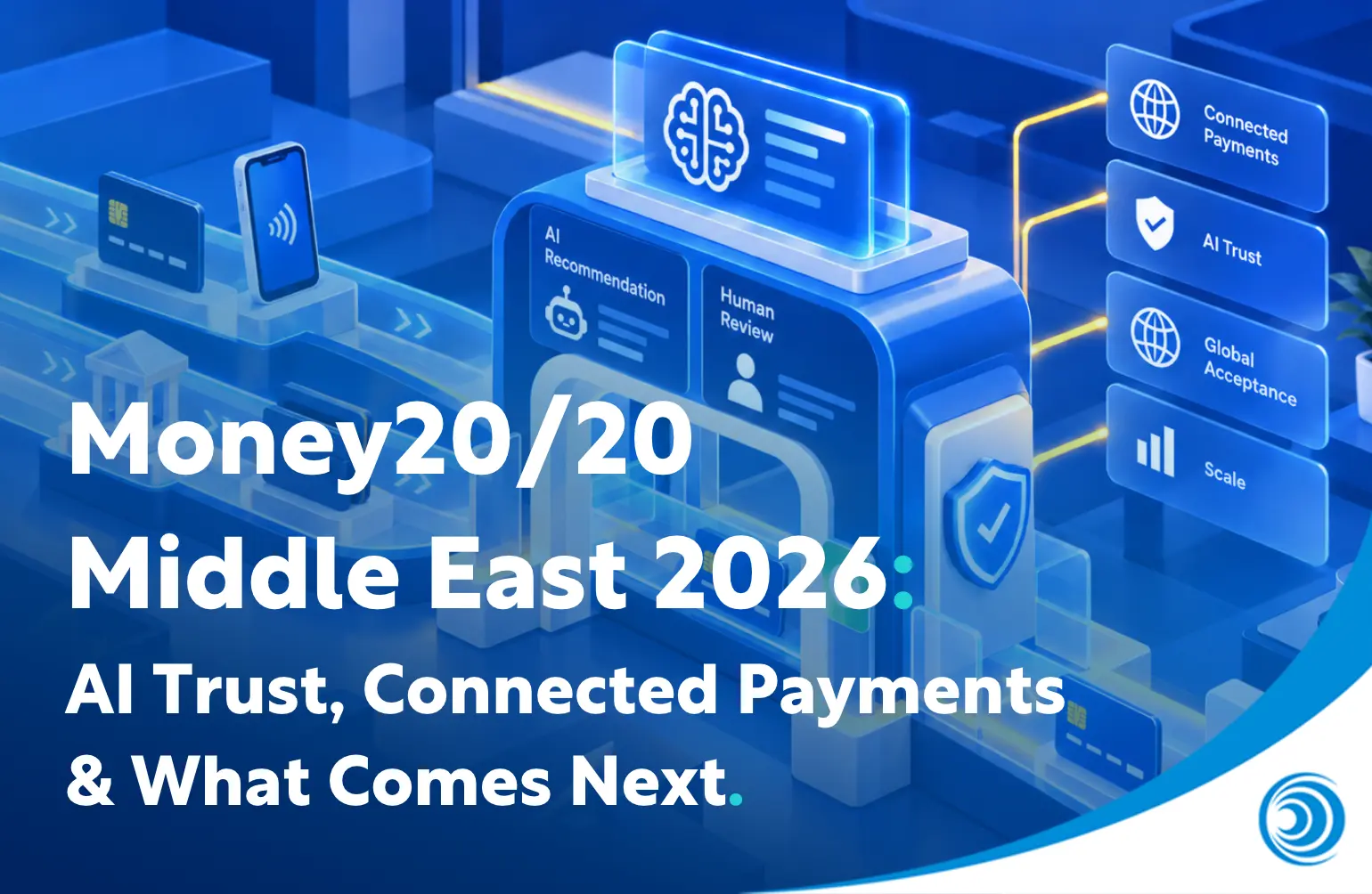

- Money20/20 Middle East 2026: AI Trust, Connected Payments & What Comes Next - September 29, 2026
- How to Build an AI Visibility Strategy for Payments & Fintech - September 14, 2026
- What Caught Our Eye on the Money20/20 Middle East Agenda - September 9, 2026
When we wrote our pre-event piece for Money20/20 Middle East, we picked a few sessions that made us ask questions.
AI was one. Specifically, what happens when AI starts making decisions that affect our money?
And perhaps the bigger question: where is the genuinely new thinking in a fintech market moving at such a pace?
Looking back at the event in Riyadh, one question in particular stands out:
How do you take a fast-growing fintech ecosystem and make it work at scale?
That theme came through in the sessions and announcements from Money20/20 Middle East 2026. Payment interoperability. International acceptance. AI governance. Investment. Talent.
The technology is still moving quickly. But there’s even more attention on what needs to happen underneath it to make all that innovation work.
Here’s what caught our eye.
AI Has Some Explaining to Do
AI was always going to feature heavily at Riyadh (when does it not?). What caught our attention was what happens when the technology starts making decisions rather than simply helping people make them.
The session, Can I Trust You with My Money? The Psychology of Financial AI, put trust and human oversight front and centre.
Afzal Hussain Mohammed Nakheeb, Founder and Chairman of T57.AI, made the case for keeping people firmly in the loop:
“AI should advise us and provide the right information, but humans should use that information to make wiser decisions.”
His comments were reported in EIN Presswire’s day-three coverage of Money20/20 Middle East.
It’s an important distinction.
Financial services have plenty of decisions that can be supported by AI. There are also decisions where customers, businesses, and regulators will quite reasonably want to know who is ultimately responsible for the outcome.
This becomes significantly harder as AI becomes more autonomous.
We raised the subject in our pre-event article about the AI Twin session, and the event brought those questions into sharper focus.
How much autonomy is useful? Where should human oversight sit? And how do you build enough transparency into an AI-driven financial product for people to trust it?
They’re questions worth asking now, before AI becomes even more embedded in financial services.
Payments Are Getting More Connected
Some of the most tangible developments came from the payments side.
Saudi Arabia and Qatar announced plans to expand cross-border acceptance of their national payment cards, mada and HIMYAN. SAMA says acceptance of mada cards in Qatar and HIMYAN cards in Saudi Arabia will be rolled out gradually. The central bank governors demonstrated the connection with a live transaction.
SAMA also announced that Saudi Arabia now supports Alipay+ acceptance, while Tap to Pay on iPhone is set to launch in the Kingdom.
For consumers, the appeal is obvious. A visitor using a wallet connected to Alipay+ can pay at participating merchants where acceptance is available. Once Tap to Pay on iPhone launches, a business with a compatible iPhone will be able to accept contactless payments without relying on a traditional payment terminal.
Behind those relatively simple experiences is a lot of work connecting systems that historically haven’t spoken to each other.
And Saudi Arabia already has a sizeable ecosystem for that infrastructure to support. Speaking at the event, SAMA Governor Ayman Al-Sayari said Saudi Arabia now has 371 fintech companies, while electronic payments account for more than 85% of retail transactions.
Mohammed Aldossary, Co-Founder and CEO of SILQ Financial Services, made a particularly sharp observation in the same coverage:
“The last decade was about digitisation. I think the next decade will be about solving the fragmentation that digitisation created.”
That feels pretty close to the heart of it.
The payment itself is only one small part of the experience. Customers don’t care which systems have to communicate behind the scenes to make the transaction happen. They care that it works.
And as the ecosystem grows, making those connections work reliably becomes an important part of the challenge.
Trust Has Moved Up the Agenda
Trust was another recurring theme – particularly around AI and the wider question of responsible innovation.
Our pre-event article flagged Trust by Design as one of the themes worth watching. It certainly didn’t disappear once the event got underway.
The AI discussions raised questions around transparency and accountability. SAMA’s approach also placed emphasis on testing and evidence before new technology moves into wider adoption. SAMA’s Deputy Governor for Financial Innovation, Nora M. Albakr spoke about the importance of demonstrating practical value rather than pursuing innovation simply because something is new, according to EIN Presswire’s coverage.
That matters in a market moving as quickly as Saudi Arabia’s. The faster those systems develop, the more important trust becomes.
And Then There’s the Human Bit
The one thing we didn’t want to lose was the people behind all this technology.
Money20/20 Middle East marked the regional debut of RiseUp, its programme supporting senior women in fintech and financial services. Women Leading the Way’s coverage looked at the women shaping the region’s financial ecosystem and the importance of creating stronger leadership routes.
It’s a useful addition to a conversation that can sometimes become very technology heavy.
Saudi Arabia is building infrastructure at pace. That requires engineers and entrepreneurs, certainly. It also requires people who understand customers, regulation, risk, marketing, leadership, and all the other slightly less headline-friendly things that make financial services work.
Technology doesn’t remove the need for those skills. If anything, it makes them more important.
So, What Are We Taking Away?
The topics coming out of Riyadh point towards a fintech market entering a new phase. Saudi Arabia already has significant digital payment adoption and a growing fintech sector. The focus is shifting towards connecting the pieces and making them work across a much bigger financial ecosystem.
That shift makes the next few years particularly interesting.
AI will keep developing. Payment infrastructure will keep becoming more connected. New products will keep appearing.
But can the systems, safeguards, and skills behind them keep pace?
Because building the future of finance is one thing. Making it work for the people who actually use it is another.
Blue Train Marketing is proud to be a Media Partner of Money20/20 Middle East. Want to find out more about our partnership and our work across the fintech and payments ecosystem? Get in touch with us.
